

On this page
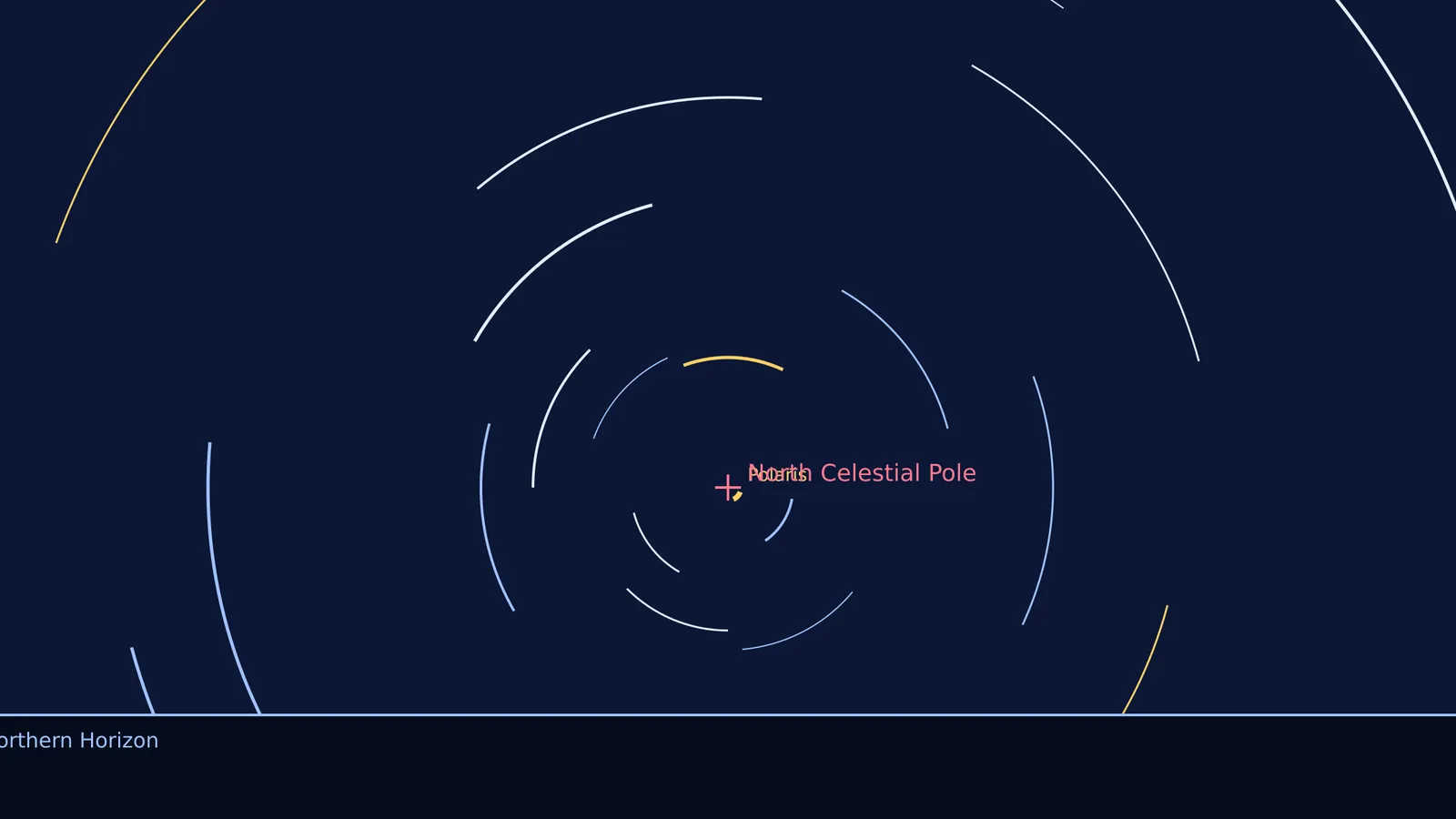
Have you ever seen a time-lapse photograph where the stars look like glowing tracks spinning around a single bright point? What you are seeing is not the stars moving, but the Earth carrying you along as it turns.
In school, you study stars, planets and the night sky in Class 6, and look deeper at Stars and the solar system in Class 8. But reading about the sky is different from predicting how it will look. If you know how the Earth spins, you can work out exactly what a time-lapse camera will see from your own backyard.
Why do stars circle the pole star?
If you stand under an open umbrella and spin it by the handle, the edges blur past your eyes, but the very centre stays perfectly still. The night sky works the same way. The Earth rotates on its axis once every 24 hours. If you extend that axis straight out into space above the North Pole, it points to the North Celestial Pole.
Because the stars are incredibly far away, they appear fixed in space. As the Earth spins, we sweep past them from west to east, making them appear to rise in the east and set in the west. But a star located exactly on the axis of rotation will not appear to move at all. All other stars will appear to draw concentric circles around that central point.
Is Polaris perfectly still?
People often call Polaris the "North Star" and assume it is exactly at the celestial pole. Actually, it is slightly off-centre.
Because of a slow wobble in Earth's axis called precession, the pole moves over thousands of years. In 2026, Polaris is approximately 0.62° away from the true North Celestial Pole (theskylive.com). For comparison, the angular width of a full moon is about 0.5°. This means Polaris itself makes a tiny circle every 24 hours, a track just slightly wider than a full moon, while the rest of the sky wheels around it.
How high is the pole star from India?
The altitude of the celestial pole above the northern horizon is always exactly equal to your latitude.
Mainland India stretches from a latitudinal extent of 8°4'N to 37°6'N (NCERT Class 9 Geography). If you stand at Kanyakumari in the south, the pole is just 8 degrees up, sitting very low against the horizon. If you travel north to Ladakh, the pole climbs to 37 degrees, sitting much higher in the sky. The star trails will still form perfect circles, but the centre of those circles shifts higher the further north you go.
Why stars circle the pole star simulation?
It is hard to sit outside for hours in the dark to watch this geometry play out. Instead, you can recreate the night sky digitally. If you open the Fermi Simulation Lab, you can set up the sky and run it forward in time.
Here is how to test your prediction:
Set your location's latitude.
Face the camera view due North.
Turn on the star trails or long-exposure mode.
Step time forward by a few hours.
You will see the stars sweep out graceful arcs. The one point that does not sweep across the screen is the pole, sitting exactly at your chosen latitude above the horizon.
If you get stuck on the geometry or why stars in the southern half of the sky seem to move differently, Fermi's AI tutor can help. The tutor works out what you already know, builds a plan for the session, and teaches through it — drawing the figure and checking understanding as it goes.


