

On this page
When you read a derivation in a physics textbook or ask a standard AI chatbot to solve a problem, the mathematics often looks like a smooth, continuous staircase. But if you look closer at the transitions between the formulas, you will find hidden jumps. An equation for the first boundary is followed by an equation for the second boundary, and then suddenly, they are combined with a single sentence like "adding these yields the result".
Human authors skip these intermediate steps to save space on the printed page, assuming the reader can do the basic algebra. Standard AI models skip them because they are designed to predict the most likely next block of text, which is often the final formula rather than the messy arithmetic in between. This leaves a structural gap in the logic, known as a derivation step, that you are expected to fill. Reading without filling these gaps creates a false sense of fluency.
Why does finding gaps help you learn?
Finding and filling these missing mathematical links is not just a way to check the algebra; it is the core mechanism of how learning happens. In 1989, cognitive scientists Michelene Chi and her colleagues studied how students learned mechanics by studying worked examples (https://doi.org/10.1207/s15516709cog1302_1). Their research defined the "self-explanation effect", which explains why two students can read the exact same derivation and walk away with entirely different levels of understanding.
The study found that successful students suspended their reading when they encountered a gap and actively tried to justify each step. These "good" learners spontaneously generated many explanations per worked example, deliberately linking specific actions to general principles (https://doi.org/10.1207/s15516709cog1302_1).
In stark contrast, "poor" learners read superficially, assumed they understood the transitions, and did not generate sufficient self-explanations (https://doi.org/10.1207/s15516709cog1302_1). By generating their own inferences to fill in the incomplete examples, the successful students built a robust, transferrable mental model that allowed them to solve completely new problems.
How to find skipped steps in an AI derivation?
To spot these gaps and trigger the self-explanation effect, you must change how you read. You cannot read a physics or mathematics derivation like a novel. You must read it line by line with a pen in hand.
Look for transition words. Phrases like "substituting equation 1 into equation 2", "rearranging the terms", "integrating both sides", or "by symmetry" are the definitive flags that a mathematical step was skipped.
When you spot one of these phrases, immediately stop reading. Write down the equation that came before the transition word, hide the rest of the text, and try to reach the next equation on your own paper. If you get stuck, you need an environment that explains the reasoning rather than just printing the final answer.
This is where Fermi's AI tutor comes in. A student brings a topic, a course, or a problem set. Fermi works out what they already know, builds a plan for the session, and teaches through it — writing on a board, drawing the figure, and checking understanding as it goes. It holds a line of reasoning across a session, noticing where a student is stuck and deciding whether to explain, ask, or show the missing step.
Where is the skipped step in the lens maker's formula?
Consider the standard derivation of the lens maker's formula, which finds the focal length of a thin lens.
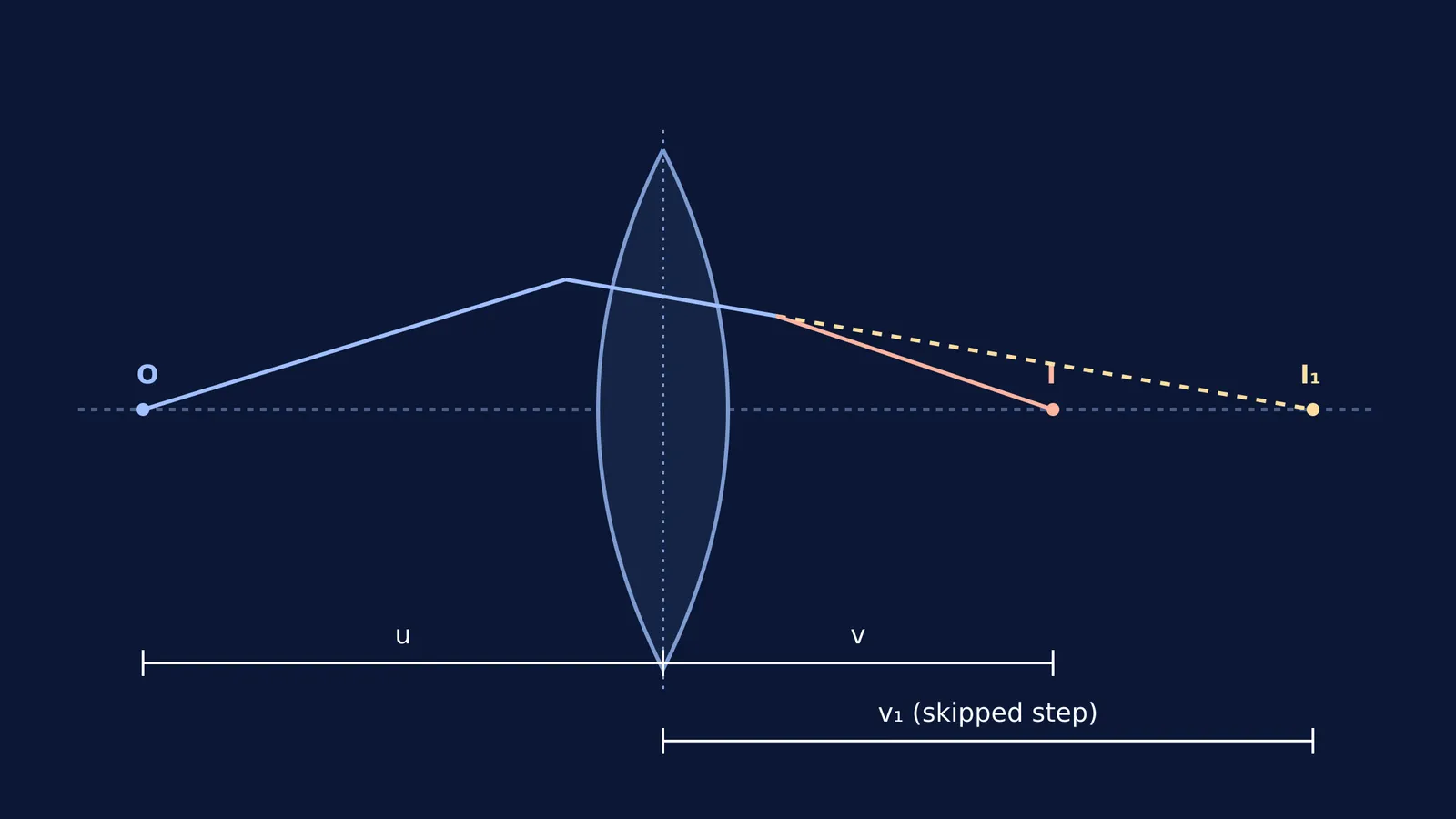
First, light refracts at the front surface of the lens (which has a radius of curvature R₁). This creates an intermediate image at a distance v₁. The equation is: n₂ / v₁ − n₁ / u = (n₂ − n₁) / R₁
Next, light refracts at the back surface (with radius R₂). The intermediate image acts as a virtual object for this second surface, forming the final image at a distance v: n₁ / v − n₂ / v₁ = (n₁ − n₂) / R₂
A standard text or standard AI output might skip straight to the combined equation, stating: "Adding the equations gives the focal length."
To self-explain this step, you would stack the two equations and physically add them together on paper. You will quickly see that the +n₂/v₁ term from the first equation and the −n₂/v₁ term from the second equation perfectly cancel out. This skipped algebraic step proves mathematically that the invisible intermediate image (v₁) disappears from the final result, leaving only the observable variables: 1/v − 1/u = (n₂/n₁ − 1)(1/R₁ − 1/R₂)
Understanding exactly why a lens's object and real image are at least 4f apart or tracing complex rays through a lens and mirror set apart: tracing the image through both requires this exact line-by-line breakdown. Whether you are dealing with refraction through a glass sphere: imaging with two surfaces or a simple thin lens, the real physics is always hidden in the steps the author skipped.


