

On this page
You can probably recite 4/3 πr³. The picture behind it gets skipped: put a ball inside a can that just fits it, and the ball takes up exactly two-thirds of the can. Archimedes proved this in his treatise On the Sphere and Cylinder, published around 225 BCE, and it is the result he asked to have marked on his grave (On the Sphere and Cylinder).
Why is a sphere's volume two-thirds of its cylinder?
Take a sphere of radius r. The smallest cylinder that holds it has radius r and height 2r.
Cylinder: πr² × 2r = 2πr³
Sphere: 4/3 πr³
Ratio: (4/3) ÷ 2 = 2/3
Surfaces match too: 4πr² for the sphere against 4πr² + 2πr² = 6πr² for the cylinder with its ends. Archimedes showed that both the volume and the surface area of a sphere are two-thirds those of its circumscribing cylinder (summary of the treatise).
Now halve everything: a hemisphere in a cylinder of radius r and height r, plus a cone with the same base and height.
Cone: 1/3 πr³
Hemisphere: 2/3 πr³
Cylinder: πr³
So a cone, a hemisphere and a cylinder of equal radius and height are in the ratio 1 : 2 : 3. One cone of rice plus one hemisphere of rice should fill the cylinder exactly.
Predict first: what will the rice show?
Write your answers down before you pour anything.
How many cones of rice fill the cylinder?
How many cones fill the hemisphere?
If you pour one cone and one hemisphere into the cylinder, will it overflow, fall short or fill exactly?
The answers are 3, 2 and exactly.
A worked example with r = 6 cm
Make each shape with a 6 cm radius and a 6 cm height.
Cylinder: a card strip 6 cm tall taped around a circle 12 cm across. Volume πr³ = 216π ≈ 678.6 cm³.
Cone: its slant height is 6√2 ≈ 8.49 cm. Cut a circle of radius 8.49 cm, keep a sector of about 254.6° (360° × 6 ÷ 8.49), and roll it up. Volume 72π ≈ 226.2 cm³.
Hemisphere: half of a hollow plastic ball, or a round bowl, with a 6 cm inner radius. Volume 144π ≈ 452.4 cm³.
Then 226.2 + 452.4 = 678.6 cm³: the cone and the hemisphere fill the cylinder. Paper is never perfect, so expect to be slightly off.
Board-exam questions that melt one solid into another use the same arithmetic; our method for melting and recasting problems works through those with checks.
How can you see it without calculus?
Archimedes found the volume of a sphere with a method resembling a slice-by-slice comparison (Cavalieri's principle). Bonaventura Cavalieri later made it a rule, in a book written in 1627 and published in 1635 (Bonaventura Cavalieri).
The rule: if two solids lie between the same two parallel planes, and every parallel plane cuts them in sections of equal area, the two solids have equal volumes.
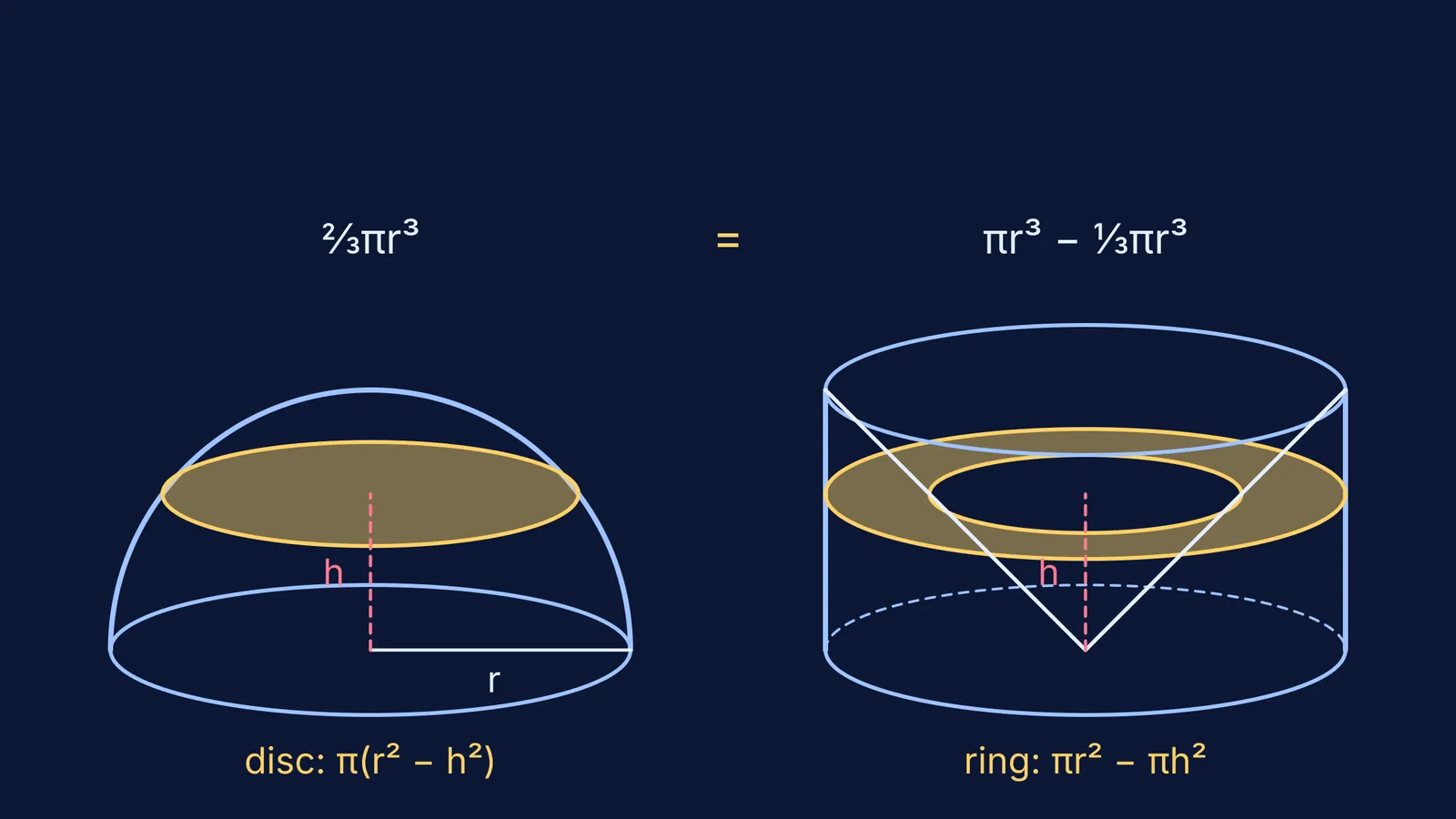
In the diagram at the top, a hemisphere sits flat face down beside a cylinder of the same radius and height with a cone hollowed out of it, point down. Slice both at height h:
The hemisphere gives a disc of radius √(r² − h²), with area π(r² − h²).
The cylinder gives a disc of radius r minus the cone's disc of radius h: a ring of area πr² − πh².
The two areas are equal at every height. So the hemisphere has the same volume as the cylinder minus the cone: πr³ − 1/3 πr³ = 2/3 πr³. Double it and you get 4/3 πr³ for the whole sphere, two-thirds of the 2πr³ cylinder.
If you like turning slices into volumes, how a solid of revolution is built from discs takes the same idea into Class 12 integration. The Fermi Simulation Lab has interactive simulations for the ideas that are easier to see than to read.
Why was Archimedes so proud of this result?
In his Life of Marcellus, Plutarch writes that Archimedes "is said to have asked his kinsmen and friends to place over the grave where he should be buried a cylinder enclosing a sphere, with an inscription giving the proportion by which the containing solid exceeds the contained" (Plutarch, Life of Marcellus, chapter 17).
Cicero, serving as quaestor in Sicily, searched the tombs beside the Agrigentine Gate of Syracuse and spotted "a little column just visible above the scrub: it was surmounted by a sphere and a cylinder" (Cicero's account, translated). The translation's notes date his visit to 75 BC. Cicero describes only a sphere and a cylinder; the cone and the 1 : 2 : 3 ratio are a classroom extension.
Archimedes also squeezed π between polygons: how Archimedes trapped π between 223/71 and 22/7 is a good next read.
If the slicing step still feels slippery, the Fermi Concept Library has a lesson for every concept in mathematics, so you can revisit cone volume and try again.


