On this page
It is a common habit: you work through a challenging physics or maths problem on paper, get an answer, and type just that final number into an AI tutor to check if you are right. If the AI says "Correct!", you move on. But what if your reasoning was completely flawed, and you just got lucky with the arithmetic?
An AI cannot find an error it cannot see. By only sharing the destination and hiding the journey, you might be teaching yourself the wrong rules.
Why do AI tutors miss mistakes?
When an AI evaluates your work, it relies entirely on the information you provide. If you only provide the final number, the AI assumes your steps were sound.
A 2024 study presented at the Conference on Empirical Methods in Natural Language Processing found that if an AI only evaluates the final output, it frequently assesses an incorrect reasoning chain as correct (Daheim et al., 2024). Without step-by-step verification, the model cannot distinguish between sound logic and a lucky guess.
This means that if you use a flawed method but stumble into the right number, the AI will likely validate your broken mental model. You walk away feeling confident in a rule that will fail you on the next exam.
How does a correct answer hide a mistake?
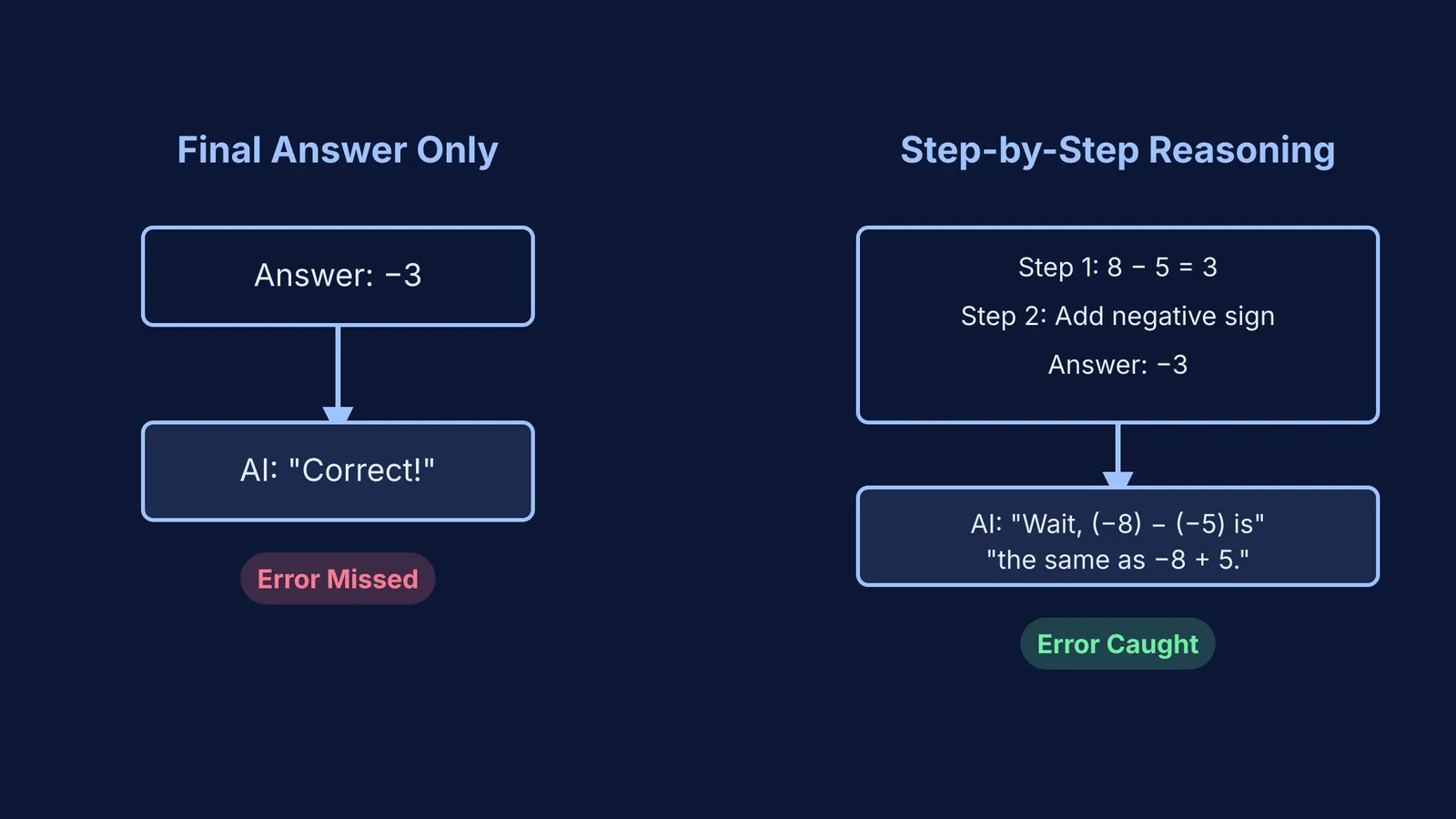
Consider a student solving (−8) − (−5). The correct answer is −3.
Imagine a student thinks: "8 minus 5 is 3. Since there are negative signs in the question, the answer must be negative, so it is −3."
They type −3 into the AI. The AI replies, "Correct!"
The student has just had their flawed rule—"subtract the numbers and make it negative"—validated. When they encounter (−5) − (−8) on a test, they will apply the same logic, guess −3, and lose marks. The AI tutor missed the error because it never saw the dangerous rule hiding behind the correct number.
Why is using AI as a crutch harmful?
Even when you are genuinely stuck and ask an AI for the full solution, simply reading its answer without engaging your own reasoning can hurt your long-term learning.
A 2025 study published in the *Proceedings of the National Academy of Sciences* tracked nearly a thousand high school maths students using generative AI. The researchers found that students who used an unrestricted AI to generate answers improved their practice performance by 48%, but suffered a 17% drop in their independent exam scores (Bastani et al., 2025).
Because the AI did the heavy lifting, the students used it as a crutch. They performed better on homework but failed to acquire the underlying skills. However, the same study showed that when the AI was constrained to act as a true tutor—giving hints and requiring the student to do the work—practice performance soared by 127% with no penalty to exam scores.
How can you show your reasoning to an AI tutor?
To actually learn, you have to expose your thought process. Do not just ask "Is 42 right?" or "Solve this for me".
Instead, use a framework that invites critique:
State the problem clearly.
State your assumptions. For example, "I am assuming friction is negligible."
Show your main steps. Write out your equations, such as "I used conservation of energy and set mgh equal to 1/2 mv²."
Provide your final answer.
This gives the AI the surface area it needs to catch logical leaps, incorrect formulas, or arithmetic slips. If you struggle with a specific topic, Fermi's AI tutor is designed to hold a line of reasoning across a whole session. It works out what you already know and builds a plan for the session, teaching through it.
If you just want to see how to approach a tough question properly, the Fermi Problem Library provides a step-by-step solver that explains the reasoning rather than printing an answer.
By showing your work, you give the AI a chance to actually teach you. Next time you finish a problem, share the journey, not just the destination.
Read more: