

On this page
Lists of "magic prompts" are everywhere. You do not need them. You need a few habits for talking to an AI, and enough knowledge of your subject to tell a good answer from a confident wrong one.
Is prompt engineering worth learning for students?
Some of it, yes. But what helps a student is mostly not tricks; it is explaining yourself clearly. Anthropic's prompting guide for its Claude models says to think of the model as "a brilliant but new employee who lacks context on your norms and workflows". Its test is simple: if a colleague with little context would be confused by your prompt, the AI will be too.
Clear explaining does not come naturally. In a 2023 study of people who were not AI experts designing chatbot prompts, participants explored prompt designs opportunistically, not systematically; expectations carried over from instructing other people, and a tendency to overgeneralise, got in their way. So a little deliberate practice is worth it. You do not need a paid course to get it.
Why does subject knowledge make prompts better?
You can only ask for what you can name. A student who knows that projectile range depends on sin 2θ can ask "Did I use the right angle in the range formula?" A student who does not can only type "Solve this."
Research on AI-written feedback shows the same pattern. Two education researchers at Universität Hamburg wrote three prompts of different quality for ChatGPT-4 and found that only the best one consistently produced high-quality feedback. They judged prompt quality with a theory-driven manual, so a prompt counted as good when it reflected what good feedback needs. What you put into a prompt shapes what comes out.
Knowing your subject also helps you spot when not to trust the answer. In a preregistered experiment with 758 knowledge workers run with Boston Consulting Group, people using GPT-4 on a task chosen to sit outside what the AI does well were 19% less likely to reach a correct solution than people working without it.
Which prompting habits actually matter?
Context. Say who you are, what you are studying and where you are stuck: "Class 11, JEE Main, I understand horizontal and vertical motion separately but not together."
Constraints. Say what you want and what you do not: "Only the first step." "Use NCERT notation." "No full solution."
Checking. Never accept the answer as it arrives. Plug numbers back in, test an extreme case, compare with your textbook, or ask the AI to state its assumptions.
What does a better prompt look like?
Take a standard question: a ball is thrown at 20 m/s at 30° above the horizontal; find its range (g = 10 m/s²).
Weak prompt: "Solve this: ball thrown at 20 m/s at 30°, find range." You get a full solution, copy it, and learn nothing about your own mistake.
Better prompt: "I am in Class 11. I got a range of 20 m using R = u² sin θ / g. Do not solve it for me. Tell me only whether my formula is right, and if not, which part to look at again."
Now the AI can point to the real error: the formula is R = u² sin 2θ / g, so the angle inside should be 60°. Redo it yourself: 400 × sin 60° / 10 ≈ 34.6 m. Then check it: the longest range at this speed comes at 45° and is 400 / 10 = 40 m, so 34.6 m is sensible.
Every part of the better prompt came from what you already knew.
Can using AI hurt how much you learn?
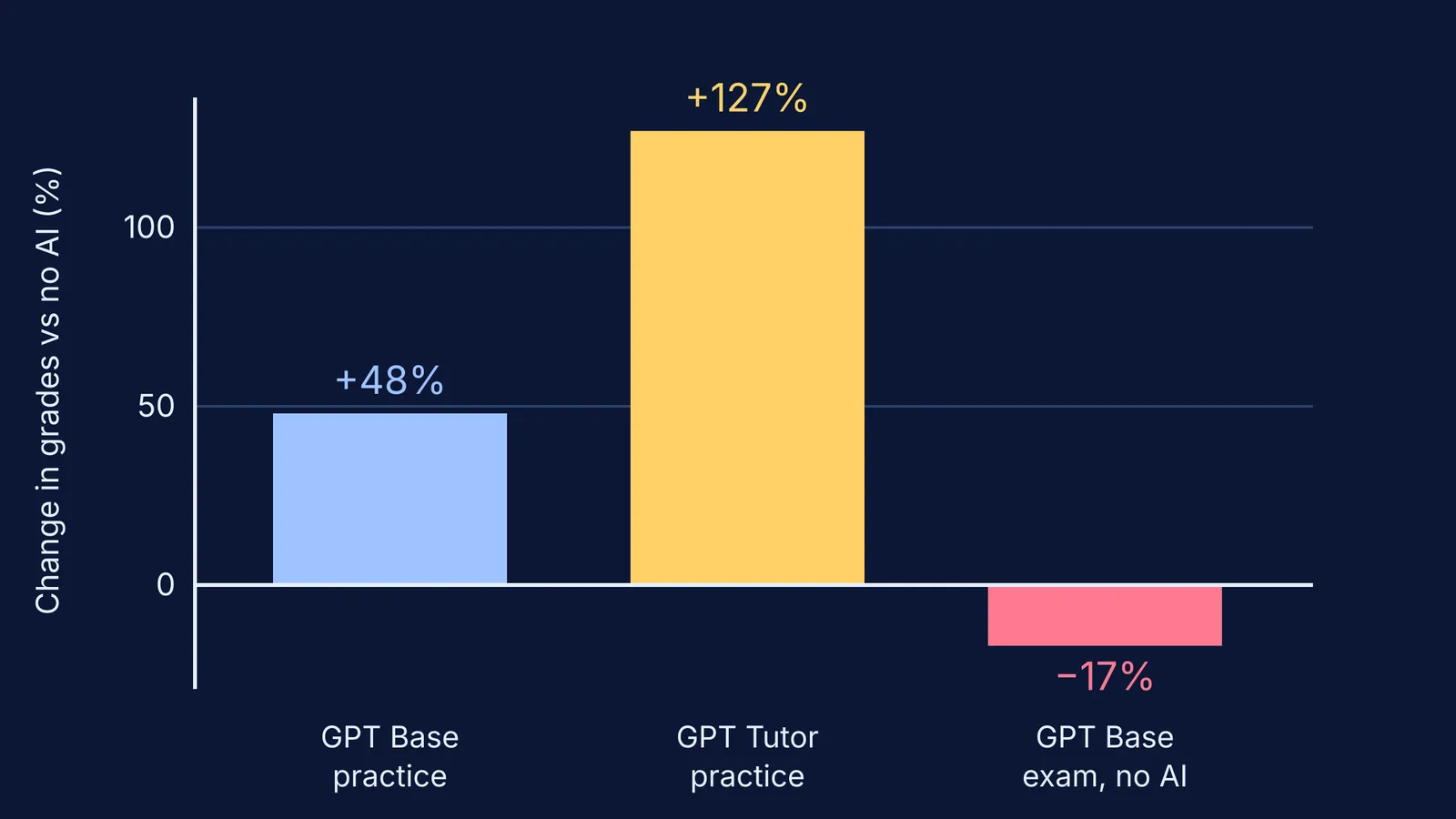
It can, if you let it do the thinking. In a field experiment published in PNAS, nearly a thousand high school maths students used GPT-4 during practice; plain access raised practice grades by 48%, but once it was taken away those students scored 17% lower than students who never had it. A second version with prompts designed to safeguard learning raised practice grades by 127%, and the authors report it largely removed the harm.
That is why checking matters most. UNESCO's AI competency framework for students, published in August 2024, sets out 12 competencies across four dimensions and stresses critical judgement of AI solutions. That kind of judgement draws on knowing your subject.
It also helps to study with a tool built to teach. Fermi's AI tutor teaches rather than just answering: it notices where you are stuck and decides whether to explain, ask or show. When your method keeps going wrong, the Fermi Problem Library has a step-by-step solver that explains the reasoning rather than printing an answer.
Where to go next
Start with the five prompt mistakes students make when asking AI, borrow from these six study prompt templates and when each one fails, and keep this four-point checklist for reading an AI answer critically open while you study. The subject knowledge behind those habits is what keeps paying off.


