

On this page
Calculators, formula sheets and open textbooks were all once treated as cheating. AI chatbots are the newest tool in that line, and the same question comes back: does the tool help show what you know, or does it hide what you don't? Here are the rules, the evidence on each side and a plan for your debate or essay.
What do exam rules say about calculators, open books and AI?
Rules differ by exam and change over time, so read the current official bulletin. For JEE Main 2026, NTA clarified in November 2025 that calculators in any form, including on-screen ones, were not allowed, after a typographical error in its information bulletin (Careers360 report on the NTA notice).
School assessment is moving the other way on open materials. CBSE's governing body approved open-book assessments for Class 9 from the 2026-27 session, in Language, Mathematics, Science and Social Science (Careers360 report on the CBSE decision). In CBSE's pilot, students scored between 12% and 47%, which the report says showed difficulty using resources and understanding concepts, so an open book did not make the test easy.
On AI itself, UNESCO's 2023 guidance on generative AI in education suggested considering an age limit of 13 for using these tools in the classroom (UN News on the UNESCO guidance).
What are the arguments for allowing AI in exams?
Tests should match real work. Outside school, people solve problems with tools at hand. An exam that bans every tool may measure memory more than skill.
Open-book tests still build memory. In two experiments, open-book and closed-book tests with feedback both improved long-term retention more than restudying, and both produced equal retention on a delayed test (Agarwal and colleagues, Applied Cognitive Psychology).
It pushes questions from recall to reasoning. CBSE linked its open-book move to the National Curriculum Framework's shift from rote memorisation to competency-based learning.
Bans are hard to enforce. For take-home work, designing tasks that expect AI may be fairer.
What are the arguments against allowing AI in exams?
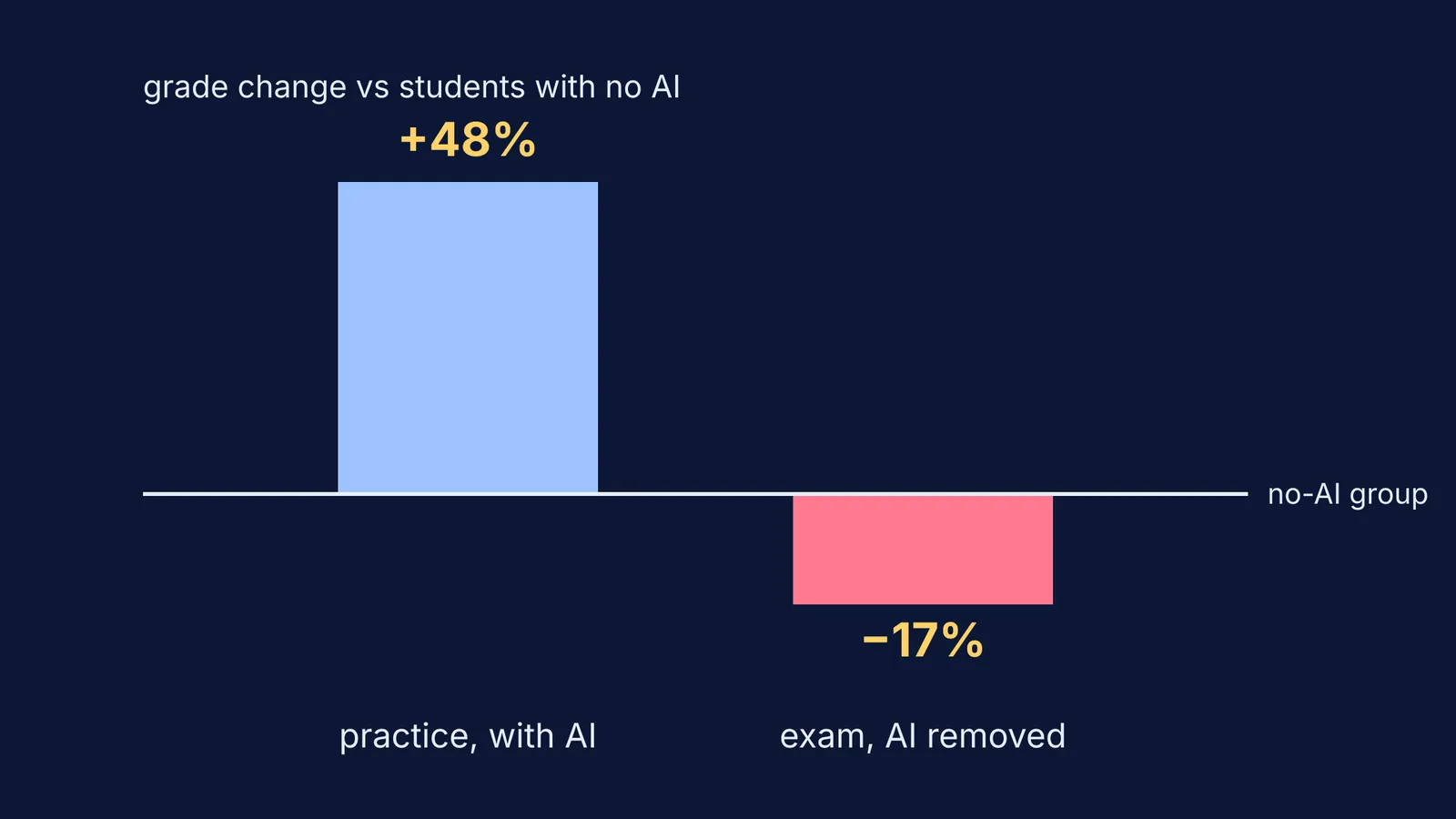
Leaning on AI can weaken the skill itself. In a field experiment with nearly a thousand high-school maths students, those given a standard ChatGPT-style tool improved practice grades by 48%, but scored 17% lower than students who never had access once it was removed (Bastani and colleagues, PNAS 2025). A version with prompts designed to protect learning raised practice grades by 127% and largely avoided the drop.
An exam should show what you can do alone. If the tool does the thinking, the marks describe the tool.
AI makes mistakes. The same study notes that AI is fallible and its outputs must be checked; our guide to checking the answer keys of AI-made MCQs shows how to do that checking yourself.
Not everyone has equal access. Paid tools, fast internet and a personal device are not evenly spread across Indian classrooms.
Is there a fair middle ground?
Try this three-question test on any tool, AI included:
What skill is this exam meant to measure?
Does the tool perform that skill for you, or only support it?
Will you be expected to do that skill without the tool later?
Worked example: in a physics paper that tests whether you can set up equations, a calculator only does the arithmetic, so it supports the skill. In a mental-maths test, the same calculator performs the skill, so it should be banned. An AI that writes your essay performs the very skill being marked.
How can you use these points in a debate or essay?
Opening line, for the motion: Some exams already allow calculators, and CBSE has approved open-book tests for Class 9. The question is not whether tools enter exams, but which tools and for what.
Opening line, against: An exam should show what you can do when the tool is gone. A 2025 PNAS study found students who leaned on a standard ChatGPT-style tool scored 17% lower than those who never had it, once it was removed (Bastani and colleagues).
Rebuttal pairs to prepare:
They say real jobs use AI. You reply: you can only check a tool's answer if you understand the work yourself.
They say AI hurts learning. You reply: the same study found a tutor built with safeguards largely avoided the harm, so the design matters, not just the tool.
For an essay, give one paragraph to each side, then end with your own rule, such as the three-question test above.
If you practise with AI, pick a tool that makes you think. Fermi's AI tutor notices where you are stuck and decides whether to explain, ask or show, and the Fermi Problem Library has a step-by-step solver that explains the reasoning rather than printing an answer. For more on this habit, read how to use AI to understand mistakes, not get answers and how to make an AI tutor ask you questions.


