

On this page
You have just spent ten minutes struggling with a tough JEE physics numerical. You flip to the back of the book or check the mock test platform, hoping to see exactly where your logic failed. Instead of a carefully worked solution, the answer key simply prints "C" or a single final equation like v = √(2gR).
When a solution skips the reasoning, you are left to reverse-engineer the examiner's mind. Staring at a correct answer until it magically makes sense is not active learning; it is often just guessing disguised as studying. Fortunately, you no longer have to settle for the limitations of a printed page.
Why is an answer key explanation too short?
Most answer keys are brief because of hard constraints. In physical books, space is expensive. On basic mock test platforms, the time it takes humans to write out every step for thousands of questions is prohibitive. Authors generally assume that if you have the final number, you can figure out the algebra you dropped along the way.
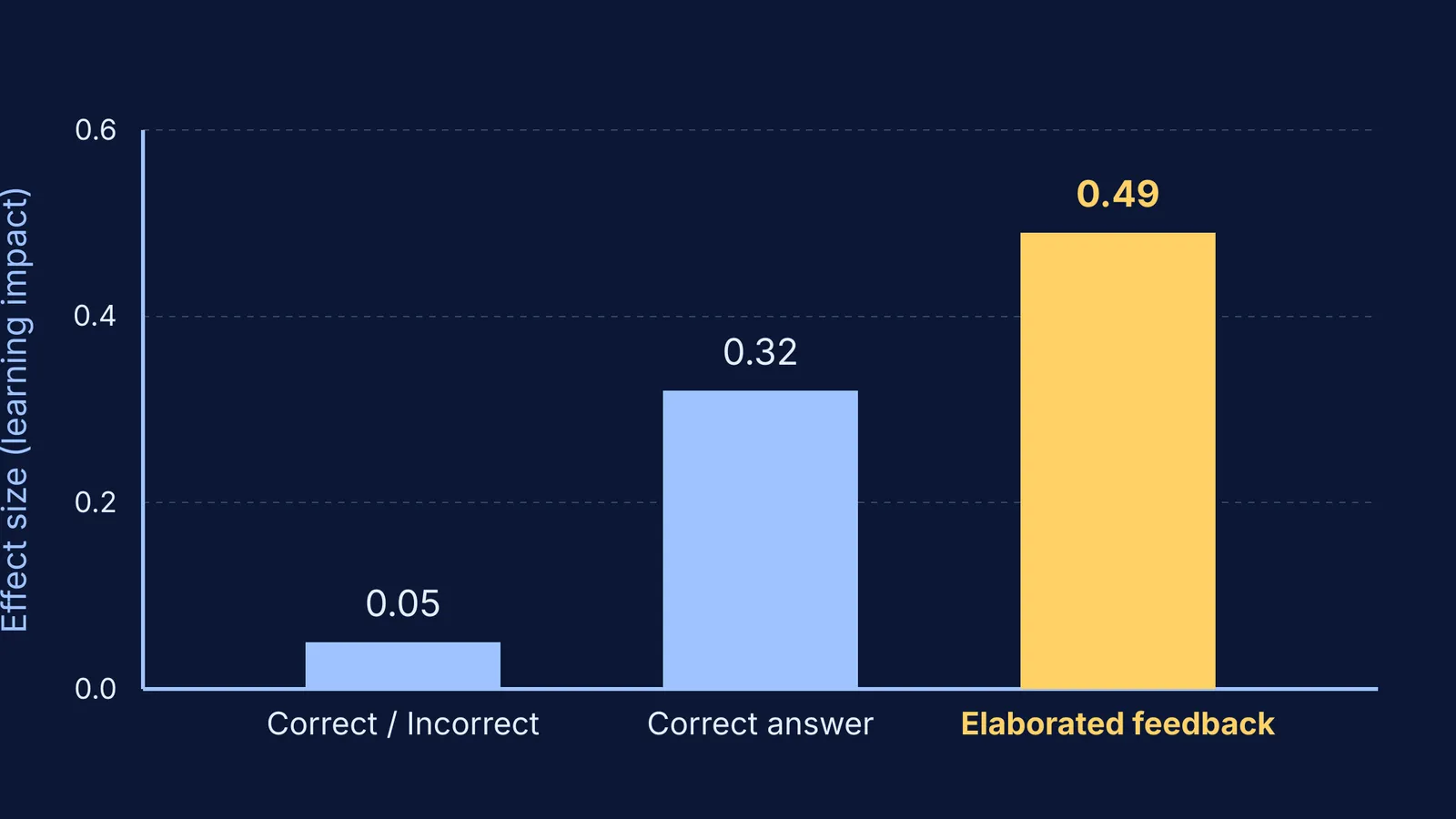
However, learning science shows that simply knowing you are wrong is a very weak way to learn. A major 2015 meta-analysis of 40 studies published in the *Review of Educational Research* measured how different types of feedback impact student learning. The researchers found that feedback regarding the correctness of the answer—just telling a student they are correct or incorrect—has a near-zero average effect size of 0.05. Providing the correct answer improves this slightly to 0.32. But "elaborated feedback", which explains the *why* and the *how* step by step, has a much larger effect size of 0.49.
If you want to understand why your scores might be flatlining, read more on why some JEE aspirants plateau despite studying every day. A major reason is relying on these weak forms of feedback that leave fundamental misconceptions untouched.
How to ask an AI for a step-by-step explanation?
When you encounter a one-line answer key, do not waste time guessing. Take a photo of the question, your own rough work, and the given answer, and ask an AI to bridge the gap.
Here is a script you can use to prompt an AI tutor effectively:
"Here is a problem I am stuck on, along with my rough work. The official answer key says the result is [insert answer]. Do not just tell me I am wrong. Please expand this answer key into a step-by-step explanation, and point out exactly which line of my rough work departs from the correct logic."
By giving the AI both the destination (the answer key) and your starting point (your rough work), you force it to provide the elaborated feedback that actually changes how you will solve the next problem. You are asking it to act as a diagnostic tool rather than just a calculator. For a deeper look at the difference between solving and explaining, see how AI tutors vs answer chatbots handle these requests.
Does checking every step actually improve scores?
Yes, because checking the steps is about rebuilding your mental model. When a test platform gives you a single letter for an answer, finding the correct method is the only thing that prevents you from making the same mistake twice.
This relates to cognitive load. When you are learning a new topic, holding all the rules, formulas, and constraints in your head takes immense mental effort. A full step-by-step explanation drastically reduces this extraneous load, freeing up your brain to focus on the underlying logic.
General-purpose chatbots, however, sometimes hallucinate when doing complex maths or stringing together physics formulas. If you use a dedicated learning platform, the process is much more reliable.
Fermi's AI tutor is built specifically for this. A student brings a topic, a course, a problem set or a scanned assignment. Fermi works out what they already know, builds a plan for the session, and teaches through it—writing on a board, drawing the figure, running the simulation, and checking understanding as it goes.
If you are working through standard curriculum topics, the Fermi Problem Library has worked problems with a step-by-step solver that explains the reasoning rather than printing an answer.
Ultimately, a short answer key is not the end of the road. It is just the starting point for a conversation with a tool that has infinite patience.


