

On this page
When you stand on a coastline and watch a vessel sail outward toward the open sea, it does not simply fade into a distant point. Instead, the water appears to swallow the vessel from the bottom up: the hull slips out of view first, followed by the deck, and finally the top of the mast.
Nearly two thousand years ago, Pliny the Elder documented this maritime phenomenon in Book 2, Chapter 65 of his Natural History, observing that land remains visible from a ship's mast-head (*malis*) after vanishing from the lower deck (*puppi*), and that a bright signal tied to the mast appears to sink gradually as a receding vessel sails over the curved sea. Pliny noted that this sequence provides direct physical proof that the ocean surface curves convexly.
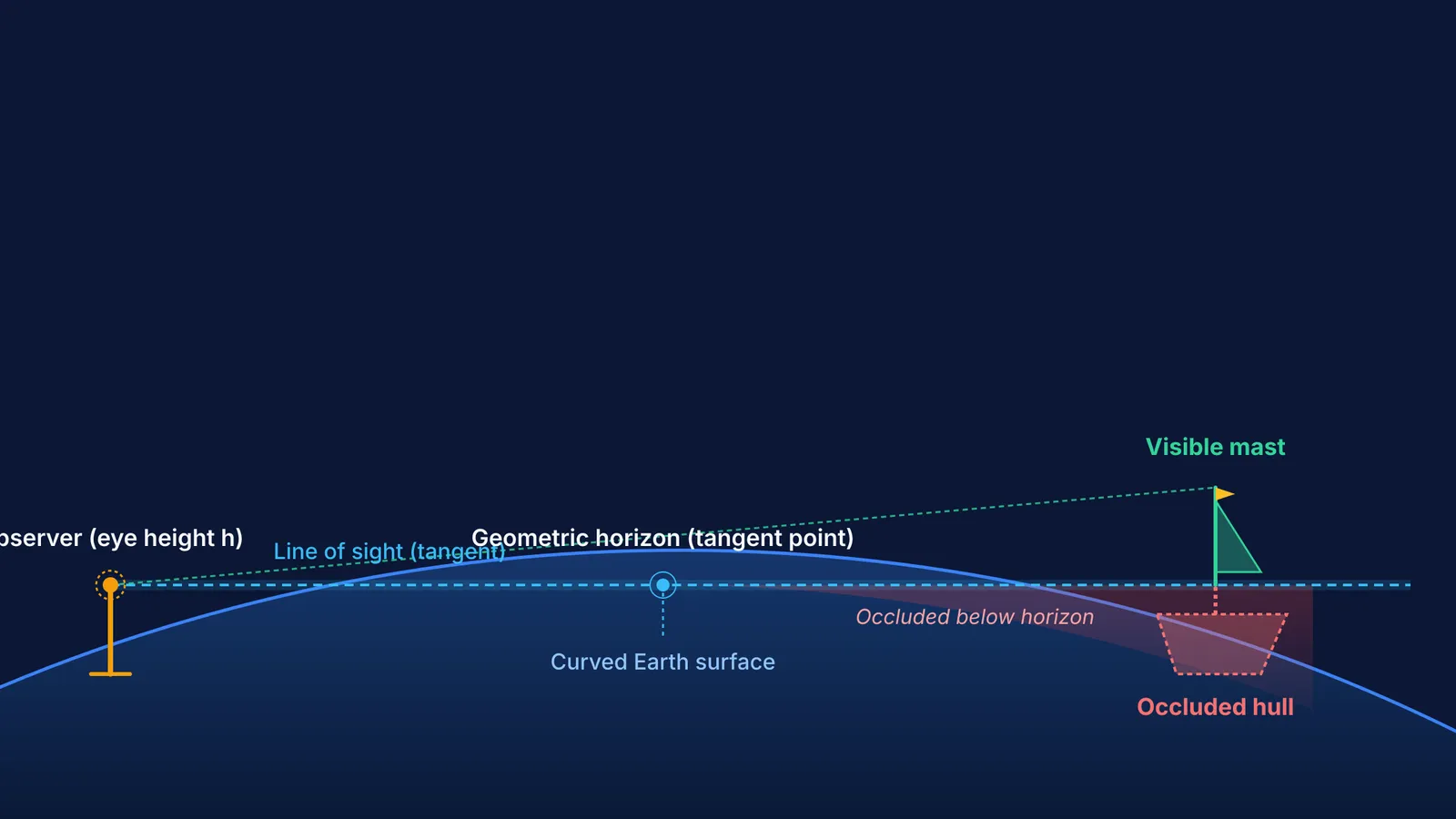
The cause is line-of-sight tangency. Because Earth is a sphere with a mean radius of roughly 6,371 kilometres, the sea surface curves downward in every direction. At a specific distance, your straight line of sight grazes the water's surface at a single tangent point, which defines your visible horizon. Beyond that point, the Earth's surface drops below your line of sight. Because the hull sits closest to the water, it dips below the horizon tangent first, while the elevated masthead remains visible.
Why do ships disappear hull first instead of shrinking?
To see why this observation is so definitive, compare it with the predictions of Euclidean perspective on a flat plane.
On a flat Earth, light rays between the ship and your eye would never encounter a curvature barrier. As the ship moved farther away, its distance D would increase, causing its angular size θ to decrease according to θ ≈ H / D, where H is feature height.
Crucially, both hull and mast would shrink by the exact same proportion at every second. The hull would never sink below the waterline or vanish before the mast. Eventually, the entire ship would shrink below the angular resolution limit of the human eye—roughly 1 arcminute, or about 0.0003 radians.
Looking through a high-powered telescope would instantly restore the entire ship to view, hull and mast alike. In reality, a telescope trained on a hull-down ship merely magnifies a partially submerged vessel; optical magnification cannot peer through the ocean's physical curve.
How do you calculate how much of a ship is hidden?
You can calculate the horizon distance using the Pythagorean theorem. For Earth's radius R (approximately 6,371 kilometres) and eye height h above sea level in metres, the right triangle formed by Earth's centre, your eye, and the horizon tangent yields d ≈ √(2Rh).
According to optical analyses documented by San Diego State University astronomer Andrew T. Young, this geometric formula simplifies to d ≈ 3.57 × √h kilometres when h is in metres. For an observer standing at the water's edge with an eye height of 1.7 metres, the geometric horizon sits roughly 4.65 kilometres away.
In the real atmosphere, air density decreases with altitude, bending light rays downward toward the denser surface air. As explained in our guide to how atmospheric refraction alters the apparent position of celestial bodies, standard refraction expands your effective horizon distance by roughly 8 percent to d ≈ 3.86 × √h kilometres.
Once a ship sails beyond your horizon distance d₁, the hidden height h_hidden of its hull at distance D is h_hidden ≈ (D − d₁)² / (2R_eff). In an 1870 field trial along a 6-mile stretch of the Old Bedford River reported in Nature, naturalist Alfred Russel Wallace used sighting targets 13 feet above the water to account for refraction and demonstrate this curvature.
What would a receding ship look like on a flat Earth?
When comparing physical predictions, testing alternative hypotheses sharpens mathematical understanding:
Flat surface prediction: The ship's bottom remains aligned with the water surface at all distances. Both the mast and the waterline remain visible until optical resolution limits merge them into a single point.
Spherical surface prediction: The water's surface forms an obstruction between the observer and the vessel. The bottom of the ship is occluded first, with the hidden vertical height increasing quadratically with distance past the horizon.
Because actual observations match the spherical model, this demonstration provides an accessible entry point into geometric optics and planetary physics.
Why does active prediction build deeper physics intuition?
In textbook physics, students often encounter 'ships disappear hull first' as a static fact to memorise. Yet learning research reveals that passive reading rarely dislodges intuitive misconceptions.
In a study of 468 physics students published in Science Education, Richard Gunstone and Richard White showed that prompting learners to commit to a prediction before an observation exposes tacit assumptions that lectures overlook. This Predict-Observe-Explain (POE) cycle forces learners to generate a mental model, confront the contradiction, and rebuild their understanding. Similar patterns appear in meta-analyses of active learning in STEM courses, which demonstrate higher conceptual retention when students actively test hypotheses.
When considering a receding ship, the POE cycle turns observation into structured inquiry:
Predict: Sketch how a ship should appear at 5 kilometres and 15 kilometres on a flat surface versus a curved sphere.
Observe: Examine coastal views or optical footage to record which parts vanish first.
Explain: Distinguish between angular shrinking from perspective and bottom-up occlusion from curvature.
When tracing ray paths across a curved surface is hard to picture from static equations alone, interactive models make the geometry tactile. The Fermi Simulation Lab provides interactive simulations for ideas that are easier to see than to read, allowing students to adjust observer height, ship distance, and planetary radius to observe the tangent line of sight in real time. In addition, research comparing simulations to static diagrams shows that dynamic controls help learners connect geometric constraints with physical observations.
The Fermi Concept Library covers every concept in physics, each with its own lesson and its place in the map.


