

On this page
We often think objects further out in space move faster, assuming it takes more energy to maintain a higher orbit. The reality is the opposite: lower satellites are the speedsters of the solar system.
Do lower satellites move faster than higher ones?
Yes. It is a fundamental law of orbital mechanics that a satellite in a lower orbit travels much faster than one in a higher orbit.
According to the NASA Earth Observatory, a satellite's speed is inversely related to its altitude: the higher a satellite's orbit, the slower it moves (NASA Earth Observatory).
A satellite stays in orbit by balancing the inward pull of Earth's gravity with its forward momentum. Because gravity is stronger near Earth's surface, a low-orbit satellite must maintain a massive forward speed to avoid falling.
How much faster is low Earth orbit?
When comparing orbits, the difference is striking:
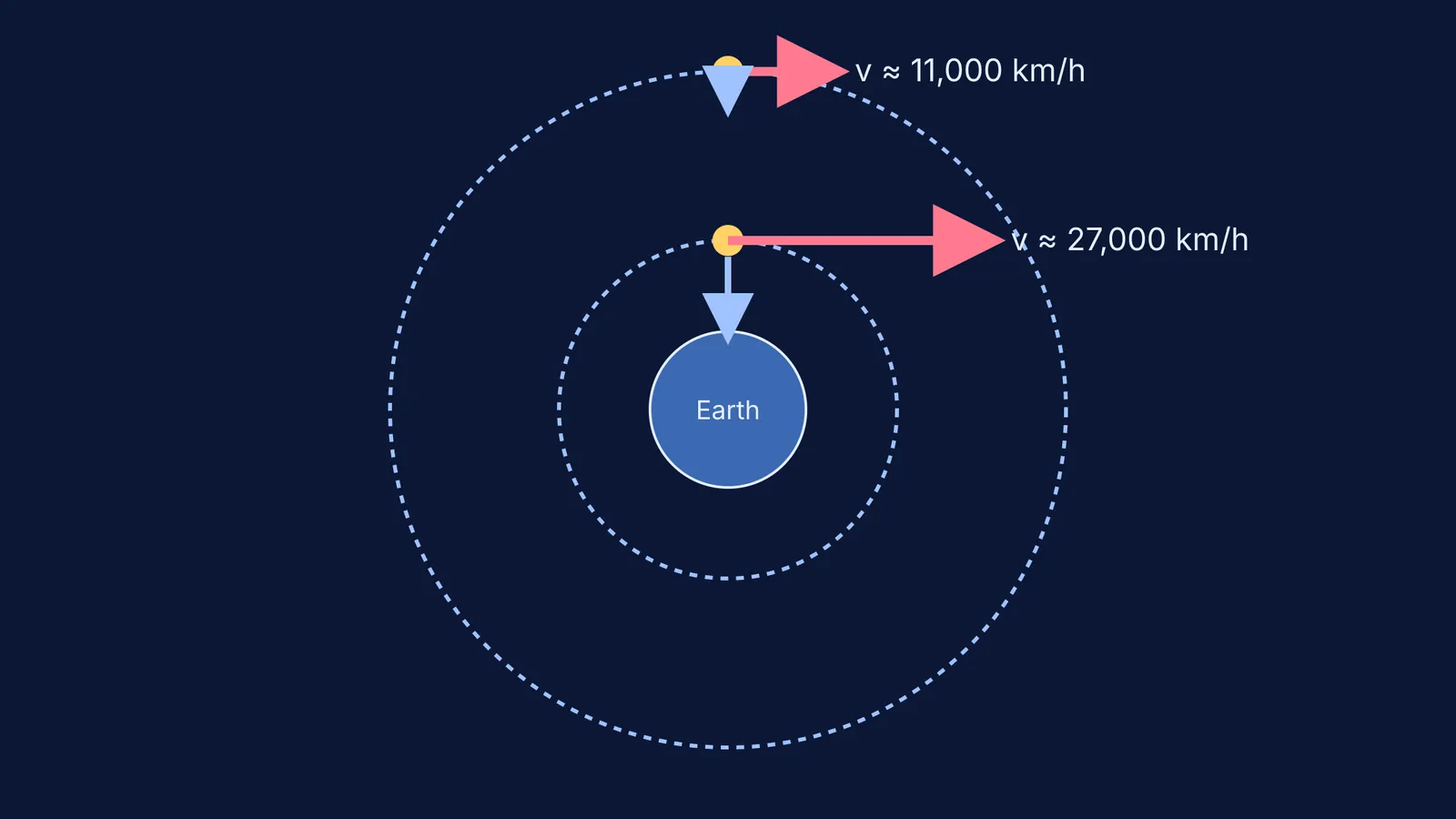
Low Earth Orbit (LEO): Satellites like NASA's Aqua, orbiting at 705 km, take just 99 minutes to circle the globe (NASA). To complete that tight circle so quickly, it travels at nearly 27,000 km/h.
Geostationary Orbit (GEO): A weather satellite sitting at 36,000 km above the equator takes 23 hours, 56 minutes, and 4 seconds to complete an orbit, matching Earth's rotation (NASA). Here, gravity is weaker, and the satellite travels at 11,000 km/h.
The mathematics of orbit speeds
The required speed v for a circular orbit is:
v = √(GM / r)
Here, G is the universal gravitational constant, M is Earth's mass, and r is the distance from the centre of the Earth (Wikipedia). Because r is in the denominator, the required speed v becomes smaller as the orbital radius gets larger. The satellite's mass cancels out, meaning a tiny cubesat and a massive space station at the same altitude travel at the exact same speed.
For students learning orbital mechanics, an intuitive feel for these relationships prevents mistaken assumptions.
You can see this in motion using the Fermi Simulation Lab. Rather than just memorising formulas, you can vary the orbit radius yourself and read off how the velocity vector shrinks as the orbit expands.
How does the orbital period change with height?
While speed decreases as you go higher, the distance the satellite must travel (the circumference) increases.
These effects combine to make the orbital period dramatically longer for higher satellites.
Kepler's third law states the square of the orbital period is proportional to the cube of the radius (T² ∝ r³). For NASA's Aqua satellite at 705 km, the period is 99 minutes (NASA). For a geostationary satellite at 36,000 km, the radius is roughly 6 times larger, making the period 24 hours. This allows it to hover permanently over one spot.
A worked example: finding the speed ratio
To compare the orbital speed of a satellite in orbit A with a higher orbit B:
Identify the altitude of each satellite.
Add Earth's radius (6,371 km, NASA) to find the true distances from Earth's centre: r₁ and r₂.
Because v is proportional to 1/√(r), the speed ratio is v₁ / v₂ = √(r₂ / r₁).
Imagine orbit B is exactly four times further from Earth's centre than orbit A, so r₂ / r₁ = 4. The speed ratio becomes √4 = 2.
This means the lower satellite moves twice as fast. If the lower satellite travels at 20,000 km/h, the higher one travels at 10,000 km/h.
This geometry explains Kepler's second law and areal velocity in elliptical orbits, where a satellite speeds up as it swings close to the planet. You can prove these rules from first principles by deriving the velocity and acceleration vectors from the position function using calculus.
Next time you see a satellite zipping across the night sky, you will know why: it is skimming Earth in a low orbit, running fast to beat gravity.


