

On this page
If you have ever asked an AI to assign the R or S configuration to a chiral molecule, you might have noticed a frustrating pattern. The AI will confidently list the Cahn-Ingold-Prelog (CIP) priority rules, correctly identify which group is priority 1 and which is priority 4, and then give you exactly the wrong answer.
This is not a hallucination of the rules, but a failure of spatial reasoning. A 2026 study published in the *Journal of Chemical Information and Modeling* 10.1021/acs.jcim.5c02145 found that advanced AI models score just 29–44% on tasks converting molecular structures to IUPAC names, struggling to parse complex molecular structures from text.
Why does this happen, and how can you assign the configuration yourself when the AI gets tangled up?
Why does AI struggle with 3D chemistry?
Large language models process information in one dimension: as a linear string of text. When they read a molecule, they are usually reading a SMILES string—a text-based code that describes connectivity.
While an AI can easily apply symbolic logic (like "bromine has a higher atomic number than chlorine"), it cannot perform geometric logic. Assigning an R/S configuration requires you to mentally rotate a 3D object so that the lowest-priority group points away from you. The AI cannot "see" this rotation. Instead, it relies on patterns in its training data, which means it frequently acts like a student who has memorised the textbook but cannot visualise the molecule.
How do you assign R/S with priority rules?
To verify an AI's answer, you have to do the mental rotation yourself using the Cahn-Ingold-Prelog rules.
Rank the four groups: Look at the atoms directly attached to the chiral centre. The atom with the highest atomic number gets priority 1, and the lowest gets priority 4.
Break ties by walking the chain: If two atoms are identical (like two carbons), look at what they are attached to. A double bond counts as two single bonds to that atom.
Check the rotation: Draw a curve from priority 1 to 2 to 3. If the curve is clockwise, the configuration is R (Rectus). If it is anticlockwise, it is S (Sinister).
However, step 3 only works perfectly if the lowest-priority group (Group 4, usually hydrogen) is pointing directly away from you, indicated by a dashed line.
What if the lowest priority group is on a wedge?
The most common place both students and AIs trip up is when Group 4 is pointing *towards* you on a wedge.
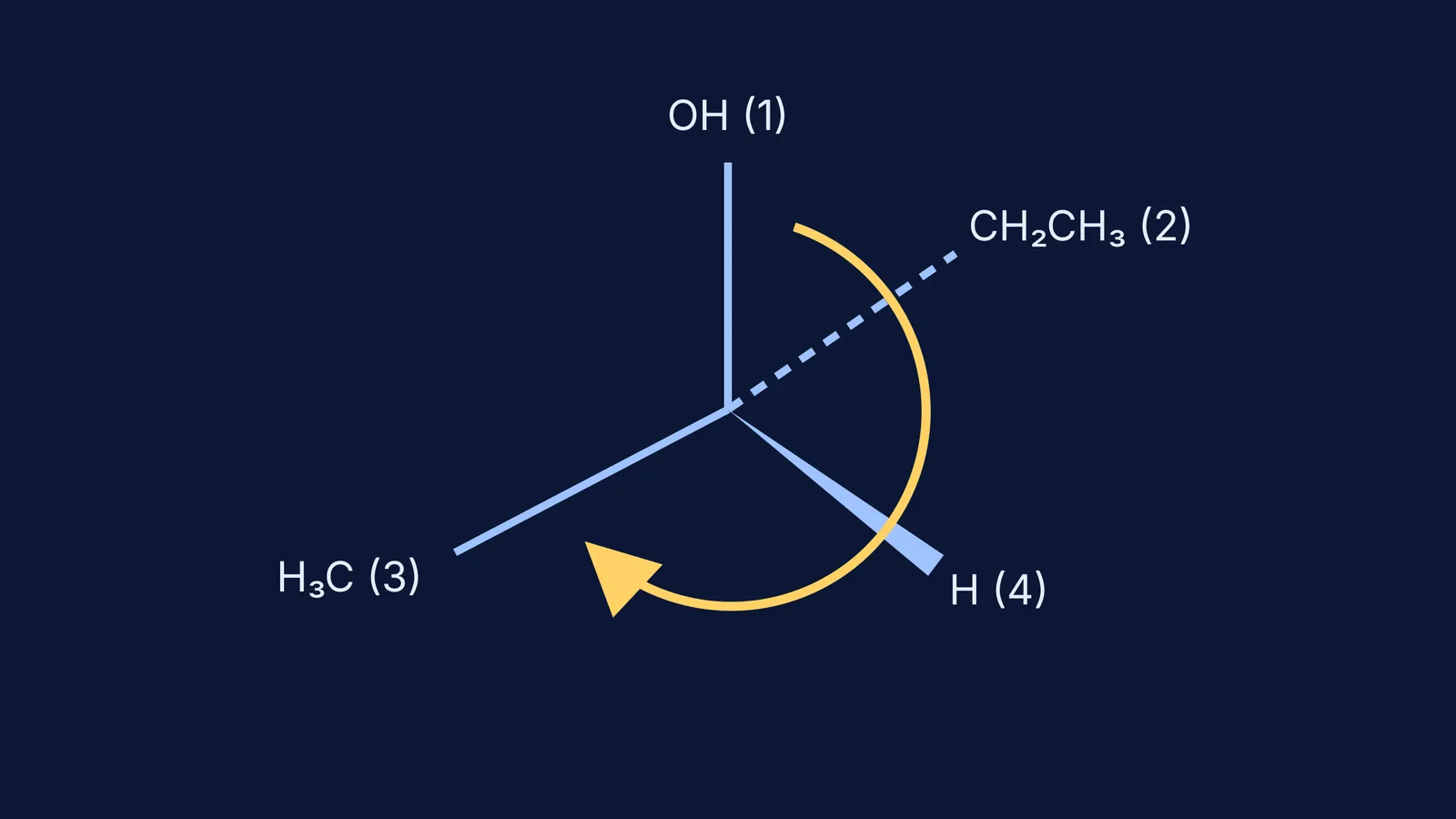
Take (S)-2-butanol as a tricky example. The chiral carbon is attached to:
-OH (Priority 1)
-CH₂CH₃ (Priority 2)
-CH₃ (Priority 3)
-H (Priority 4)
If you draw this with the hydrogen atom on a wedge (pointing towards you) and the ethyl group on a dash (pointing away), the sequence from 1 to 2 to 3 appears clockwise.
Because the lowest-priority group is pointing at you, you are looking at the molecule from the wrong side. The rule reverses: a clockwise sequence with the lowest priority group on a wedge means the configuration is S, not R.
When to use AI for stereochemistry
AI is an excellent tool for breaking down the rules, but you should always be the one doing the final spatial check. Before trusting a quick answer, you can use Fermi's AI tutor to build a plan for the session and check your understanding as you go.
If you are stuck on drawing out different orientations or checking how many stereocenters a complex molecule has, the Fermi Problem Library has worked problems with a step-by-step solver that explains the reasoning rather than printing an answer.
For more practice with spatial reasoning, review how to count stereoisomers from the number of chiral centres, read up on stereoisomerism step by step, or try telling the four alcohols and three ethers of C4H10O apart.


