On this page
Most chatbots can explain the d-block in general terms. Exam questions usually test the exceptions: why zinc complexes are colourless, why copper(II) sulphate solution is blue, why Cu⁺ doesn't last in water. Below are the core ideas, then five quiz prompts with a marking key.
In a 2006 study, Roediger and Karpicke found that students who took recall tests on a prose passage remembered more of it on tests two days or a week later than students who restudied it, even though restudying made them more confident (Psychological Science, 2006). Quizzing the AI gives you that recall practice too.
Why do transition metals show variable oxidation states?
The 4s and 3d orbitals have very similar energies, so removing a third electron costs only a little more than removing the first two (chemguide). That extra cost is roughly paid back by the extra lattice or hydration enthalpy released when the higher-charged compound forms, which is why several oxidation states can be stable.
When these atoms form ions, the 4s electrons are lost before the 3d electrons (LibreTexts/Descriptive_Chemistry/Elements_Organized_by_Block/3_d-Block_Elements/1b_Properties_of_Transition_Metals/Electron_Configuration_of_Transition_Metals)). The same page lists +2, +3, +4, +6 and +7 as common oxidation states for manganese, and only +2 for zinc.
Why are transition metal ions coloured?
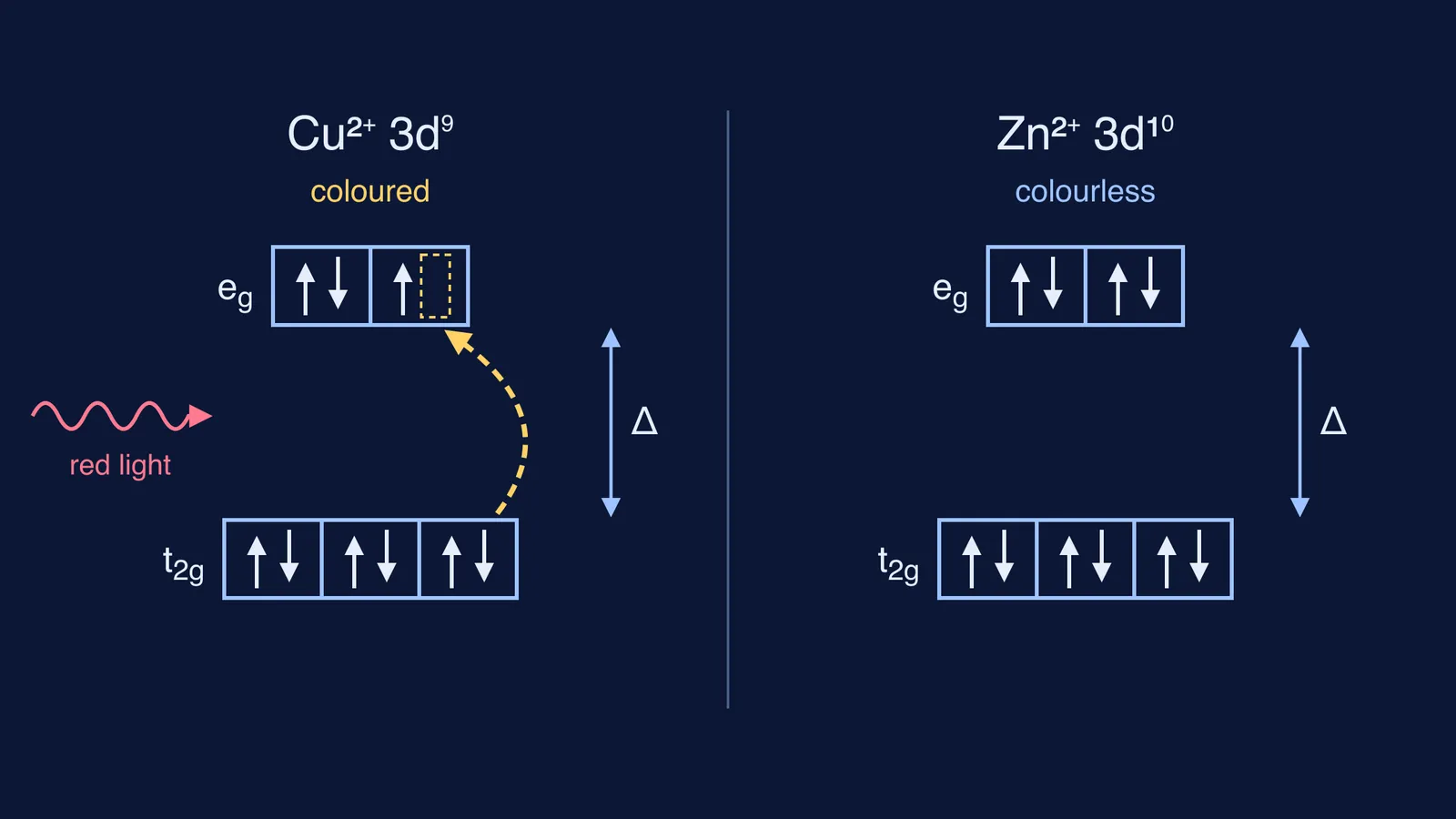
When ligands such as water surround a transition metal ion, they split the five d orbitals into a lower and an upper set (chemguide). Visible light can promote an electron from the lower set into a space in the upper set. Your eye sees the complementary colour of whatever was absorbed.
Aqueous copper(II) ions absorb in the red part of the spectrum, so the light that gets through looks pale blue, according to the same chemguide page. Zinc complexes are colourless because zinc's 3d level is full, leaving no space to promote an electron into. Scandium(III) complexes are colourless because they have no d electrons.
Why is zinc not a transition metal, but copper is?
IUPAC defines a transition element as one whose atom has an incomplete d sub-shell, or which can form cations with an incomplete d sub-shell (IUPAC Gold Book).
Zinc is [Ar] 3d¹⁰ 4s² and Zn²⁺ is [Ar] 3d¹⁰. Both have a full d level, so zinc meets neither part of the definition (chemguide).
Copper is [Ar] 3d¹⁰ 4s¹. Cu⁺ is [Ar] 3d¹⁰, but the more common Cu²⁺ is [Ar] 3d⁹, according to the same chemguide page. That one ion with an incomplete d sub-shell is enough to make copper a transition element.
Copper has a second exception. Simple copper(I) ions in water disproportionate to copper(II) ions and copper metal: 2Cu⁺ → Cu²⁺ + Cu (chemguide). Copper(I) survives in an insoluble solid such as CuI, or in a complex with a ligand other than water.
See also why copper's E° is positive among the 3d metals and why chromium and copper break the aufbau order.
How do you quiz an AI on transition metal exceptions?
Ask these five in order. Before reading each reply, write down the points after the arrow: a correct answer must include them.
"Why do transition metals show variable oxidation states?" → 4s and 3d have similar energies; 4s electrons go first; extra ionisation energy is offset by lattice or hydration enthalpy.
"Zinc is in the d-block. Is it a transition element by the IUPAC definition?" → No. Zn and Zn²⁺ are both 3d¹⁰.
"Cu⁺ is 3d¹⁰. Why is copper still called a transition element?" → Cu²⁺ is 3d⁹, an incomplete d sub-shell.
"Why are aqueous Zn²⁺ ions colourless but aqueous Cu²⁺ ions blue?" → Zn²⁺ has no space in its d orbitals for an electron to jump into; Cu²⁺ (d⁹) has one, absorbs red light and looks pale blue.
"What happens to Cu⁺ in water, and how can copper(I) be kept stable?" → 2Cu⁺ → Cu²⁺ + Cu; stable as insoluble CuI or in non-water complexes.
Then ask a trap question: "Cu⁺ is a copper ion, so is it coloured like Cu²⁺?" A careful answer says Cu⁺ is d¹⁰ like Zn²⁺, so it has no d-to-d jump, and points out that copper(I) iodide is an off-white solid. A careless one agrees with you. Check it against why Sc³⁺, Ti⁴⁺, Zn²⁺ and Cu⁺ ions are colourless.
What should you do when the AI gets it wrong?
Mark each answer against your list yourself. If it misses a point, name it ("you did not write the configuration of Zn²⁺") and ask again. Check every configuration against your textbook: a wrong d count makes everything after it wrong.
If an idea like d-orbital splitting still feels shaky, the gap is in the concept, not the fact. The Fermi Concept Library has a lesson for every chemistry concept and shows its place in the concept map. Fermi's AI tutor works out what you already know, decides whether to explain, ask or show, and checks your understanding as it goes.
Then write each exception with its d count on one page, and revise from that page rather than the chat.