

On this page
When you step into a school laboratory during an exam, your hands must execute physical routines while your mind tracks numbers, polarities, and safety margins. Under exam conditions, students rarely lose marks because they forgot the governing formula. They lose marks because they forgot to remove a plug key between readings, dragged a jockey across resistance wire, or omitted zero-error corrections in their observation table.
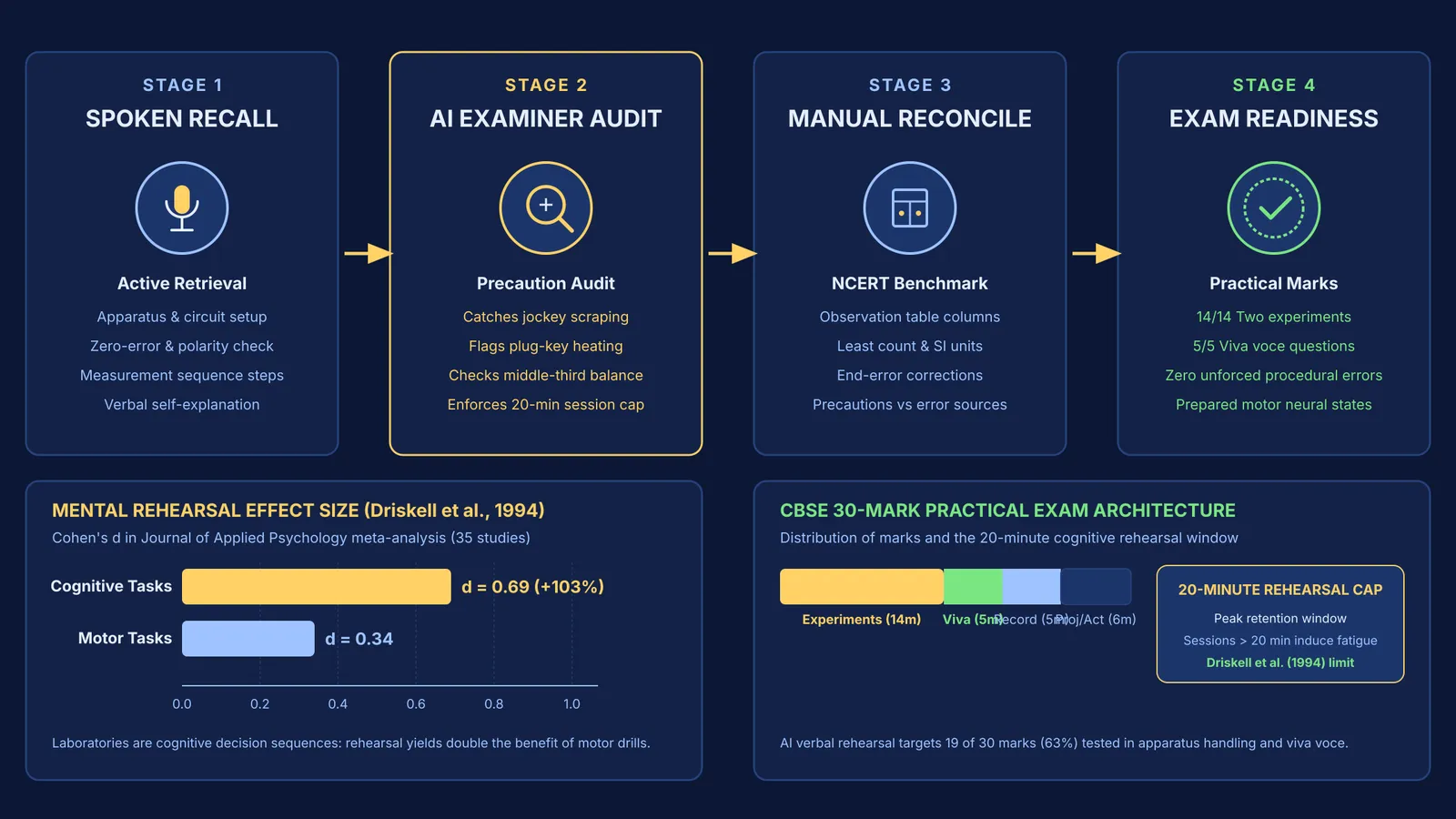
In a meta-analysis published in the *Journal of Applied Psychology*, James E. Driskell, Carolyn Copper, and Aidan Moran (1994) showed that mental rehearsal produces an average effect size of d = 0.69 for cognitive tasks, compared to d = 0.34 for motor tasks. Because laboratory practicals are primarily cognitive sequences of decisions, talking through an experiment builds the structural schema needed for execution. Driskell and colleagues also found that mental rehearsal achieves peak effectiveness in sessions lasting approximately 20 minutes, after which fatigue diminishes returns.
Cognitive scientist Michelene T. H. Chi and colleagues (1994) demonstrated in *Cognitive Science* that prompting students to self-explain steps forces them to detect contradictions, resolve gaps, and repair flawed mental models. Furthermore, neuroscientists led by Saurabh Vyas and colleagues (2018) showed in *Neuron* that mental rehearsal primes neural population activity in the motor cortex, moving neural states into the preparatory window required for physical execution. Talking aloud transforms passive reading into active retrieval, much like summarising concepts before comparing them with AI.
How do you talk through an experiment with an AI tutor?
To rehearse an experiment effectively, assign the AI tutor the role of a strict external examiner. Rather than asking the AI to summarize the practical for you, you describe the apparatus, connections, zero checks, and measurement sequence step by step. After each step, the AI checks what you missed.
Use this prompt to set up your session:
"I will talk through each step of [Experiment Name, e.g., finding wire resistance with a metre bridge]. Act as a strict lab examiner. After each step I describe, do three things: (1) Confirm what is correct, (2) Flag omitted precautions, zero checks, or apparatus adjustments, and (3) Ask what reading comes next. Wait for my answer before moving forward."
This dialogue mirrors how Fermi's AI tutor teaches: holding a line of reasoning across a session, noticing where you hesitate, and deciding whether to ask, explain, or prompt you for the next step.
To keep your mental practice sharp, cap your walkthrough at roughly 20 minutes, the duration identified by Driskell, Copper, and Moran (1994) before cognitive fatigue reduces error detection.
Which precautions and readings do students miss most often?
Under the CBSE Senior Secondary Curriculum, practical exams carry 30 marks, where two experiments account for 14 marks (7 marks each) across circuit diagrams, apparatus settings, observations, calculations, graphs, and precautions. An additional 5 marks depend on viva voce performance.
Consider how a spoken walkthrough catches typical oversights during a standard Class 12 metre bridge practical:
Student: "I connect the cell, resistance box in the left gap, unknown wire in the right gap, and galvanometer to the central strip. Then I slide the jockey to find the null point."
AI tutor: "Two errors: First, verify opposite galvanometer deflections by touching the jockey near 0 cm and 100 cm before seeking balance. Second, never slide the jockey—sliding scrapes the wire and makes its diameter uneven. Gently tap it."
Student: "I tap the jockey and find the balance point at 42 cm. I record length l, calculate 100 − l, and solve for resistance with X = R(100 − l)/l."
AI tutor: "Correct formula, but check two details: Is your resistance R chosen to keep balance in the middle third (30 cm to 70 cm) to maximize bridge sensitivity? And will you interchange the resistance box and unknown wire to cancel end errors?"
These interventions mirror the checks examiners make when evaluating whether you are speaking confidently in a viva exam or plotting physics practical graphs.
How do you reconcile AI feedback with your lab manual?
Once you complete your spoken rehearsal with the AI, open your physical lab manual. As catalogued in the NCERT Physics Laboratory Manual, every sanctioned experiment features standardized sections: Aim, Apparatus, Principle, Circuit Diagram, Observation Table, Calculations, Precautions, and Sources of Error.
Audit your rehearsal against the text across three checkpoints:
Observation columns and units: Verify that your rehearsed table recorded every intermediate value, including least count, zero error corrections, and standard SI units.
Circuit polarities and alignments: Confirm that cell terminals, meter ranges, and optical bench heights match the textbook diagram.
Precautions vs sources of error: Separate preventable mistakes (such as leaving a plug key closed between readings) from intrinsic instrument limits (such as non-uniform wire resistance).
If you struggle to picture how variables interact during an experiment, the Fermi Simulation Lab provides interactive simulations for ideas that are easier to see than to read. Combining spoken AI rehearsal with manual verification gives you an organized, error-free procedure before you enter the examination hall.


