

On this page
Why does sin x + sin 2x repeat every 2π?
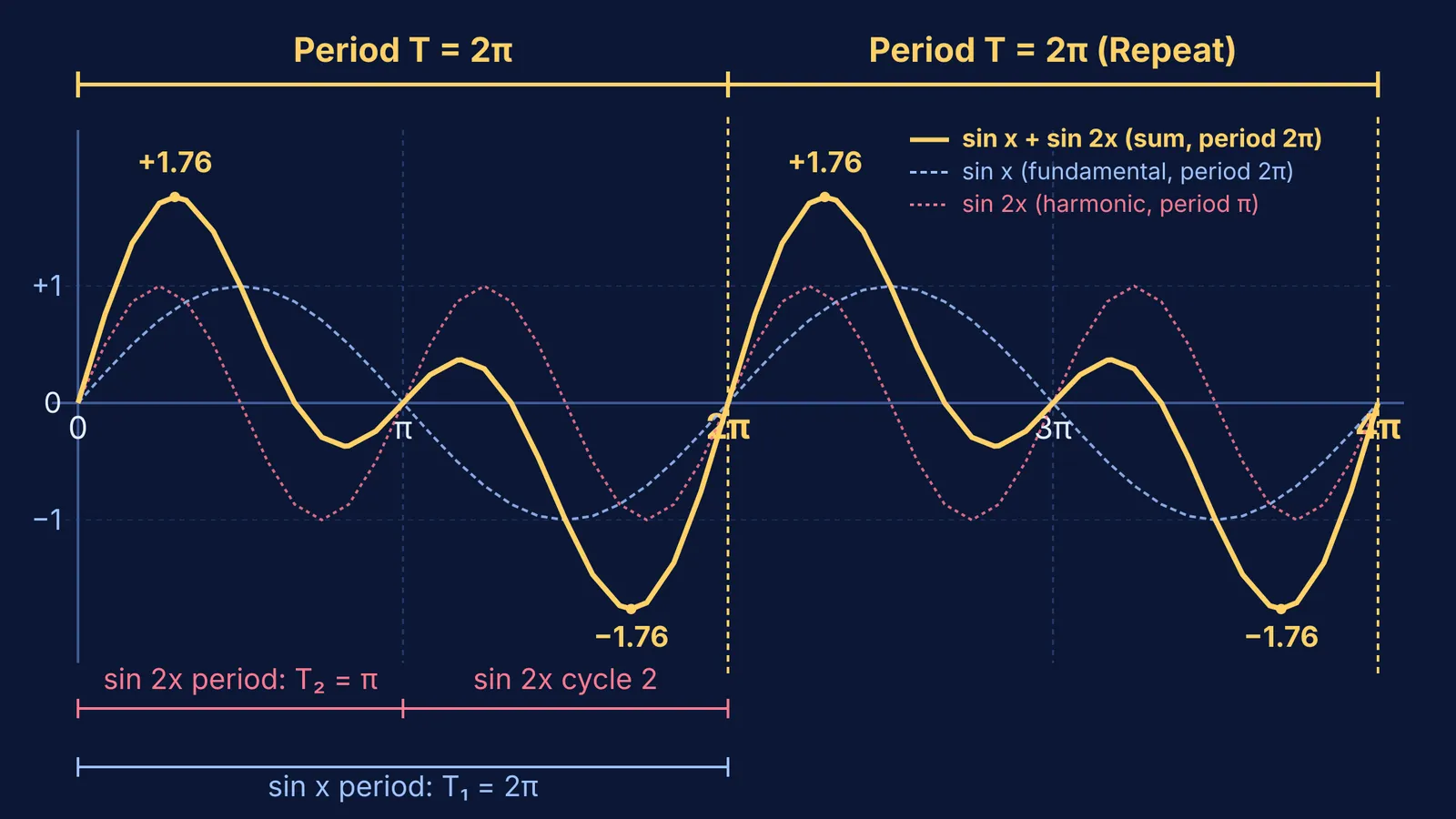
When you add two pure tones or wave functions, the resulting curve inherits its rhythm from both pieces. Consider the function f(x) = sin x + sin 2x. As analyzed by John M. H. Olmsted and Carl G. Townsend in The Two-Year College Mathematics Journal, the sum of periodic functions repeats only at a common multiple of the individual periods. The first component, sin x, completes one full cycle over an interval of 2π radians. The second component, sin 2x, oscillates at twice the frequency, completing a cycle every π radians. Because π is half of 2π, every single period of sin x spans exactly two full cycles of sin 2x.
Students often guess that because sin 2x finishes its oscillation in π radians, the whole sum might repeat every π radians. Plotting the wave proves why that intuition fails. At x = π/2 radians, sin(π/2) = 1 and sin(2 × π/2) = 0, giving a sum of 1. If the function had a period of π radians, shifting x by π radians would produce the exact same value. Yet at x = 3π/2 radians, sin(3π/2) = −1 and sin(2 × 3π/2) = 0, giving a sum of −1. The component sin x changes sign after π radians, whereas sin 2x returns to its starting value.
The resulting waveform is asymmetrical across any interval of π radians. Over the first interval [0, π], the two waves reinforce each other during the first quarter-cycle to create a prominent peak of approximately 1.76 at x ≈ 0.94 radians, followed by a shallow dip to −0.37 at x ≈ 2.57 radians. Over the next interval [π, 2π], this pattern inverts into a modest bump of +0.37 followed by a deep trough of −1.76. For sin x + sin 2x, the least common multiple of 2π and π is 2π radians.
How do you find the period of sin 2x + cos 3x?
Now consider a mixture where neither period is a simple whole-number multiple of the other: g(x) = sin 2x + cos 3x. In signal analysis, as taught in MIT OpenCourseWare's Signals and Systems curriculum, composite periodic waveforms are understood through their harmonic frequencies. Here, the component sin 2x has a period of T₁ = 2π / 2 = π radians, corresponding to an angular frequency of 2 rad/s. The component cos 3x has a period of T₂ = 2π / 3 radians, corresponding to an angular frequency of 3 rad/s.
To find where their sum repeats, we seek the smallest positive interval T that contains an integer number of full cycles for both waves simultaneously: T = k₁ T₁ = k₂ T₂. Substituting the individual periods yields k₁ π = k₂ (2π / 3), which simplifies to k₁ / k₂ = 2 / 3. Choosing the smallest positive integers gives k₁ = 2 and k₂ = 3. Therefore, the common interval is T = 2 × π = 3 × (2π / 3) = 2π radians.
You can calculate this directly using the fractional least common multiple rule: LCM(a/b, c/d) = LCM(a, c) / GCD(b, d). Writing the periods as π/1 and 2π/3 gives LCM(π, 2π) / GCD(1, 3) = 2π radians. In terms of harmonics, the fundamental frequency is GCD(2 rad/s, 3 rad/s) = 1 rad/s, confirming T = 2π radians. Over one 2π cycle, sin 2x completes 2 waves while cos 3x completes 3 waves before realigning.
When does the LCM rule fail for wave combinations?
While the LCM rule gives a valid period for standard textbook exercises, two pitfalls can cause it to fail. The first failure occurs when the ratio of the two periods is irrational. Consider the sum h(x) = sin x + sin(√2 x). The period of sin x is 2π radians, while the period of sin(√2 x) is 2π / √2 = √2 π radians. Their ratio is 2π / (√2 π) = √2, which is an irrational number. As proved by Regina Caveny and James Caveny in Mathematics Magazine, no two non-zero integers can satisfy m(2π) = n(√2 π). Because their peaks drift out of phase and never simultaneously realign, continuous waves with incommensurable periods produce an aperiodic curve that never strictly repeats.
The second pitfall occurs when functional symmetry makes the fundamental period smaller than the LCM. Take the classic example f(x) = |sin x| + |cos x|. Both |sin x| and |cos x| individually have a fundamental period of π radians, so the standard LCM rule predicts a period of π radians. However, shifting x by π/2 radians interchanges the two components: |sin(x + π/2)| = |cos x| and |cos(x + π/2)| = |−sin x| = |sin x|. The sum remains identical every π/2 radians, halving the predicted period. When working on problems with absolute values or even powers like sin⁴ x + cos⁴ x, always test whether a submultiple like T/2 satisfies f(x + T/k) = f(x).
How do you predict any trigonometric period?
To solve period questions reliably in board exams and competitive tests like JEE Main, follow this structured routine:
Determine individual periods: Use T = 2π / |b| for sine and cosine, and T = π / |b| for tangent and cotangent terms of the form sin(bx + c).
Test for commensurability: Divide T₁ by T₂. If the ratio is irrational, stop: the combined function is not periodic.
Apply the fractional LCM formula: For rational ratios, express both periods as fractions of π and calculate LCM(numerators) / GCD(denominators).
Check for symmetry submultiples: If the expression involves even powers, absolute values, or complementary pairs like sine and cosine, test if T/2 or T/4 satisfies f(x + T/k) = f(x).
Verify against boundary points: Evaluate the function at x = 0 and x = T to verify that f(0) = f(T) and f′(0) = f′(T).
When combining oscillatory functions, plotting curves on paper can make it hard to see how individual phases lock together. The Fermi Simulation Lab provides interactive simulations for ideas that are easier to see than to read, letting you adjust harmonic frequencies dynamically. Exploring interference in wave simulations builds visual intuition for how frequencies superpose, which research on interactive simulations versus static graphs shows helps students connect formulas with physical behavior. For tricky periodic combinations with absolute values or higher powers, the Fermi Problem Library provides worked problems with a step-by-step solver that explains the reasoning rather than printing an answer. Once you know the fundamental period, integrating periodic functions over multiple periods becomes a quick matter of multiplying the single-period integral by the number of cycles.


