

On this page
A normal graph tells you where the curve is. A parametric graph also tells you when the point gets there. Make the point move on screen, say what it will do before you press play, and a page of equations turns into motion you can predict.
What are parametric equations, in plain words?
In the definition used by OpenStax Calculus Volume 2, if x and y are continuous functions of t on an interval, the equations x = x(t) and y = y(t) are parametric equations and t is the parameter. Think of t as a clock: at each tick, x(t) says how far across the point is and y(t) says how far up.
One shape can hide many motions: fast or slow, clockwise or anticlockwise. A static plot throws the timing away. An animated point keeps it.
How do you animate a moving point on a graphing tool?
In GeoGebra, the Curve command draws a whole path: Curve(2 cos(t), 2 sin(t), t, 0, 2π) gives a circle of radius 2 centred at the origin. The Slider command makes the clock, and one of its settings switches automatic animation on.
Type s = Slider(0, 2π, 0.01, 1, 300, false, true, true, false). The eighth value, true, makes it animate.
Type P = (2 cos(s), 2 sin(s)). P is the moving point.
Type Curve(2 cos(t), 2 sin(t), t, 0, 2π) to draw the path behind it.
Before it runs, write down where P starts, which way it goes and where it speeds up.
Our guide to using graphing tools to learn functions rather than skip them explains how to make the tool check your thinking instead of replacing it.
Why predict first? In a 2004 study in the American Journal of Physics, Crouch, Fagen, Callan and Mazur compared ways of presenting classroom physics demonstrations. A moving point is a small demonstration: write the guess down, then watch.
What curve will each moving point trace?
Four predictions to test. Predict, run it, then explain any surprise.
1. Circle: x = 2 cos t, y = 2 sin t. P starts at (2, 0), moves anticlockwise and finishes one lap at t = 2π, at a steady speed. Swap to (2 sin t, 2 cos t) and P starts at the top and goes clockwise. Same circle, different motion.
2. Ellipse: x = 4 cos t, y = 3 sin t. OpenStax describes this as a horizontal ellipse centred at the origin with semi-major axis 4 and semi-minor axis 3. The speed is not steady: the velocity is (−4 sin t, 3 cos t), so the speed is 3 at the right end and 4 at the top. It rushes along the flatter top and bottom and slows round the pointed ends.
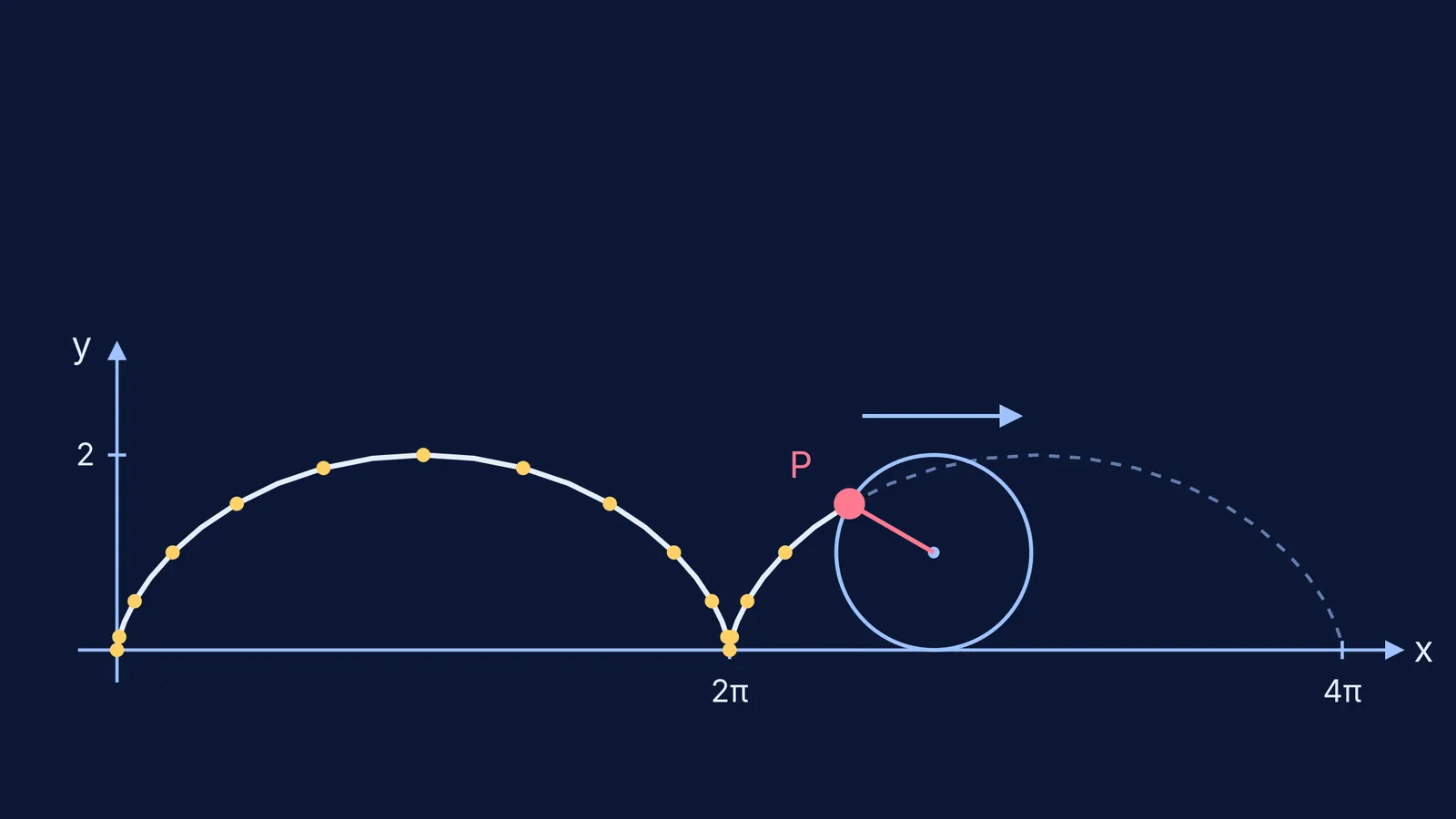
3. Cycloid: x = t − sin t, y = 1 − cos t. This is the path of a point on the rim of a rolling circle. Wolfram MathWorld gives x = a(t − sin t), y = a(1 − cos t), with each arch 2πa wide and 2a high and an arc length of 8a. With a = 1, expect arches about 6.28 units wide and 2 units high. The surprise: the velocity (1 − cos t, sin t) is zero at t = 0 and t = 2π, so the point stops dead each time it touches the ground and is fastest at the top.
4. Projectile: x = 100t, y = −4.9t² + 4000. OpenStax uses this for a package dropped from a plane flying level at 100 m/s, 4000 m up. Run t from 0 to 30. Sideways steps stay equal while the fall speeds up. It lands when 4.9t² = 4000, so t ≈ 28.6 s and x ≈ 2860 m.
Why does a projectile trace a parabola?
OpenStax University Physics writes the motion as x = x₀ + vₓt and y = y₀ + v₀ᵧt − ½gt², with g = 9.8 m/s². Launch from the origin, eliminate t, and you get y = (tan θ₀)x − [g / 2(v₀ cos θ₀)²]x², of the form y = ax + bx²: a parabola. The animation adds what the equation hides: equal steps sideways, growing steps down. To work backwards from it, see finding u and θ from the equation of trajectory.
For practice, read differentiating parametric functions.
A 10-minute plan for your next session
Pick one curve and write three predictions: start point, direction, fastest spot.
Animate it and tick or cross each one.
Change one number, such as 4 cos t to 2 cos t, and predict again.
Explain the shape aloud in one sentence to a parent or friend.
When an idea is easier to see than to read, the Fermi Simulation Lab has interactive simulations to explore. If a prediction keeps going wrong, Fermi's AI tutor can notice where you are stuck and decide whether to explain, ask or show.


