

On this page
An open-book exam lets you bring your notes, but not skip learning. The questions are usually built so the book alone cannot answer them, and the clock keeps running while you search. Here is how to learn the material, build an index you can search in seconds, and practise against the clock within the rules.
Why are open-book exams harder than they sound?
An open-book test is one in which students can look at their notes and textbooks while answering, as defined in a 2008 study by Pooja Agarwal and colleagues. In its lab experiments, open-book tests gave better scores at first, but on a later test both kinds of test led to the same retention.
The bigger risk is how you prepare. In a 2011 follow-up by Agarwal and Henry Roediger, participants who expected an open-book test spent less time studying, and they did worse on a later closed-book test of comprehension and transfer.
A 2016 systematic review in Academic Medicine of 37 studies found that students may prepare more for closed-book exams and take longer to finish open-book ones. Performance favoured closed-book exams, especially where students had prepared more for them. The authors found too little evidence to use only one format and suggested a mix.
CBSE has approved open-book assessments for Class 9 from 2026-27, Careers360 reports. These are pen-and-paper tests, and in a pilot, scores ranging from 12% to 47% showed students struggled to use their resources. Your school's circular has the details.
How should you prepare for an online open book exam?
Study as if the book will be closed. Revise each chapter with notes shut: write down what you remember, then check. For why this works, see what a 2018 meta-analysis found about practice tests on new questions. Your notes should only remind you of things, never be the first time you see an idea.
How do you build an index for an open-book exam?
Build a one-page index, not a second textbook: more pages make searching slower. Make one index page per subject with three columns:
Topic: for example, "Kirchhoff's loop rule".
Where: the textbook page or your notes page.
Use it when: the clue in a question that tells you to use it, such as "two batteries in different branches".
Add a short formula sheet in the same order, and tag a few worked examples by question type. Number your notebook tabs to match the "Where" column. For an online exam, keep one clearly named file per subject and check that search finds each key term.
How do you practise timed application questions?
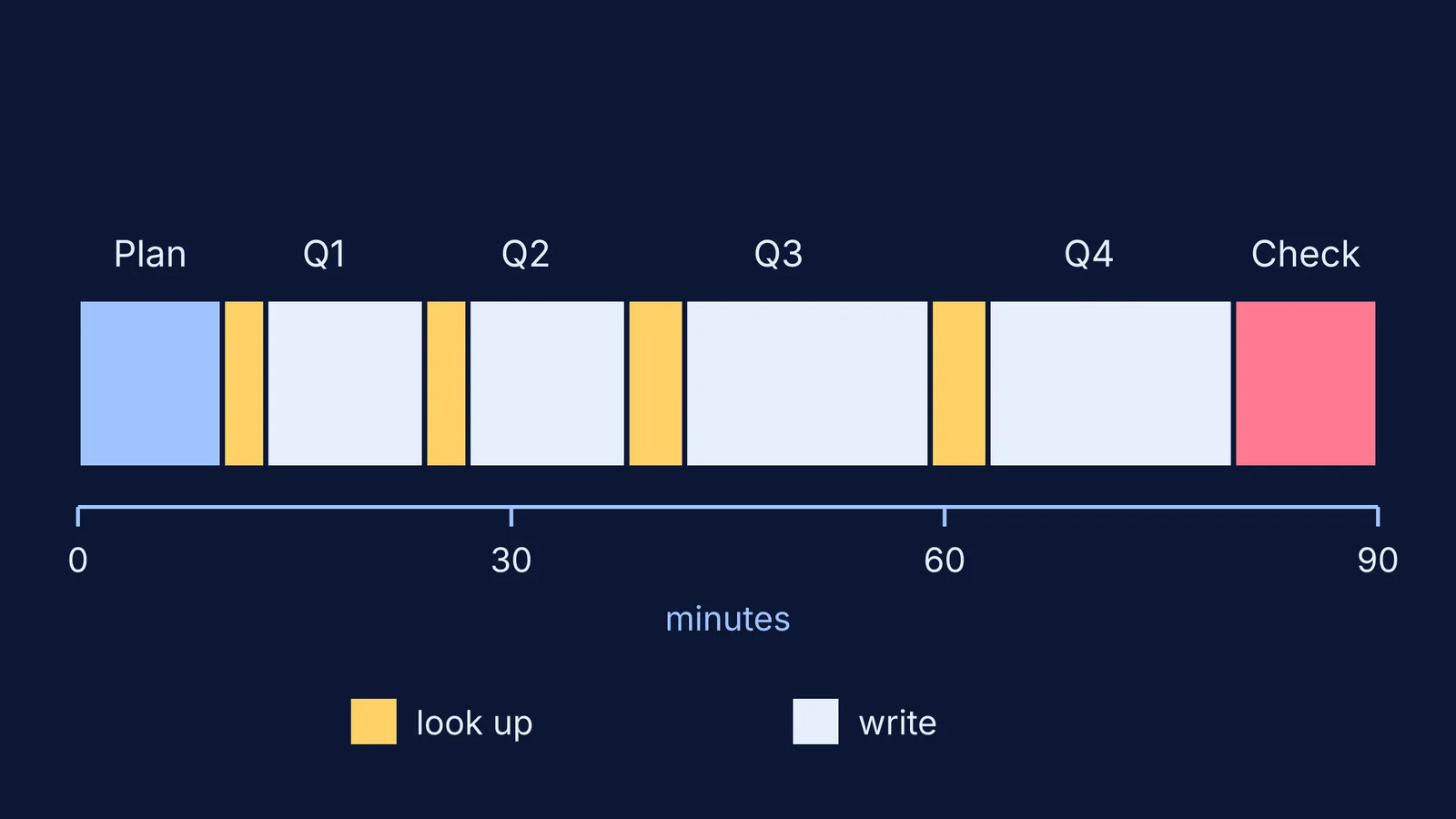
Take the real format and give yourself a time budget. Here is a worked example for a 90-minute paper with four questions worth 10, 10, 15 and 15 marks:
Spend the first 10 minutes reading every question and marking which index entries each one needs.
That leaves 70 minutes for 50 marks, or 1.4 minutes per mark: 14 minutes each for Q1 and Q2, and 21 minutes each for Q3 and Q4.
Allow yourself about 3 to 4 minutes of looking things up per question. When that time is up, write the answer from what you know.
Keep the last 10 minutes to check units, signs and whether you answered what was asked.
Do this with past or sample papers at least twice. Afterwards, note where your time went, as you would when you review a mock test in a 60-minute routine. Time lost searching means the index needs work; time lost writing means you need more application practice. The Fermi Problem Library has worked problems with a step-by-step solver that explains the reasoning rather than printing an answer, which helps when you need to see why a method fits.
What counts as cheating in an online open-book exam?
Open notes do not mean anything goes. The University of Glasgow's guidance on online exam misconduct tells students not to share notes, because very similar answers count as collusion. It also bans discussing the specific exam questions or answers with other students, and using AI software to generate or co-produce any part of the work. Your school's rules may differ, so check before every paper:
Which materials are allowed: textbook only, your own notes, or the internet?
Are calculators, AI tools or messaging apps banned during the exam?
Do you need to cite a source when you use its words?
If something is unclear, ask in writing before the day: "Ma'am, for Friday's open-book test, may I use my typed notes and a scientific calculator?" For help on the grey areas, read where AI help ends and copying begins.
If you don't know where to start your revision, Fermi's AI tutor can work out what you already know and build a plan for the session. If exam stress is affecting your sleep or mood, talk to a parent or teacher, or call Tele MANAS on 14416.


