On this page
Enrolling in the National Institute of Open Schooling offers flexibility, but studying without a traditional timetable requires disciplined self-direction. NIOS learners rely primarily on printed or digital Self-Learning Materials available on the official NIOS study material portal. While these textbooks are structured as self-instructional modules with clear objectives, studying alone can leave students unsure whether their pace is on track or whether their working matches board expectations.
Using an AI tutor alongside official NIOS textbooks bridges the gap between independent reading and interactive classroom instruction. By establishing structured weekly goals, verifying exercise solutions, and systematically recording doubts, students can build consistent study habits.
How should NIOS learners plan weekly goals?
Leaving study hours unstructured often results in pre-exam panic. In a seminal review of self-regulated learning published in Theory Into Practice, Barry Zimmerman (2002) demonstrated that academic achievement hinges on a forethought phase where learners establish specific, proximal goals rather than general intentions. For an NIOS student balancing five subjects, a practical weekly target focuses on mastering one chapter or two sub-modules rather than attempting an entire syllabus block at once.
Instead of reading passively, students can use an AI tutor to break down NIOS modules into manageable milestones:
Divide each lesson into three progressive phases: reading conceptual theory, solving in-text questions, and working through terminal exercises.
Schedule specific preparation blocks for Tutor Marked Assignments, which account for a 20% weightage in the final theory assessment on the NIOS student portal.
Reserve a dedicated weekly revision slot each weekend to re-solve marked questions from previous chapters.
How can an AI tutor check answers against NIOS books?
Textbooks available on the NIOS course material portal are designed around two assessment layers: In-Text Questions embedded throughout each topic and Terminal Exercises at the chapter end. While answers to in-text questions appear at the back of each lesson, terminal exercises often present comprehensive multi-step numericals or derivations without step-by-step intermediate working.
Relying on final numerical answers can create a false sense of mastery. In a comprehensive monograph on effective learning techniques, John Dunlosky and colleagues (2013) found that practice testing shows high utility and self-explanation shows moderate utility for long-term retention, whereas passive rereading shows low utility. Students can harness active retrieval by solving a problem on paper, sharing their intermediate steps with an AI tutor, and asking targeted questions to spot conceptual leaps.
When learners get stuck on a multi-step problem in the terminal exercises, an AI tutor can guide them through the underlying logic. Fermi's AI tutor holds a line of reasoning across a session, notices where a student is stuck, and decides whether to explain, ask, or show rather than merely printing a final numerical answer. When an end-of-lesson exercise lacks a full worked solution, learners can turn to the Fermi Problem Library to inspect worked problems with a step-by-step solver that explains the reasoning rather than printing an answer.
How do you track and resolve doubts without a classroom?
Under NIOS instructional guidelines, students typically have access to 30 Personal Contact Programme sessions per subject at accredited study centres. Because these weekend sessions are infrequent, unaddressed questions during weekday self-study can halt progress.
In an extensive meta-analytic synthesis of educational influences, John Hattie and Helen Timperley (2007) established that instructional feedback yields an average effect size of 0.79 standard deviations when it provides actionable guidance on how to close learning gaps. Rather than leaving confusing paragraphs behind, learners should keep a three-part doubt record noting the lesson number, the exact conceptual sticking point, and the verified resolution.
When a foundational definition or formula from an earlier module causes confusion, students can check the Fermi Concept Library to see how fundamental concepts in physics, chemistry, biology, mathematics, and computing fit into the broader topic map, each with its own lesson and its place in the map.
How do you structure a weekly study routine for NIOS modules?
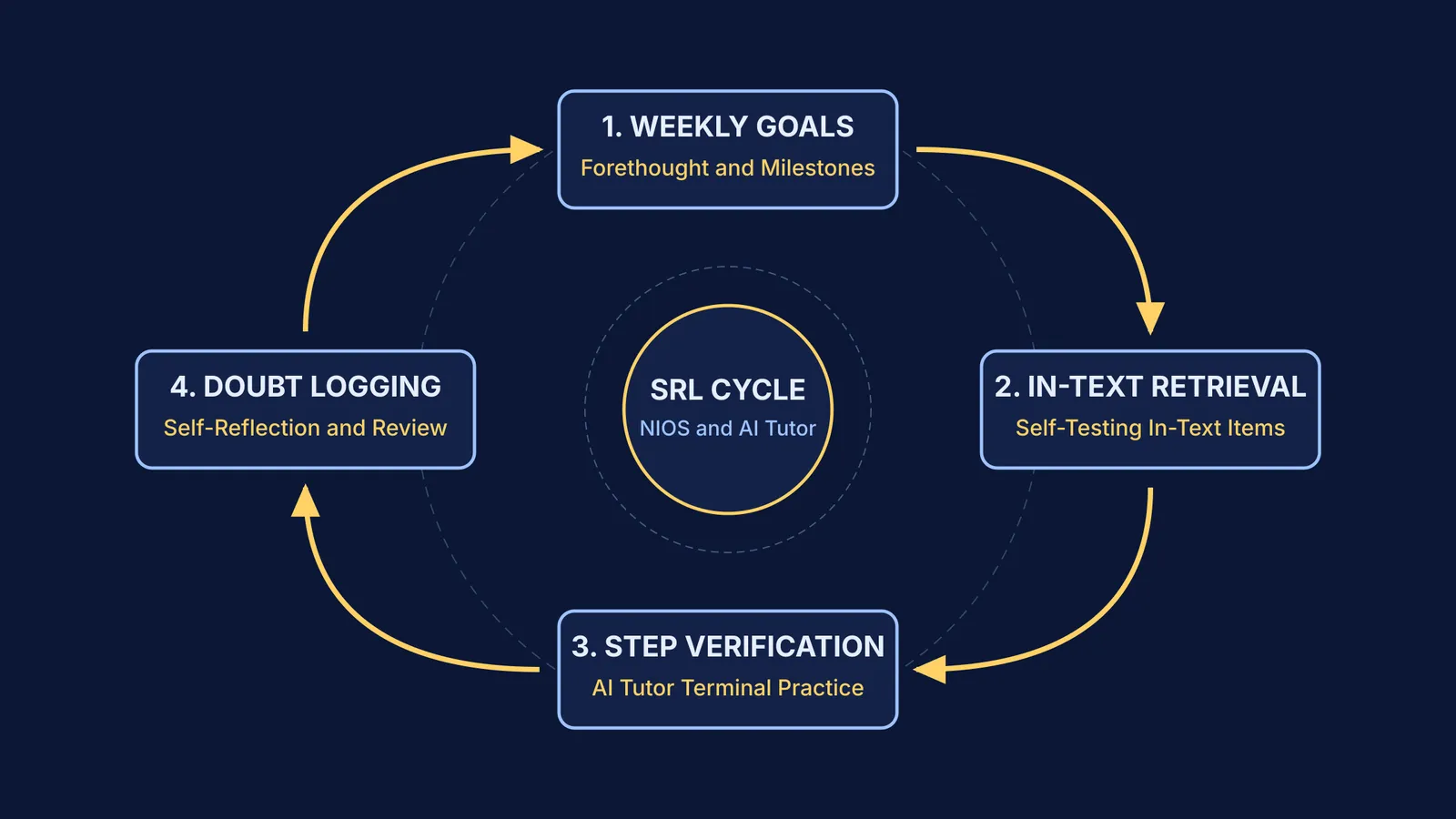
To integrate textbooks from the NIOS course material portal with an AI tutor effectively, learners can apply a repeatable four-step study routine:
Target setting: Review the lesson objectives at the start of the NIOS chapter and configure weekly milestones that cover two or three sections per study sitting.
In-text retrieval: Read a section actively, close the textbook, and write out answers to the In-Text Questions before checking the official solutions at the lesson end.
Step-by-step verification: Attempt the end-of-chapter Terminal Exercises independently, using an AI tutor to evaluate reasoning wherever answers diverge from expectations.
Doubt logging and consolidation: Enter unresolved errors into your doubt tracker, review the "What You Have Learnt" summary box, and verify that all core objectives are met.
Set your schedule at the start of each week, solve every exercise by hand first, and bring your working to an AI tutor whenever an answer does not match.