

On this page
The Newton-Raphson method is a powerful numerical tool for finding the roots of equations—the exact points where a curve crosses the zero line. When you have a complex equation that cannot be solved with basic algebra, you can start with a guess and use calculus to slide closer to the true answer. For centuries, scientists had to rely on tedious trial and error to find roots. Today, we use this elegant geometric shortcut.
According to Wolfram MathWorld, the method achieves quadratic convergence for simple roots, meaning the error is squared at each step. This mathematical property makes it the standard algorithm inside many calculators and computer programs for working out square roots and solving high-degree polynomials.
What is the Newton-Raphson method?
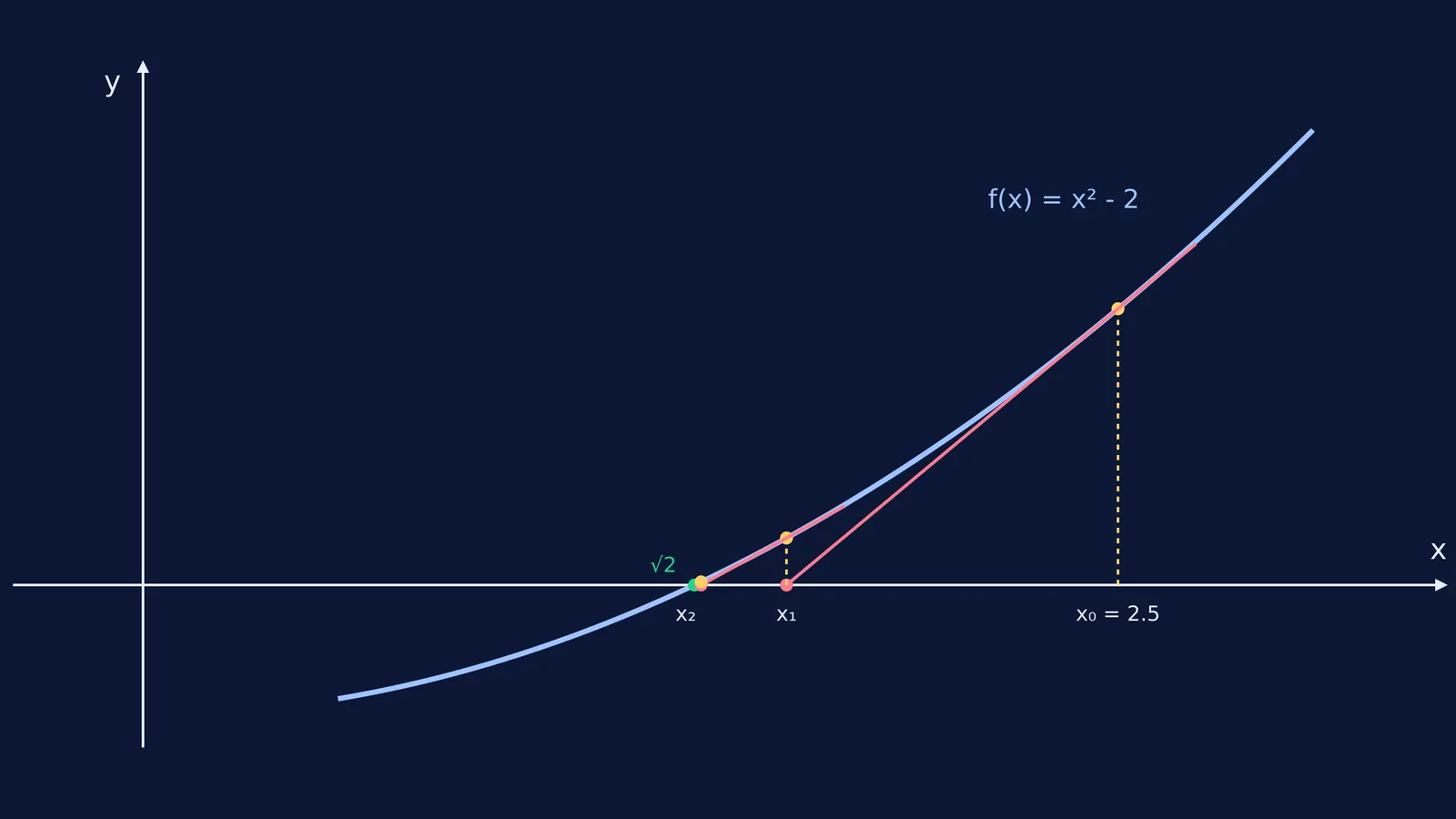
Imagine you are standing on a curve, trying to find exactly where it hits the ground (the x-axis). You cannot see the exact spot from where you are. But if you look at the steepness of the ground beneath your feet, you can follow that slope downwards in a straight line.
In mathematics, that straight line is the tangent. The Newton-Raphson method uses the derivative of a function to find the exact tangent line at your current guess. You follow this tangent down to the x-axis, and the precise point where it lands becomes your new, much better guess. You then travel vertically back up (or down) to the curve and repeat the process, zigzagging closer and closer to the root.
For any function f(x), the formula to find the next guess (x_n+1) from your current guess (x_n) is: x_n+1 = x_n - f(x_n)/f'(x_n)
This formula takes your current position on the x-axis and subtracts a correction factor. That factor is perfectly scaled based on the height of the curve f(x_n) divided by its slope f'(x_n).
If you want to see this sliding process in action, you can test different equations in the Fermi Simulation Lab to watch how tangents close in on a root. You can also explore how this geometric view connects to finding the total number of roots by counting intersections of two sketched curves.
How do you calculate the square root of 2?
Let us apply this to a real problem: finding the value of √2. We want to find the positive root of the equation f(x) = x² - 2 = 0.
First, we need the derivative, which represents the steepness of the curve at any given point. Using the standard rules of calculus derived by Gottfried Leibniz, the derivative of x² is simply f'(x) = 2x.
Plugging this specific function and its derivative into the Newton-Raphson formula gives: x_n+1 = x_n - (x_n² - 2) / (2x_n)
By splitting the fraction, this simplifies nicely to: x_n+1 = 0.5 × (x_n + 2/x_n)
Let us start with an initial guess of x₀ = 1.5 (since 1.5 squared is 2.25, which is reasonably close to 2).
Step 1: x₁ = 0.5 × (1.5 + 2/1.5) = 1.41666...
Step 2: x₂ = 0.5 × (1.41666 + 2/1.41666) = 1.414215...
Step 3: x₃ = 0.5 × (1.414215 + 2/1.414215) = 1.414213562374...
The true value of √2 is 1.414213562373... After just three simple arithmetic steps, our manual approximation matches the true value up to 11 decimal places.
How fast does Newton-Raphson converge?
The astonishing speed we just witnessed is the hallmark of the method. Wolfram MathWorld notes that for most simple roots, the method exhibits quadratic convergence.
This means the error is squared at each step. Practically, if your first step gives you two correct decimal digits, the next step will give you four, the next will yield eight, and the one after that will produce sixteen. The precision cascades so quickly that you only need a handful of steps to satisfy the most demanding engineering requirements.
Compare this to a simpler approach like the bisection method, which slowly halves the search interval at each step. Bisection is highly reliable but takes many more iterations to reach the same level of precision. When a high degree of accuracy is needed quickly, Newton-Raphson is the superior choice, provided you start close enough to the root.
When does the Newton-Raphson method fail?
The method is powerful, but it is not flawless. Because the formula requires dividing by the derivative f'(x_n), it completely breaks down if that derivative is exactly zero.
Geometrically, a derivative of zero means the tangent line is perfectly horizontal. If you are standing at a peak or a trough of a curve, the slope is flat. A horizontal line will never intersect the x-axis, sending your next guess out to infinity and breaking the calculation entirely.
Wolfram MathWorld warns that the procedure can be unstable near horizontal asymptotes or local extrema. For our square root equation f(x) = x² - 2, the exact bottom of the U-shaped curve is at x = 0. If you choose x₀ = 0 as your starting point, the derivative 2(0) is exactly zero. The tangent is a flat line at y = -2, and the calculation fails on the very first step.
Similarly, if you pick a starting point that inadvertently throws your next guess onto a flat peak elsewhere on a more complex polynomial curve, the method will crash. This is why using graphing tools to learn functions is so valuable: visually sketching the curve beforehand helps you choose a sensible starting point that avoids flat spots and guarantees a swift, successful descent to the answer.


