

On this page
Three doors. A car is behind one and a goat is behind each of the other two. You pick a door. The host, who knows where the car is, opens another door to show a goat and asks if you want to switch. Most people say two doors are left, so it must be 50-50. It isn't. Here is how to test that, then see why.
What is the Monty Hall problem?
The statistician Steve Selvin posed the puzzle in 1975, in letters to *The American Statistician*. It became famous in September 1990, when Marilyn vos Savant answered it in *Parade*. By her estimate the magazine received about 10,000 letters, most saying she was wrong, according to the Wikipedia account of the problem. The same page sets out the standard rules: the host always opens a door you did not pick, always shows a goat, and always offers the switch. Under those rules, switching wins the car with probability 2/3 and sticking wins with probability 1/3.
Most people get this wrong. In Granberg and Brown's 1995 study, only 12% of people switched the first time they met the dilemma. Across repeated trials, switching rose to 55%. The authors wrote that people neglect the cue that the host knows where the car is. So start by playing.
How do you simulate the Monty Hall game at home?
You need three playing cards (an ace for the car and two other cards for the goats), a partner to play the host, and a notebook.
Predict first. Write down how many of 300 games you think sticking will win, and how many switching will win.
Set up each round. The host shuffles the three cards face down and looks at them in secret. You point to one.
Host reveals a goat. The host turns over a non-ace card from the two you did not choose. If both are goats, the host picks one at random.
Play both strategies. Record what sticking and switching would each have given you. In every round exactly one of the two wins.
Tally in blocks of 25. Write the running totals after every 25 rounds so you can watch them settle.
With the 2/3 and 1/3 probabilities from the standard analysis, the expected count in 300 games is 100 wins for sticking and 200 for switching. The binomial standard deviation is about 8 games, so most runs land within about 16 games of those numbers. After 10 rounds your tally can look like anything. After 300 it shouldn't. That settling is the law of large numbers, which Jacob Bernoulli proved.
If you'd rather see thousands of rounds in seconds, the Fermi Simulation Lab has interactive simulations for ideas that are easier to see than to read. Make your prediction before you press play.
Why does switching win in the Monty Hall problem?
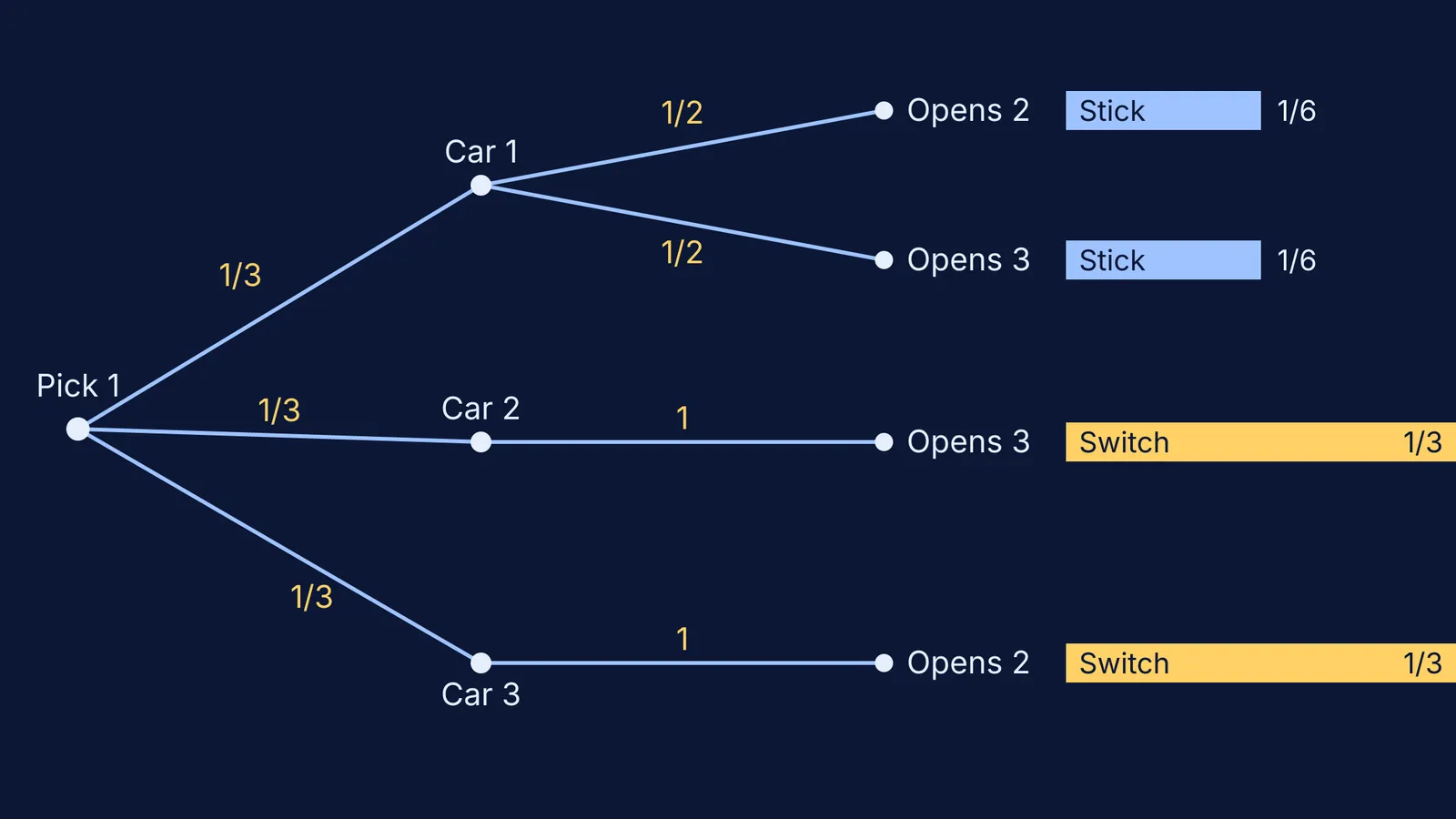
Say you pick door 1 and the host opens door 3. We want P(car behind door 2, given that the host opened door 3).
If the car is behind door 1 (probability 1/3), the host can open door 2 or door 3, so P(opens 3) = 1/2.
If the car is behind door 2 (probability 1/3), the host must open door 3, so P(opens 3) = 1.
If the car is behind door 3 (probability 1/3), the host cannot open door 3, so P(opens 3) = 0.
The total probability that the host opens door 3 is 1/3 × 1/2 + 1/3 × 1 + 0 = 1/2. Bayes' theorem then gives P(car behind door 2 | host opens 3) = (1/3 × 1) ÷ 1/2 = 2/3, and P(car behind door 1 | host opens 3) = (1/3 × 1/2) ÷ 1/2 = 1/3. Your door keeps its 1/3. The host's forced choice moves the other 2/3 onto the one door left closed. Practise the method with our guide to conditional probability and Bayes' theorem in three steps.
The short version: switching loses only when your first pick was the car, which happens 1/3 of the time.
What if the host doesn't know where the car is?
This is the cue Granberg and Brown found people neglect. Suppose the host opens door 2 or door 3 at random, and door 3 happens to show a goat. Car behind door 1 and door 3 opened: 1/3 × 1/2 = 1/6. Car behind door 2 and door 3 opened: 1/3 × 1/2 = 1/6. So, given that a goat appeared behind door 3, each remaining door has probability 1/2. With an ignorant host the game really is 50-50. The host's knowledge is the information you are using.
Many JEE probability mistakes come from that skipped step. Our list of five common probability reasoning mistakes is a good next read. If you get stuck partway through a Bayes problem, the Fermi Problem Library has a step-by-step solver that explains the reasoning rather than printing an answer.


