

On this page
Friction problems in physics are notoriously difficult because the forces are conditional. A 2021 review of 42 research papers published in *Physical Review Physics Education Research* found that confusing the types and magnitudes of friction is a universal struggle (DOI: 10.1103/PhysRevPhysEducRes.17.023107). The core issue is that students — and frequently, the AI tools they ask for help — treat static friction as a constant formula rather than a responsive limit.
This leads to situations where a student calculates a 10 N friction force for a block that is only being pushed with 5 N, inadvertently predicting that the block will accelerate backwards. Here is a prompt routine to ensure your AI tutor evaluates the conditions correctly before jumping to the math.
Why do students confuse static and kinetic friction?
Formulas like W = mg provide a single, fixed value, so students naturally try to apply the same "plug-and-chug" logic to static friction. They treat the formula for maximum static friction (f_s,max = μ_s N) as the permanent value of the force.
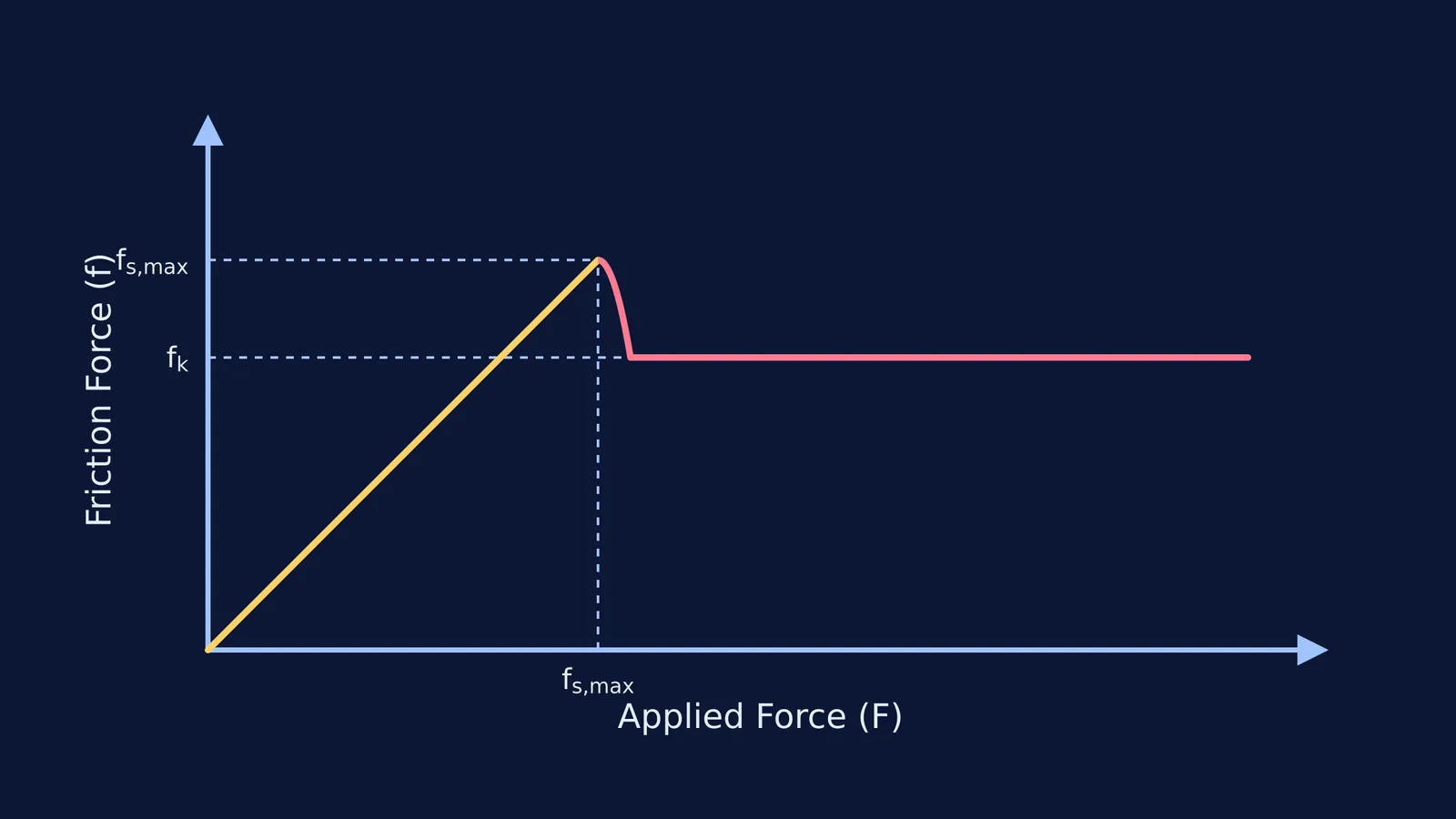
In reality, static friction is a responsive force. It matches the applied force exactly, up to its breaking point. If you push a heavy desk with 20 N of force and it does not move, the static friction is exactly 20 N, regardless of what μ_s N equates to. Once the applied force exceeds the maximum static friction threshold, the bond breaks. At this point, the block moves, and the weaker, constant kinetic friction (f_k = μ_k N) takes over.
A related misunderstanding is the direction of the force. The same 2021 review of 42 studies noted that the belief that friction always opposes motion is the most frequent misconception across the literature (DOI: 10.1103/PhysRevPhysEducRes.17.023107). Friction actually opposes *relative slipping* between two surfaces. In mechanics scenarios such as pulling a spool by its string, friction can even point in the direction of motion to enable rolling.
How to ask AI whether friction is static or kinetic?
When you ask a standard AI chat to "Find the friction on this block," it often rushes to multiply the coefficient of friction by the normal force without checking if the block actually moves.
To prevent this, you need to constrain the AI's reasoning. Use this prompt routine when pasting a mechanics problem:
The Friction Verification Prompt: "Solve this physics problem step by step. Before calculating the final frictional force, do the following:
Calculate the maximum possible static friction (f_s,max = μ_s N).
Calculate the net applied force trying to slide the object along the surface.
Compare the two values and explicitly state whether the object moves or remains stationary.
Based on step 3, declare whether we must use static friction (matching the applied force) or kinetic friction."
This routine forces the AI to justify the physical reality before doing the algebra.
Most learning tools answer questions, but Fermi's AI tutor teaches — it holds a line of reasoning across a whole session, notices where a student is stuck, and decides whether to explain, ask, or show. If you jump straight to kinetic friction in the Fermi Problem Library, the tutor will pause you to check the static limit first.
What is a worked example of prompting AI for friction?
Imagine a 10 kg block sitting on a flat table. The coefficient of static friction (μ_s) is 0.5, and kinetic friction (μ_k) is 0.3. You push the block with a horizontal force of 30 N. (Assume gravity g = 10 m/s²).
If you feed this directly to an AI without constraints, it might immediately calculate kinetic friction: f_k = μ_k N = 0.3 × 100 N = 30 N. It might then say the block moves at constant velocity.
But if you use the Friction Verification Prompt, the AI must follow the physical constraints:
Find maximum static friction: f_s,max = 0.5 × 100 N = 50 N.
Compare forces: The applied force (30 N) is less than the maximum static friction (50 N).
Determine motion: The block does not move.
Determine friction type: Because it is stationary, the static friction simply matches the applied force. The actual friction force is 30 N, not 50 N.
This structured reasoning prevents the AI from falling into the same "formula trap" that catches many students.
How do you verify the AI's math?
Even with a strong prompt, it is good practice to audit the AI's logic. When the response comes back, run it through this quick checklist:
Did it check the threshold? Ensure the AI explicitly computed the angle of repose or the f_s,max limit before deciding which friction coefficient to use.
Is static friction matching the push? If the AI concludes the block is stationary, the frictional force should equal the applied pushing force. If it equals μ_s N but the applied force is smaller, the AI has hallucinated.
Is the coefficient correct? Verify that μ_s (static) was used for the threshold check, and μ_k (kinetic) was used only if the block is accelerating.
By forcing the AI to slow down and prove the block's state of motion, you build a stronger habit of analyzing physical constraints rather than just hunting for equations.


