

On this page
You sit down to study thermodynamics for physics, and the equations look completely different from the thermodynamics you just learned in chemistry. Why does physics talk about work done *by* the gas, while chemistry focuses on work done *on* the gas? Many students treat these subjects as separate worlds, rushing to memorize formulas without understanding the fundamental connections between them. However, learning to connect concepts across subjects is a highly effective way to deepen your understanding, save study time, and boost your exam scores.
Why do students struggle to connect concepts?
In thermodynamics, the struggle often begins with sign conventions and the definition of the system. In chemistry, reactions are usually carried out in open beakers, so the focus is entirely on the molecules themselves—the system. If the molecules absorb heat or have work done on them, their internal energy increases, making those quantities positive. Physics, on the other hand, approaches thermodynamics from the perspective of engines and pistons. Physicists care about the useful mechanical work a machine can output, so work done *by* the gas expanding against a piston is defined as positive. These contrasting priorities mean the very same physical reality is described by two different mathematical equations. When a student tries to blindly apply the physics formula to a chemistry problem, they often end up with the wrong sign for the change in internal energy, leading to a cascade of errors in their calculations.
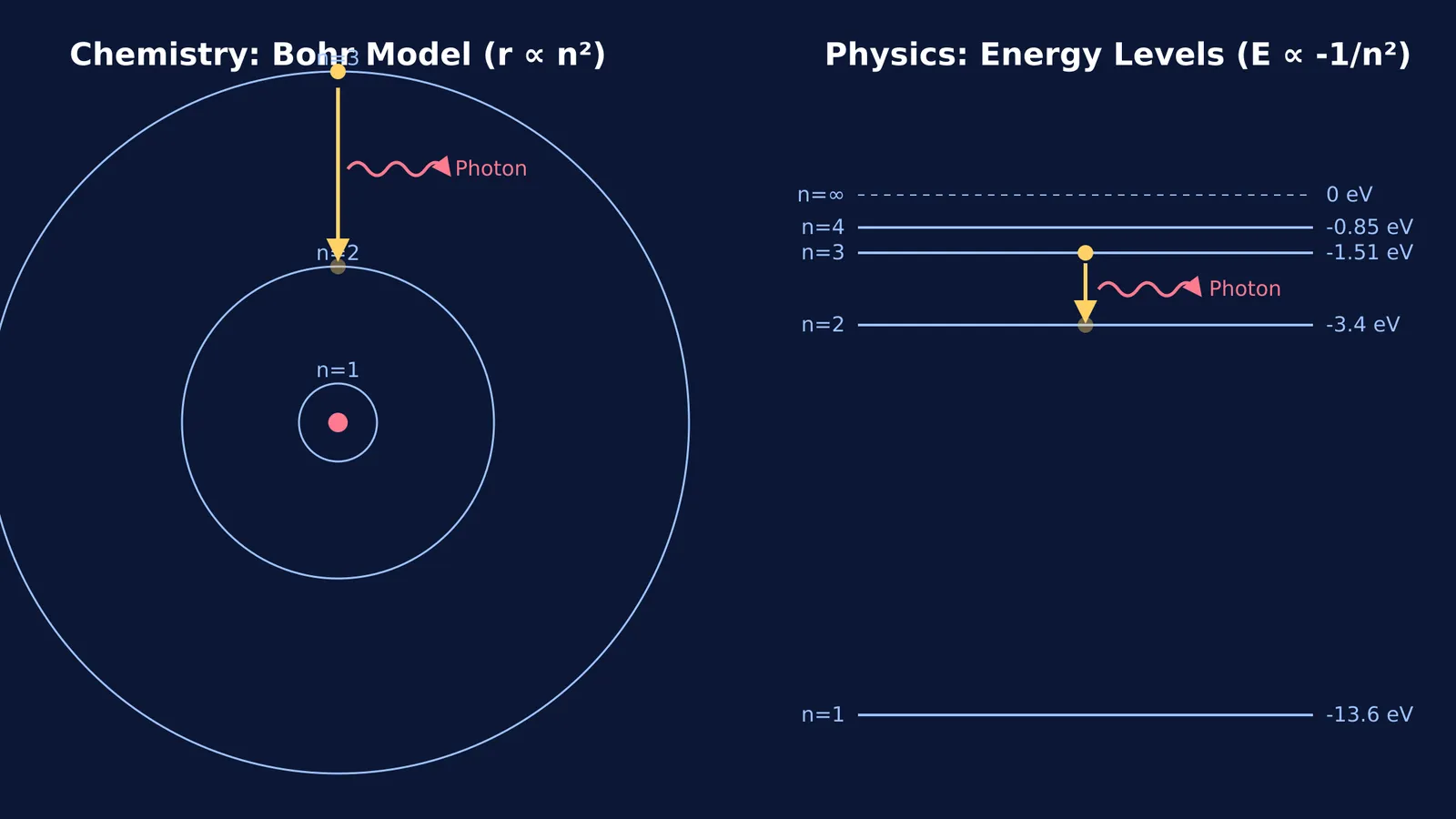
When you learn the Niels Bohr's atom model in chemistry, the focus is often on visualizing electron shells to explain chemical bonding, valency, and periodic trends. In physics, the focus completely shifts. Suddenly, you are solving hydrogen spectrum problems, calculating the wavelengths of emitted photons, and exploring the strict quantization of energy levels. Because the language, the diagrams, and the mathematical notation differ so drastically, your brain often stores them as two completely separate ideas.
Similarly, the transition from the Bohr model to the quantum mechanical model causes friction because the two fields emphasize different aspects of the atom. Chemistry uses the Bohr model's clearly defined shells to make sense of the periodic table, electronegativity, and ionic bonding. It is a highly practical visualization for building molecules. Physics demands mathematical precision regarding energy transitions, where electrons are not just orbiting, but changing states and emitting discrete photons of light. Without a guide to reconcile these perspectives, students often fail to realize that the chemistry model is an intentional simplification. They memorize the electron configurations for chemistry and the Rydberg formula for physics, missing the underlying unity of quantum mechanics that governs both.
This "silo" effect causes real trouble in exams because tests like JEE and NEET love to ask questions that cross these boundaries. For example, a 2007 study on thermodynamics education found that only about 6% of students could correctly answer qualitative questions about entropy before instruction. The researchers noted that students often incorrectly treat entropy as a conserved quantity because they carry over the strict "conservation of energy" mindset from physics into chemical thermodynamics. When the context changes, their intuition fails them.
How can you connect physics and chemistry topics with AI?
Instead of memorizing two different sets of rules and hoping you use the right one on exam day, you can use an AI tutor to actively translate between them. Research shows that directly comparing different frameworks is highly effective. A 2008 study found that when curriculums explicitly contrast atomic models—rather than teaching them in isolation—77% to 99% of students learn to correctly describe the modern quantum model. Explicitly mapping where models disagree is much faster than teaching them as separate chapters.
This is exactly where a responsive AI steps in. If you are confused by a physics problem because you are stubbornly applying a chemistry rule, Fermi's AI tutor works out what you already know and builds a plan for the session. Rather than just printing an answer and leaving you to figure out why your method failed, it teaches through the connection. It explains exactly where your chemistry intuition stops working for the physics problem and helps you pivot. You can also explore the Fermi Concept Library to see how a single idea, such as Gibbs energy and spontaneity, maps across both subjects in a unified way.
An AI tutor provides a unique advantage here because it is not bound by a strict syllabus. A human teacher in a crowded classroom might not have the time to backtrack and explain a concept from another subject. However, an AI tutor can instantly pull up the relevant diagrams, contrast the equations side-by-side, and highlight the specific point where your understanding diverges. It acts as an interdisciplinary translator. For example, if you are working on a physics problem about adiabatic expansion and you get stuck, the AI can relate the concept back to the kinetic theory of gases you already mastered in chemistry. It builds a bridge from your existing strong foundations to the new, challenging material.
How can you use a framework for interdisciplinary study?
The next time you encounter a concept in one subject that you have already seen in another, do not skip it assuming you already know it. Instead, use this three-step script with your AI tutor to firmly bridge the gap:
State your current mental model: "I learned the Bohr model in chemistry as electrons in planetary orbits to determine valency. How does this relate to the negative energy levels I am seeing in my physics textbook?"
Ask for the direct translation: "Can you show me the exact mathematical or conceptual differences between how chemistry and physics define work and heat in thermodynamics?"
Test the boundaries of your knowledge: "Give me a challenging problem that requires knowledge from both physics and chemistry to solve correctly."
Connecting the dots does take a little extra thought upfront. However, by actively asking where ideas meet, you will stop memorizing formulas twice. You will build a more resilient memory and start understanding how the universe actually works.


