

On this page
The mathematical formulas for the ionic product (often written as Q or Qsp) and the solubility product constant (Ksp) look exactly the same. For a simple salt like AgCl, both are calculated by multiplying the molar concentrations of the ions: [Ag⁺][Cl⁻].
However, they measure different things. The solubility product constant, Ksp, represents the maximum possible product of those ion concentrations when the solution is perfectly saturated and at equilibrium. The ionic product, Q, is the product of the ion concentrations at any given moment, whether the solution is at equilibrium or not. Understanding this distinction is similar to comparing Reaction quotient Q vs K: predicting which way a reaction moves.
What is the difference between ionic product and Ksp?
The formulas are identical, but Ksp applies only to saturated solutions at equilibrium, while Q applies to the solution at any point in time. Because Ksp marks the absolute limit of solubility, you can predict whether a solid will drop out of solution by comparing Q to Ksp.
How do you predict if a precipitate will form?
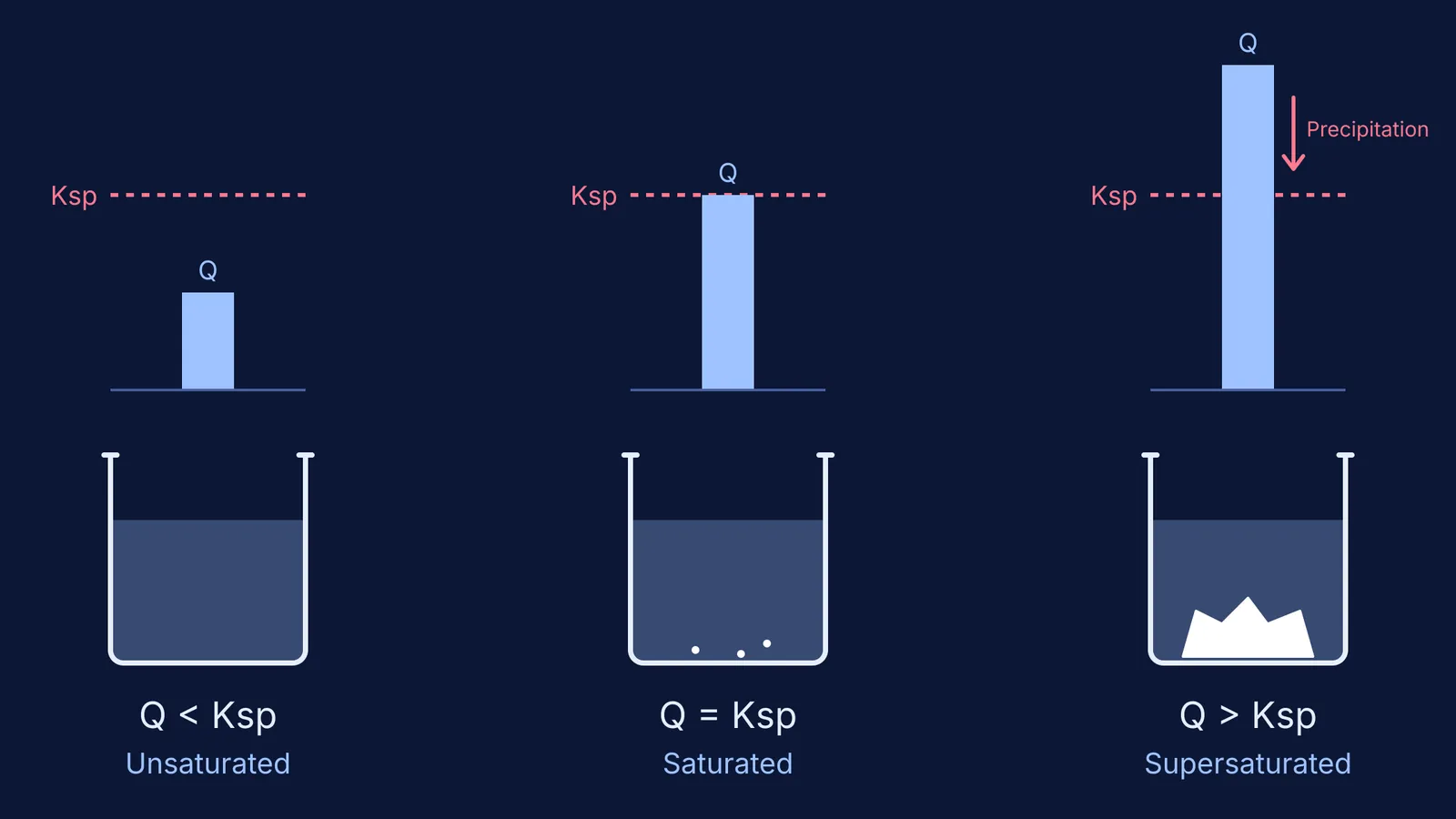
According to OpenStax Chemistry, there are three possible scenarios when you compare the current concentrations to the equilibrium limit:
Q < Ksp (Unsaturated): The solution can still dissolve more salt. If there is any solid present, it will dissolve. No precipitate forms.
Q = Ksp (Saturated): The solution is exactly at equilibrium. It is holding the maximum amount of dissolved ions possible without precipitating.
Q > Ksp (Supersaturated): The concentration of ions is too high for the water to hold. The reaction will shift in reverse, and a solid precipitate will form until the concentration of dissolved ions drops enough to make Q equal Ksp.
A worked example: mixing two solutions
A common exam trap involves mixing two separate solutions and asking if a precipitate will form. The trick is to remember that when you mix solutions, the total volume increases, which immediately dilutes the original concentrations before any reaction happens.
Suppose you mix 100 mL of 0.002 M silver nitrate (AgNO₃) with 100 mL of 0.002 M sodium chloride (NaCl). Will silver chloride (AgCl) precipitate? According to OpenStax Chemistry, the Ksp of AgCl is 1.6 × 10⁻¹⁰.
Calculate the new volume and concentrations. By combining 100 mL of each, the total volume becomes 200 mL. Because the volume has doubled, the concentration of each ion is halved.
[Ag⁺] = 0.001 M (or 1 × 10⁻³ M)
[Cl⁻] = 0.001 M (or 1 × 10⁻³ M)
Calculate the ionic product (Q). Multiply the new concentrations together.
Q = [Ag⁺][Cl⁻] = (1 × 10⁻³) × (1 × 10⁻³) = 1 × 10⁻⁶
Compare Q with Ksp.
Q = 1 × 10⁻⁶
Ksp = 1.6 × 10⁻¹⁰
Because 1 × 10⁻⁶ is much larger than 1.6 × 10⁻¹⁰, Q > Ksp. The solution is supersaturated, and a white precipitate of AgCl will form. This principle governs everything from laboratory tests to understanding Solubility product: Ksp, common ion effect and precipitation.
Testing your predictions
Reading about equilibrium is one thing, but seeing it play out reinforces the maths. The Fermi Simulation Lab provides interactive environments where you can adjust the molarities of different reacting solutions, watch the ionic product shift, and observe visually whether a solid drops out of the virtual solution.
If you are working through a homework set and repeatedly forget to account for volume changes when finding Q, Fermi's AI tutor will notice where you are getting stuck. Rather than just handing you the final Q value, the tutor will point out the missing dilution step and help you build a reliable plan for tackling precipitation problems.


