

On this page
Every day, power stations generate electricity that travels hundreds of kilometres across a vast network of cables to reach your home. But pushing electricity through a wire is not free. According to the U.S. Energy Information Administration, transmission and distribution losses averaged about 5% of the electricity transmitted between 2018 and 2022.
To keep this number from climbing even higher, the grid uses extremely high voltages, often stepping power up to hundreds of thousands of volts before sending it across the country. Understanding why is a classic physics problem, one you will encounter frequently if you are studying Class 10 electricity or preparing for competitive engineering and medical exams.
How do power lines work?
When electricity flows through a wire, the electrons constantly collide with the metallic atoms that make up the conductor. This natural resistance turns some of the electrical energy into heat. This is the exact same principle that makes a toaster or an electric room heater work. However, in a power line, it is purely wasted energy. Every joule of heat lost to the environment is a joule that the power station had to generate but cannot sell to a customer. You can explore the fundamentals of this phenomenon in our guide to the heating effect of current.
To find the power lost to heat (P_loss), we use the equation: P_loss = I²R
Here, I is the current flowing through the line, and R is the total resistance of the wire. Because the resistance of the cable is generally fixed by its material (like aluminium or copper) and its length across the landscape, the only viable way to reduce the heating loss is to reduce the current itself.
We also know that the total power P delivered by the station is given by the product of voltage and current: P = V × I
By rearranging this formula, we can see that the current is: I = P / V
Why do power lines use high voltage?
If we take our current equation and substitute it into the heating loss equation, we get a new and powerful view of the problem: P_loss = (P / V)² R = (P² R) / V²
This combined equation reveals that the heating loss is inversely proportional to the square of the transmission voltage. Because the voltage term is squared in the denominator, even a small increase in voltage will lead to a drastic reduction in the power lost to heating. The mathematics clearly shows that maximizing voltage is the most effective strategy for efficiency.
If you struggle to picture this invisible flow of energy and how changing one variable affects the others, the Fermi Simulation Lab has interactive simulations where you can adjust the transmission voltage yourself and watch the current and heat change in real time.
How much energy is saved by a ten-fold increase?
Let us put this to the test with some realistic numbers. We will predict how heating losses change if power is sent at a significantly higher voltage, then verify it step by step with the I²R formula.
Imagine a small town requires 1 megawatt (1,000,000 W) of continuous power to keep its homes, schools and hospitals running. The transmission lines connecting it to the local power station have a total resistance of 10 Ω. This resistance is due to the long distance the cables must cover.
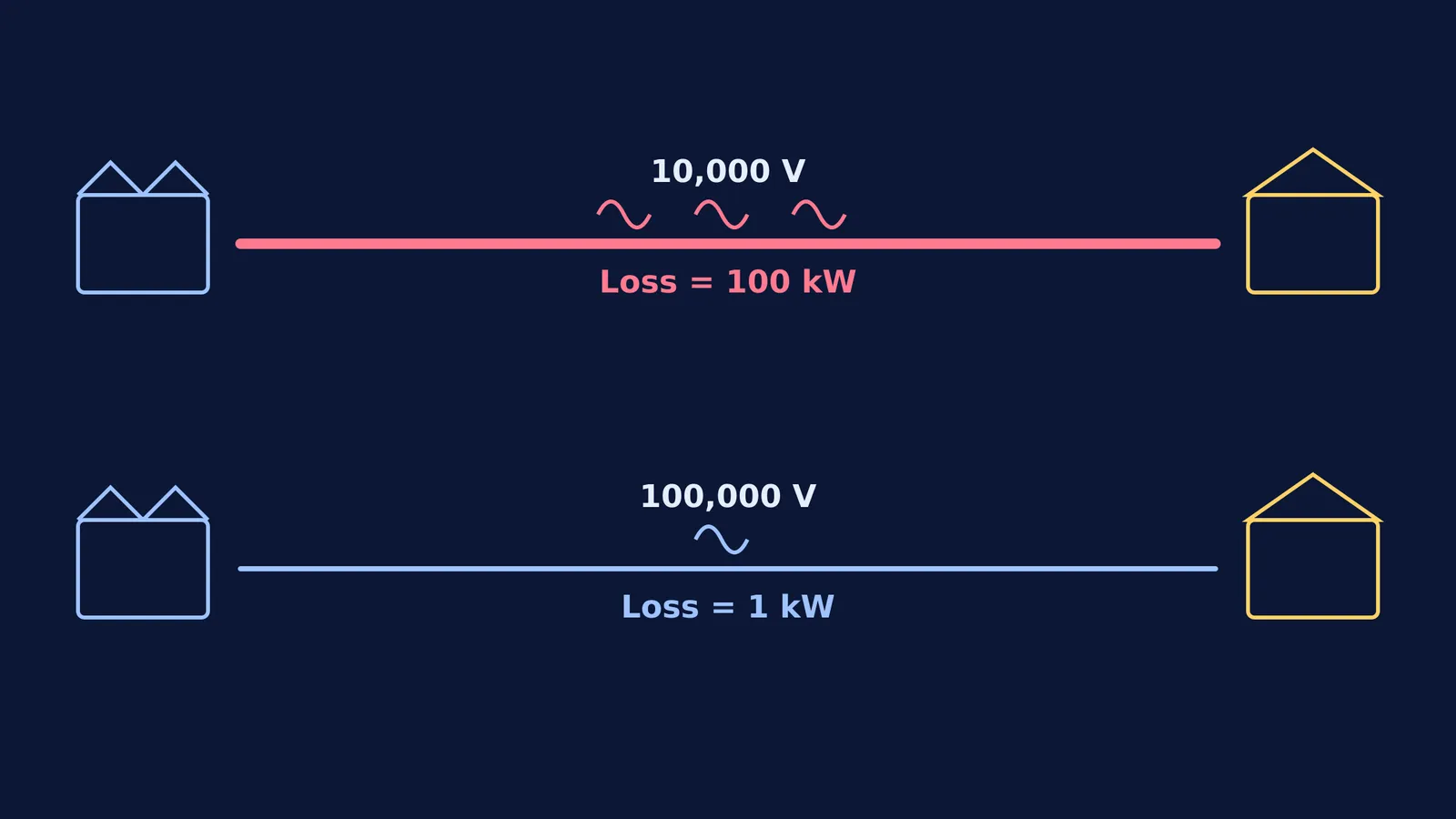
Case 1: Sending power at 10,000 V First, find the current needed to deliver the 1 MW of power: I = 1,000,000 W / 10,000 V = 100 A
Now, calculate the power lost to heating along the lines: P_loss = I²R = 100² × 10 = 10,000 × 10 = 100,000 W The loss is 100 kW. This means that a tenth of the generated power is entirely wasted warming up the air around the cables.
Case 2: Sending power at 100,000 V We have multiplied the transmission voltage by a factor of ten. Let us find the new current: I = 1,000,000 W / 100,000 V = 10 A
Calculate the new heating loss: P_loss = I²R = 10² × 10 = 100 × 10 = 1,000 W The loss drops to just 1 kW, or one-thousandth of the generated power.
By choosing to use a step-up transformer before transmission, the grid saves a massive amount of energy. When the power reaches the town, local step-down transformers reduce it back to a safer 230 V for household use.
How do grid operators manage the balance?
While higher voltages mean lower losses, they also introduce significant new engineering challenges. Managing extremely high voltages requires specialized infrastructure:
Much taller steel pylons to keep the live cables safely away from the ground, trees and buildings.
Significantly larger ceramic insulators to stop current leaking into the towers.
Specialized step-up and step-down transformers at both ends of the line.
Heavier safety regulations and wider cleared paths to prevent dangerous electrical arcing through the air.
Because of these factors, transmission voltages cannot be stepped up infinitely. Grid engineers must continually calculate the ideal balance between the immense upfront cost of building high-voltage infrastructure and the long-term cost of the energy that would otherwise be lost to the atmosphere over decades of operation.


