On this page
Imagine taking a full step, then half a step, then a third of a step, then a quarter. You are always taking steps forward, but your steps get vanishingly small with every move. Will you eventually stop making meaningful progress, or could you theoretically walk forever and reach the edge of the universe?
This mathematical thought experiment is known as the harmonic series. It is defined as the sum of all fractions with a numerator of one: 1 + 1/2 + 1/3 + 1/4 + 1/5 and so on. Because the terms you are adding get closer and closer to absolute zero, intuition strongly suggests the total must settle at some fixed limit.
Does the harmonic series converge?
When students first encounter the series, they often predict it will settle—perhaps around 2 or 3. It seems logical that adding ever-shrinking numbers should eventually stop making a difference. Unlike the geometric series 1/2 + 1/4 + 1/8 + …, which famously stops exactly at 1 (see our post on Zeno of Elea and the paradoxes of motion and infinity), the harmonic series diverges. It grows to infinity, albeit incredibly slowly. Zeno's runner taking half-steps reaches the finish line, but a runner taking harmonic steps would wander the cosmos forever.
How is the harmonic series divergence visualised?
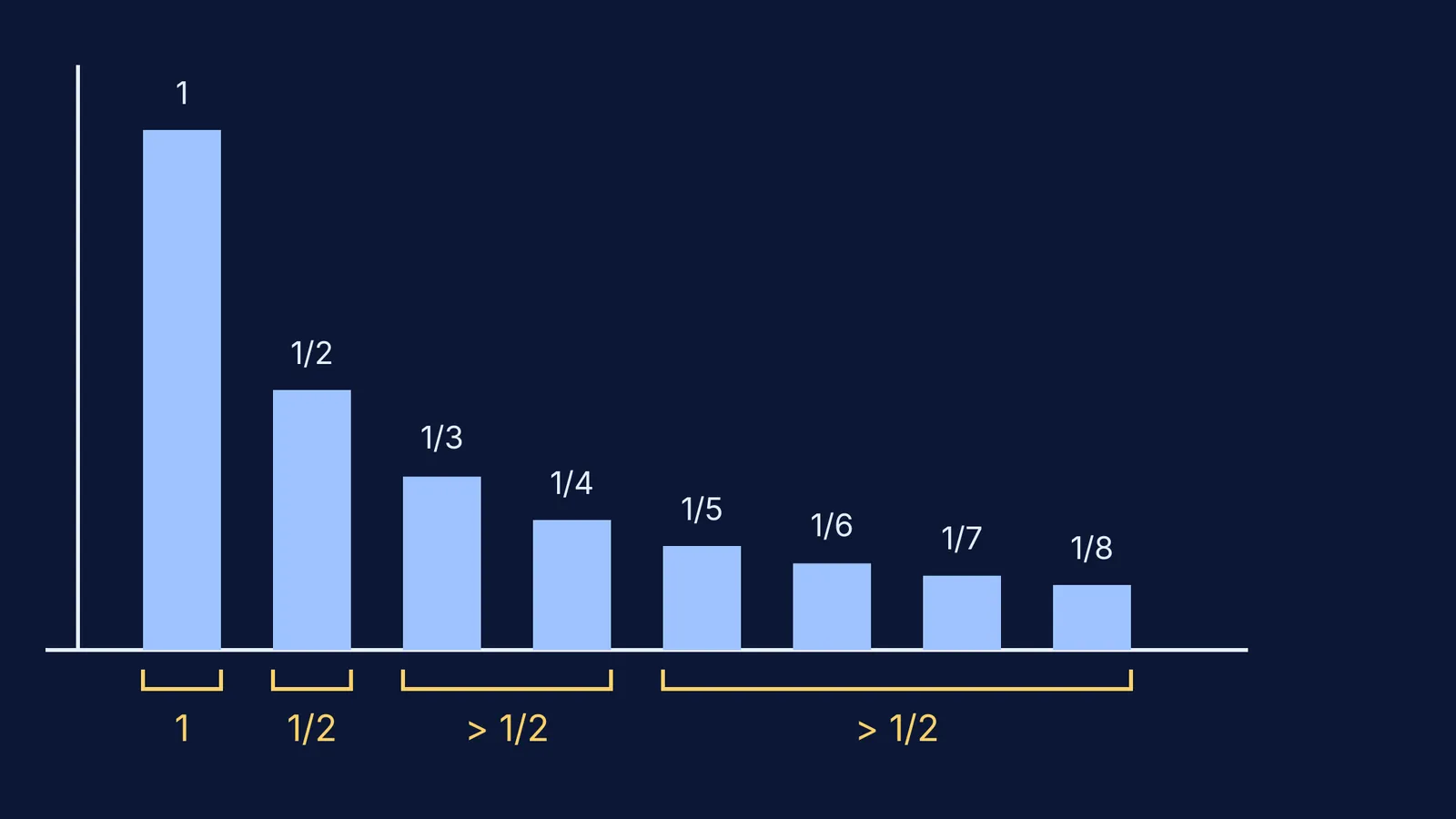
In around 1350, the French mathematician Nicole Oresme devised a brilliant, visual way to prove the series diverges (Wikipedia)). Instead of looking at individual fractions, he grouped them into blocks.
If you leave the 1 and the 1/2 alone, you can group the next two terms: (1/3 + 1/4). Because 1/3 is larger than 1/4, their sum must be strictly greater than 1/4 + 1/4, which is exactly 1/2.
Next, group the following four terms: (1/5 + 1/6 + 1/7 + 1/8). Every fraction in this block is greater than or equal to 1/8. So, the sum of these four terms is strictly greater than 4 × 1/8, which is again 1/2.
You can continue this pattern forever. By grouping eight terms, then sixteen terms, then thirty-two, you generate an endless sequence of blocks that each sum to more than 1/2. Since adding 1/2 infinitely many times results in infinity, the harmonic series must also reach infinity.
When you predict whether 1 + 1/2 + 1/3 + … settles to a number, then add terms in a simulation and see it creep upward forever, you are watching Oresme's proof in action. In the Fermi Simulation Lab, you can run this exact experiment. As the simulation adds thousands of terms, the curve never flattens out entirely.
If a student hits a mental block wondering why a sum of shrinking numbers doesn't stop, Fermi's AI tutor works out what they already know, builds a plan for the session, and teaches through it—drawing the grouping blocks on a board to help them see the pattern themselves.
How many terms does it take to reach 100?
If you calculate the first few sums manually, the growth appears to grind to a halt. It takes 11 terms to pass a sum of 3, and 83 terms to pass 5 (OEIS A002387). You might assume it will never reach 10, let alone larger numbers.
To cross a sum of 100, the number of terms required is almost beyond comprehension. In 1971, mathematicians R. P. Boas Jr. and J. W. Wrench Jr. published a paper calculating that it takes exactly 15,092,688,622,113,788,323,693,563,264,538,101,449,859,497 terms to exceed 100 (The American Mathematical Monthly).
To put this colossal 44-digit number into perspective, if a supercomputer could add one billion terms every single second, it would still take over 4.7 × 10²⁶ years to reach 100. The harmonic series eventually passes any number you can imagine, but it takes its time doing so.
A checklist for testing infinite series
When you meet an infinite series in calculus or JEE maths, you can test it systematically rather than relying on guesswork. Similar rules apply when solving problems like Sums like 9 + 99 + 999 + …:
The nth term test: Does the individual term shrink to zero? If it does not, the series diverges immediately. If it does shrink to zero (as 1/n does), you must test further.
The p-series test: A series of the form 1/n^p converges if p > 1, and diverges if p is 1 or less. For the harmonic series, p = 1, so it diverges.
The comparison test: Can you match the sequence to a series you already know? If your terms are larger than those of a known divergent series (as Oresme showed), your series diverges too.