

On this page
Type a haloalkane question into a chatbot and you will often get a confident product. The useful skill is making it show the decision, one clue at a time, and then checking that decision against your NCERT textbook.
What decides substitution or elimination, according to NCERT?
The NCERT Class 12 Chemistry chapter on haloalkanes and haloarenes describes it as a race. An alkyl halide with β-hydrogen atoms has two competing routes when it meets a base or nucleophile: substitution (SN1 or SN2) and elimination. Which route wins depends on the alkyl halide, the strength and size of the base or nucleophile, and the reaction conditions.
Its "Elimination versus substitution" box gives a pattern to test any AI answer against:
Primary halides prefer SN2.
Secondary halides go SN2 or elimination, depending on the strength of the base or nucleophile.
Tertiary halides go SN1 or elimination, depending on the stability of the carbocation or the more substituted alkene.
A bulkier nucleophile prefers to act as a base and pull off a proton.
The reagent and solvent clues sit elsewhere in the same chapter. Table 6.4 lists NaOH or KOH as giving an alcohol by substitution. The elimination section says that when a haloalkane with a β-hydrogen is heated with an alcoholic solution of potassium hydroxide, a β-hydrogen and the halogen are removed and an alkene forms. NCERT also notes that SN1 reactions are generally carried out in polar protic solvents such as water, alcohol or acetic acid.
One number shows why the substrate matters so much. NCERT's Figure 6.3 gives relative SN2 rates of 30 for a methyl halide, 1 for ethyl, 0.02 for isopropyl and 0 for tert-butyl, because bulky groups block the incoming nucleophile.
How do you ask an AI whether a haloalkane gives substitution or elimination?
Don't just ask for the answer. Send this script, one line at a time:
"Classify the haloalkane as primary, secondary or tertiary, and list its β-hydrogens."
"Is the reagent acting mainly as a nucleophile or as a base? Say why: aqueous or alcoholic, small or bulky."
"What do the solvent and the temperature tell you?"
"Now choose substitution or elimination, name the mechanism and give the major product. If more than one alkene is possible, apply Saytzeff's rule."
"For each step, tell me which NCERT idea supports it. Don't invent page numbers."
Separate steps let you mark the AI the way an examiner marks you: step by step.
Worked example: what does 2-bromopentane give?
Say you ask about 2-bromopentane heated with alcoholic KOH. A good answer runs like this:
Substrate: secondary, with β-hydrogens on C1 and C3. NCERT says secondary halides can go either way, so the reagent and conditions decide.
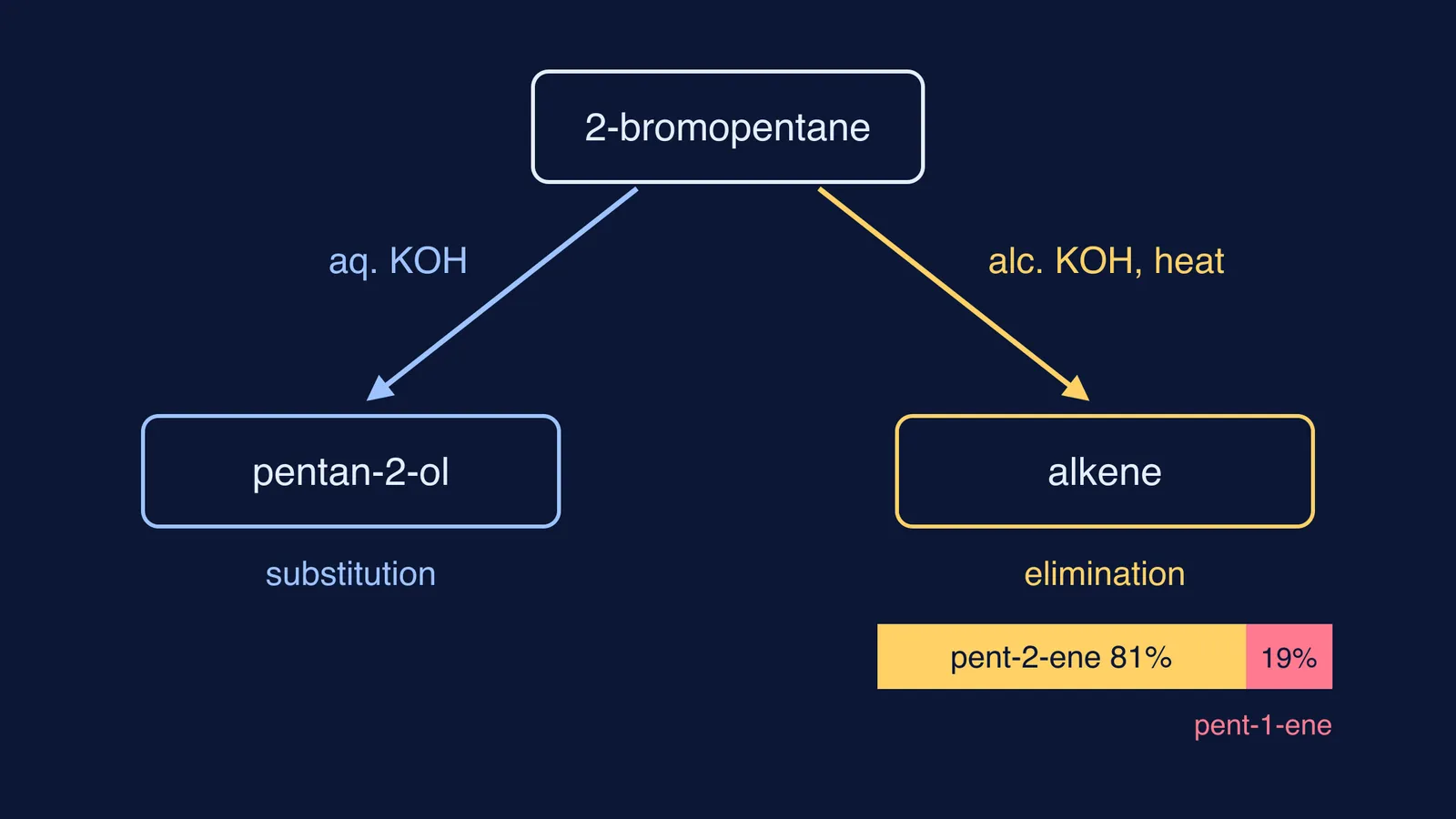
Reagent and conditions: alcoholic KOH with heat is NCERT's own description of β-elimination.
Product: two alkenes are possible. Zaitsev's rule (NCERT notes the name is also pronounced Saytzeff) says the preferred alkene has more alkyl groups on the doubly bonded carbons.
NCERT's own example shows 2-bromopentane giving pent-2-ene (81%) and pent-1-ene (19%).
Now change one word. With aqueous KOH, the textbook answer is substitution (Table 6.4 lists KOH as giving an alcohol), so expect pentan-2-ol as the main product. If the AI gives the same alkene for both versions, it has ignored the solvent. More in our explainer on aqueous vs alcoholic KOH with haloalkanes.
Try a third case: tert-butyl bromide with hydroxide ion. NCERT uses this as its SN1 example, giving tert-butyl alcohol through a carbocation. If the AI calls it SN2, ask it about Figure 6.3, where tert-butyl's relative SN2 rate is 0. See our guide to predicting SN1 vs SN2 in haloalkanes and the one on E1, E2 and Saytzeff's rule.
Why check an AI's chemistry against NCERT?
Because an AI can be strong on average and still slip on simple steps. In a 2025 study in Nature Chemistry, Adrian Mirza and colleagues built ChemBench, a set of more than 2,700 chemistry question-answer pairs, and found that the best models on average outperformed the best human chemists in their study. The same paper reports that the models struggled with some basic tasks and gave overconfident predictions.
Red flags to watch for:
It names a product before classifying the substrate.
It treats aqueous and alcoholic KOH as the same reagent.
It gives pent-1-ene as the major product from 2-bromopentane and alcoholic KOH, which contradicts NCERT's example.
This is the kind of back-and-forth Fermi's AI tutor is built for: it teaches rather than answers, holds a line of reasoning across a session, notices where you are stuck and decides whether to explain, ask or show. If you keep reaching the wrong product by the wrong route, the Fermi Problem Library has worked problems with a step-by-step solver that explains the reasoning rather than printing an answer.
Tonight, run the five-line script on three NCERT exercise questions and mark every step against the chapter.


