

On this page
Most students learn the fuse as one line: "it melts when the current is too high." A simulation makes you answer what that line hides: how high is too high, and why does a thicker fuse wire take so much more current to fail? Predict each answer before you read it.
How does a fuse protect a circuit?
The NCERT Class 10 chapter on electricity says the heat produced in a resistor is H = I²Rt, which is Joule's law of heating (NCERT Science Class 10, Chapter 11). Heat goes with the square of the current, so doubling the current gives four times the heat in the same wire.
The same chapter describes the fuse as a piece of wire, made of a metal or alloy of appropriate melting point, placed in series with the device. If a current larger than the specified value flows, the wire heats up, melts and breaks the circuit. NCERT lists domestic fuse ratings of 1 A, 2 A, 3 A, 5 A and 10 A. Its example is a 1 kW iron on 220 V, which draws 4.54 A and so needs a 5 A fuse.
The next chapter explains where large currents come from (NCERT Science Class 10, Chapter 12). Short-circuiting happens when the live and neutral wires come into direct contact and the current abruptly increases. Overloading can also happen when too many appliances are connected to a single socket.
Worked example: when does the fuse melt as you add load?
Set up a simulation like the one NCERT draws: a 220 V supply, a 5 A fuse, and sockets in parallel (NCERT Chapter 12). Every appliance you switch on adds its own current, I = P/V, and the fuse carries the total. Before each step, predict: holds or melts?
A 100 W lamp: 100/220 = 0.45 A. Total 0.45 A. Holds.
Add a 1000 W iron: 4.55 A more. Total 5.00 A. Right at the rating, which is why NCERT pairs a lone iron with a 5 A fuse. Holds.
Add a 60 W fan: 0.27 A more. Total 5.27 A. Over the rating, so by NCERT's rule it is too much. But the wire makes only slightly more heat than at 5 A, so it may take a long time to melt, or not melt at all.
Swap the fan for a 2 kW heater instead: 9.1 A more, total about 14 A. Melts quickly.
Compare the heating rates with H = I²Rt. At 5.27 A the fuse makes (5.27/5)² = 1.11 times the heat it makes at 5 A. At 14 A it makes (14/5)², about 7.8 times as much. The wire is always losing some heat to the air, so a small overload heats it slowly while a big fault melts it fast.
Why does a thicker fuse wire need a larger current to melt?
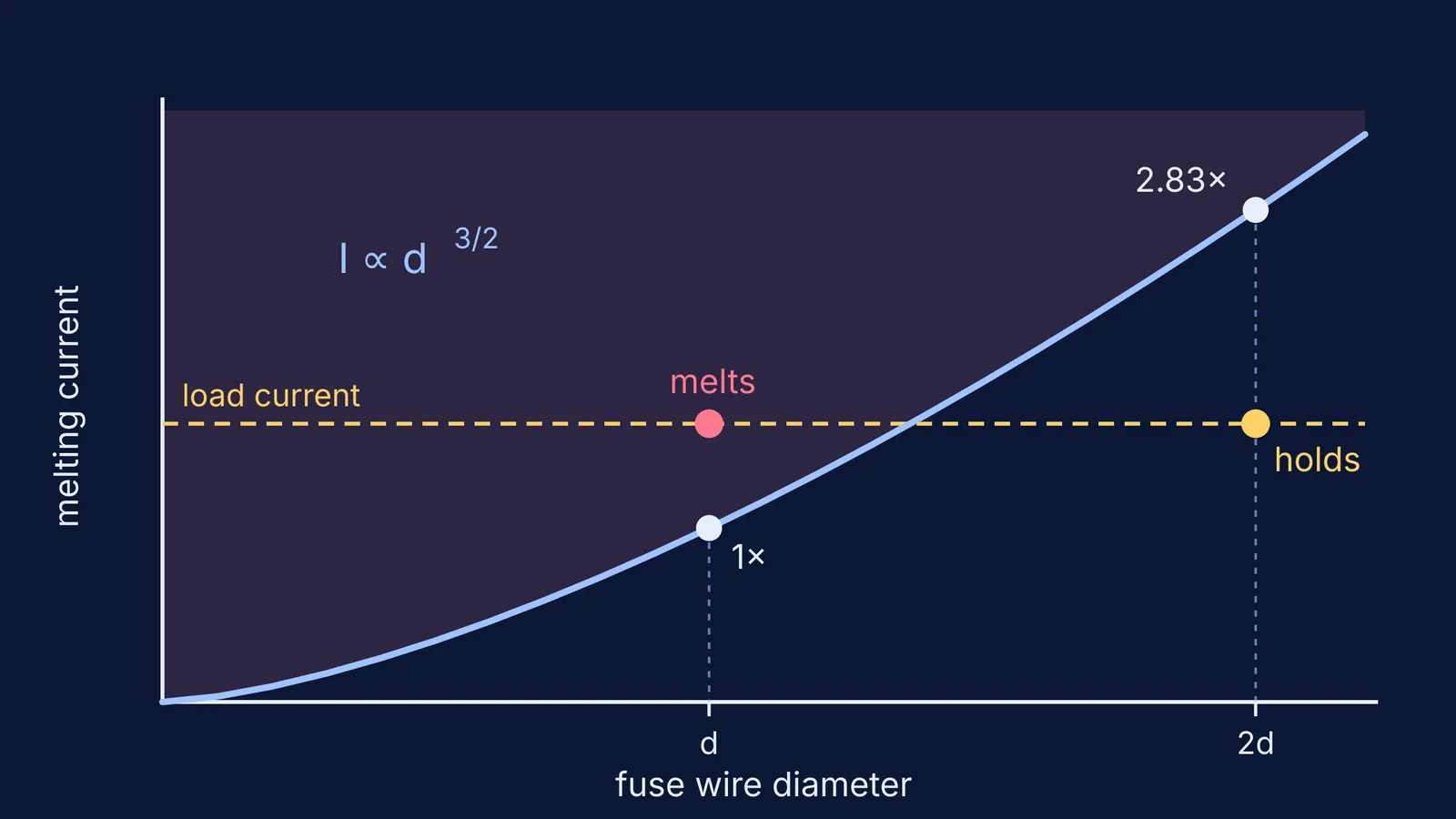
In the 1880s the engineer William Henry Preece studied the current needed to fuse a wire by balancing the I²R heat made inside it against the heat it loses through its surface (Preece, Proceedings of the Royal Society of London, vol. 36). Slides by Adrian Bevan of Queen Mary University of London set out the result: the fusing current is proportional to d^(3/2), where d is the wire's diameter (Adrian Bevan, Wire fusing, QMUL). The same slides warn that it holds for long wires in free air, not for short or potted ones. Household fuse wire is usually encased in a porcelain cartridge (NCERT Chapter 11), so treat the law as a guide to the trend, not an exact rating.
Where does the 3/2 come from?
Resistance per metre goes as 1/d², because resistance depends inversely on the area of cross-section. So heat made per metre goes as I²/d².
Heat lost per metre goes with the surface area, which grows as d.
The wire reaches its melting temperature when heat made balances heat lost at that temperature: I²/d² ∝ d, so I² ∝ d³ and I ∝ d^(3/2). Double the diameter and the melting current rises by 2^1.5, about 2.83 times.
What should you try in a simulation?
Predict the total current before every switch-on, then check.
Double the fuse diameter and predict the new melting current from d^(3/2) before you run it.
Compare a slow overload with a short circuit and see how long the fuse lasts in each.
The Fermi Simulation Lab has interactive simulations for ideas that are easier to see than to read. Review the formulas in our guide to the heating effect of current, power and fuses, then test yourself on five DC circuit misconceptions in a simulation.
One caution: never test any of this on mains wiring. Leave household fuses and repairs to a licensed electrician.


