

On this page
Heat two mixed liquids under a fractionating column and the thermometer at the top climbs, holds steady, then climbs and holds again. That staircase is the whole story of fractional distillation, and a simulation lets you predict each step first.
How does fractional distillation separate liquids?
When a mixture boils, the vapour has more of the liquid with the lower boiling point in it. Raoult's law explains why: in an ideal mixture, each liquid's partial pressure equals its pure vapour pressure multiplied by its mole fraction. The more volatile liquid pushes harder into the vapour, so the vapour ends up richer in it.
One boil-and-condense step only partly enriches the vapour. In a fractionating column, a tall packed tube, the vapour condenses and re-boils many times on its way up. Each vaporisation-condensation cycle is called a theoretical plate, and each one leaves the distillate richer in the lower-boiling component, as the LibreTexts organic lab techniques guide/05%3A_Distillation/5.03%3A_Fractional_Distillation) explains. The same guide says you need a fractionating column when the two boiling points are less than 100 °C apart.
For the maths, our post on Raoult's law for ideal and non-ideal liquid mixtures works through it.
Which fraction collects first?
Take a mixture with equal moles of cyclohexane and toluene. The NIST Chemistry WebBook lists cyclohexane's boiling point as 353.9 K (about 81 °C), and toluene's as 383.8 K (about 111 °C). So the prediction is that cyclohexane, the lower-boiling liquid, collects first.
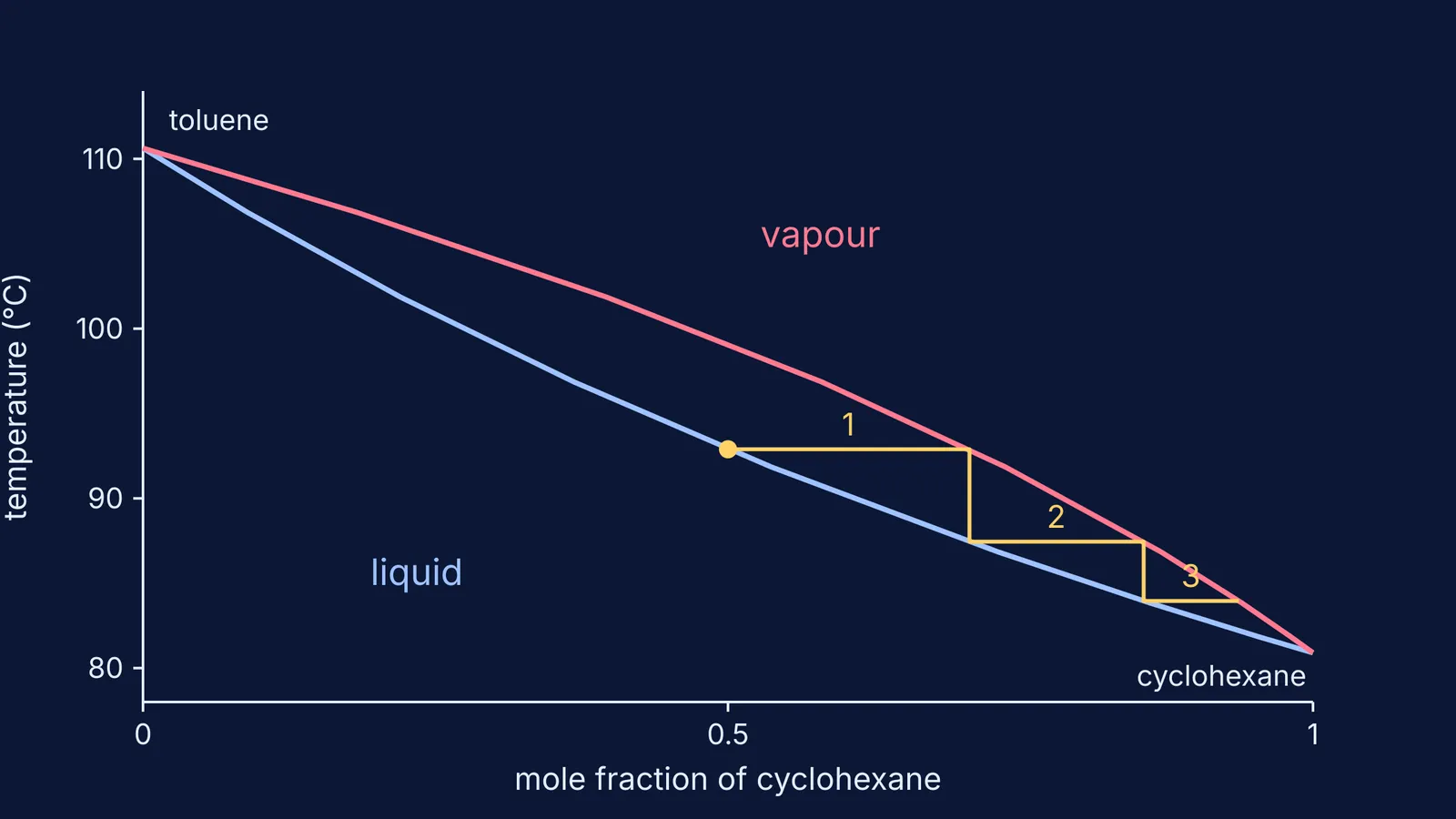
How fast does the column purify it? We calculated it at 1 atm from Raoult's law and the Antoine constants on those NIST pages, treating the mixture as ideal:
The 50:50 liquid starts to boil near 93 °C, and its vapour is about 71% cyclohexane.
Plate two: that vapour condenses and boils again near 87 °C, and the new vapour is about 86% cyclohexane.
Plate three: it boils near 84 °C, and the vapour is about 94% cyclohexane.
In three plates you go from half and half to nearly pure. That fits the rule of thumb in LibreTexts' theory of fractional distillation/05%3A_Distillation/5.03%3A_Fractional_Distillation/5.3A%3A_Theory_of_Fractional_Distillation): a 50:50 mixture of two liquids whose boiling points are 20-30 °C apart needs at least three theoretical plates to give a distillate more than 95% pure. Our numbers land just short of that line, which is why taller columns matter.
Why does the thermometer reading plateau between fractions?
The thermometer bulb sits at the top of the column, where vapour leaves for the condenser. It measures whatever is condensing there, not the flask. As long as the column sends up nearly pure cyclohexane, the reading stays close to cyclohexane's boiling point. A University of Pittsburgh lab guide to fractional distillation puts it this way: "Each plateau indicates the boiling point of a component."
The flask slowly gets hotter as it loses cyclohexane, but too little toluene reaches the top yet to change what condenses there. Once the cyclohexane runs low, the reading climbs while a mixture distils, then settles on a second plateau near toluene's boiling point. That climb is your signal to swap the collecting flask: whatever comes over between the plateaus is an intermediate fraction containing both liquids.
The Pittsburgh guide adds that, once the first liquid has distilled, the reading can fall until vapour of the second liquid reaches the bulb. If you've read temperature-time graphs during heating, you'll recognise the flat-then-rise shape, but here composition sets the temperature, not a single substance melting or boiling.
When does fractional distillation fail?
Some mixtures form an azeotrope, where the boiling liquid and its vapour have the same composition. Wikipedia's azeotrope article gives the ethanol-water azeotrope as 95.63% ethanol and 4.37% water by mass, boiling at 78.2 °C. That is below either pure liquid: the NIST WebBook gives pure ethanol's boiling point as 351.5 K, about 78.4 °C. Once a mixture reaches the azeotrope, no column, however tall, separates it further by distillation.
How should you run a distillation simulation?
Some ideas are easier to see than to read. The Fermi Simulation Lab has interactive simulations for those, and this plan works with any distillation simulation:
Choose two liquids, look up both boiling points and predict the first fraction.
Sketch the graph of temperature against volume collected, plateaus included, before you start.
Run it with a short column, then a tall one, and see how much sharper the step between plateaus gets.
Mark where you would swap flasks, and say what is in each one.
Repeat with ethanol and water, and explain why the first plateau sits at the azeotrope's temperature rather than pure ethanol's.
If Raoult's law itself feels shaky, the Fermi Concept Library gives each chemistry concept its own lesson. To see how screen-based labs compare with real glassware, read our summary of research on virtual chemistry labs versus hands-on practicals.
Pick one mixture tonight and write your prediction down first.


