

On this page
The "Excretory Products and their Elimination" chapter introduces one of the most intricate structures in human physiology: the nephron. Memorising the functions of the proximal convoluted tubule, Loop of Henle, and distal convoluted tubule from a textbook can feel like reading a parts list.
But human excretion is a dynamic, continuous process. Normally, over 150 liters of fluid enter the glomeruli of an adult every day, and 99% of the water in that filtrate is reabsorbed. To truly understand how this happens, you need to trace the filtrate's journey actively, following the fluid as its composition changes from the cortex deep into the medulla.
Why active learning beats passive reading?
Reading about the nephron is a passive activity. You might follow the text on a page without absorbing the underlying logic of why water leaves one tubule and sodium leaves another. Actively tracing a drop of filtrate as it moves through the tubules forces you to think about permeability, concentration gradients, and active transport at every turn.
This active approach is measurably better for complex science topics. A comprehensive 2014 study on STEM education found that failure rates under traditional lecturing increase by 55% over the rates observed under active learning, while active learning increased average examination scores by about 6%. By puzzling through the mechanism yourself, you build a mental model that lasts until the exam and beyond, preparing you for the application-based questions seen in competitive exams.
How to trace the nephron with an AI tutor?
Instead of rereading the chapter when you have doubts, you can use an AI to guide an active revision session. A good AI tutor will not just hand you a summary paragraph; it will prompt you to work out what happens at each stage of urine formation.
Here is how you can step through the nephron:
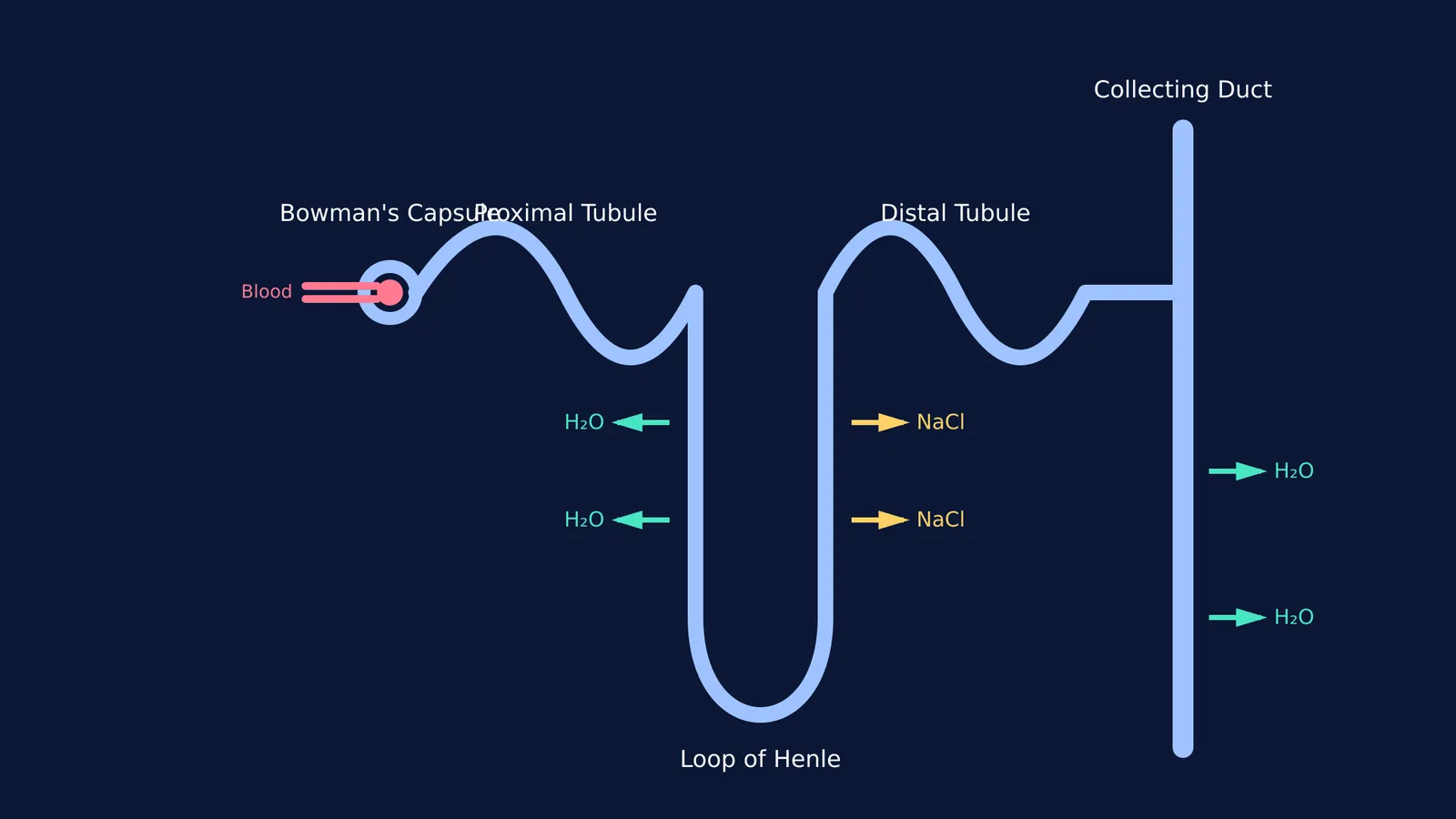
Bowman's Capsule: The journey begins with ultrafiltration. Ask the tutor why proteins and red blood cells are left behind in the blood while smaller molecules pass through. You will have to recall the size of fenestrations in the endothelial cells and the filtering slits formed by podocytes.
Proximal Convoluted Tubule (PCT): This is the heavy lifter of the nephron. You can tell the tutor that most nutrients and water are reabsorbed here, and let it test you on the specific ions that follow. It can check your understanding of how the active transport of sodium from the tubule cells into the interstitial fluid drives the secondary active transport of glucose and amino acids.
Loop of Henle: This is where the concentration gradient of the medullary interstitium is built and maintained. The descending limb is permeable to water but not electrolytes, while the ascending limb is exactly the opposite. If you get confused here, Fermi's AI tutor can hold the line of reasoning, checking your understanding of how water leaves the descending limb before moving on to the ascending limb. It can walk you through the countercurrent multiplier mechanism step by step, asking you what happens to the osmolarity of the filtrate as it travels down into the medulla and back up toward the cortex.
Distal Convoluted Tubule (DCT) and Collecting Duct: Finally, conditional reabsorption of sodium and water takes place. You can discuss with the tutor how hormones adjust this final stage based on the body's hydration levels. Exploring the specific roles of anti-diuretic hormone (ADH) and aldosterone ensures you grasp how the kidneys respond to physiological stress and blood pressure changes.
Does the logic match the standard textbook diagram?
Once you have traced the entire path and cleared your doubts, open your textbook and look at the standard diagram of the nephron. The arrows showing water leaving the descending limb and sodium chloride leaving the ascending limb will no longer be random lines to memorise. They will perfectly match the logical sequence you just worked out, making it much easier to reproduce the diagram during a test.
If you are studying for medical entrances, connecting the nephron's function to the rest of the body is the crucial next step. You might explore why waste differs across species based on their habitats, or review the formed elements of blood that remain in the glomerular capillaries during ultrafiltration. Tracing these biological mechanisms yourself ensures you actually understand the physiology, rather than just remembering the labels for an exam.


