

On this page
When you ask an AI chatbot for "sources of error in simple pendulum practical," it usually hands you textbook platitudes: air resistance, friction at the support, and string stretching. While these factors exist, reciting them in your notebook or viva examination is dangerous. An external examiner will ask: "Did air drag cause 0.1% error or 10%?" A generic chatbot answer cannot tell you, because it has never seen your bench.
A 2023 study by Stanford and Auburn researchers published on arXiv evaluated GPT-4 across 40 college physics problems. While the model solved 62.5% of well-specified problems where every parameter was given, its accuracy plunged to 8.3% on under-specified, real-world problems where physical assumptions had to be inferred. The researchers identified three core failure modes: incorrect physical modeling, implausible assumptions about missing data, and calculation mistakes. In a physics lab, every experiment is an under-specified problem until you feed the AI your apparatus constraints.
How do you prompt AI with your exact laboratory setup?
The international standard for experimental science, the BIPM Guide to the Expression of Uncertainty in Measurement (JCGM 100:2008), separates uncertainties into two groups: Type A evaluations from repeated trials, and Type B evaluations from instrument resolution and calibration limits.
To get accurate error analysis, supply both types of data in a four-part prompt:
1. The governing formula: State the equation, such as g = 4π²L / T².
2. Instrument least counts: State each tool's resolution (for example, metre scale least count = 0.1 cm, stopwatch least count = 0.01 s).
3. Raw data: Provide measured lengths, bob dimensions, and recorded times across every trial.
4. Output required: Ask the AI to derive the maximum fractional error formula, compute each term's percentage contribution, and identify which measurement dominates total uncertainty.
This is where Fermi's AI tutor changes the dynamic: rather than outputting a static answer, it holds a line of reasoning across the session, notices where you are stuck, and checks your understanding as it walks through each term.
How do you verify an AI tutor's error calculations?
Because language models generate text by predicting probable tokens rather than running deterministic mathematics, you must verify every numerical step against your apparatus, following standard procedures like the BIPM GUM.
Consider a Class 11 pendulum experiment measuring the acceleration due to gravity, g. Suppose you measure effective length L = 0.900 m with a metre scale whose least count is ΔL = 0.001 m. The fractional error in length is ΔL / L = 0.001 / 0.900 ≈ 0.0011, or 0.11%.
Now consider timing. You measure 20 oscillations at t = 38.0 s. Your stopwatch reads to 0.01 s, but human reaction time introduces an uncertainty of roughly Δt ≈ 0.20 s. Because period T = t / 20 = 1.90 s, the uncertainty in one period is ΔT = Δt / 20 = 0.01 s. The fractional error in period is ΔT / T = 0.01 / 1.90 ≈ 0.0053, or 0.53%.
Propagating these into g = 4π²L / T², the exponent on T doubles its relative contribution: Δg / g = (ΔL / L) + 2(ΔT / T) = 0.11% + 2(0.53%) = 1.17%.
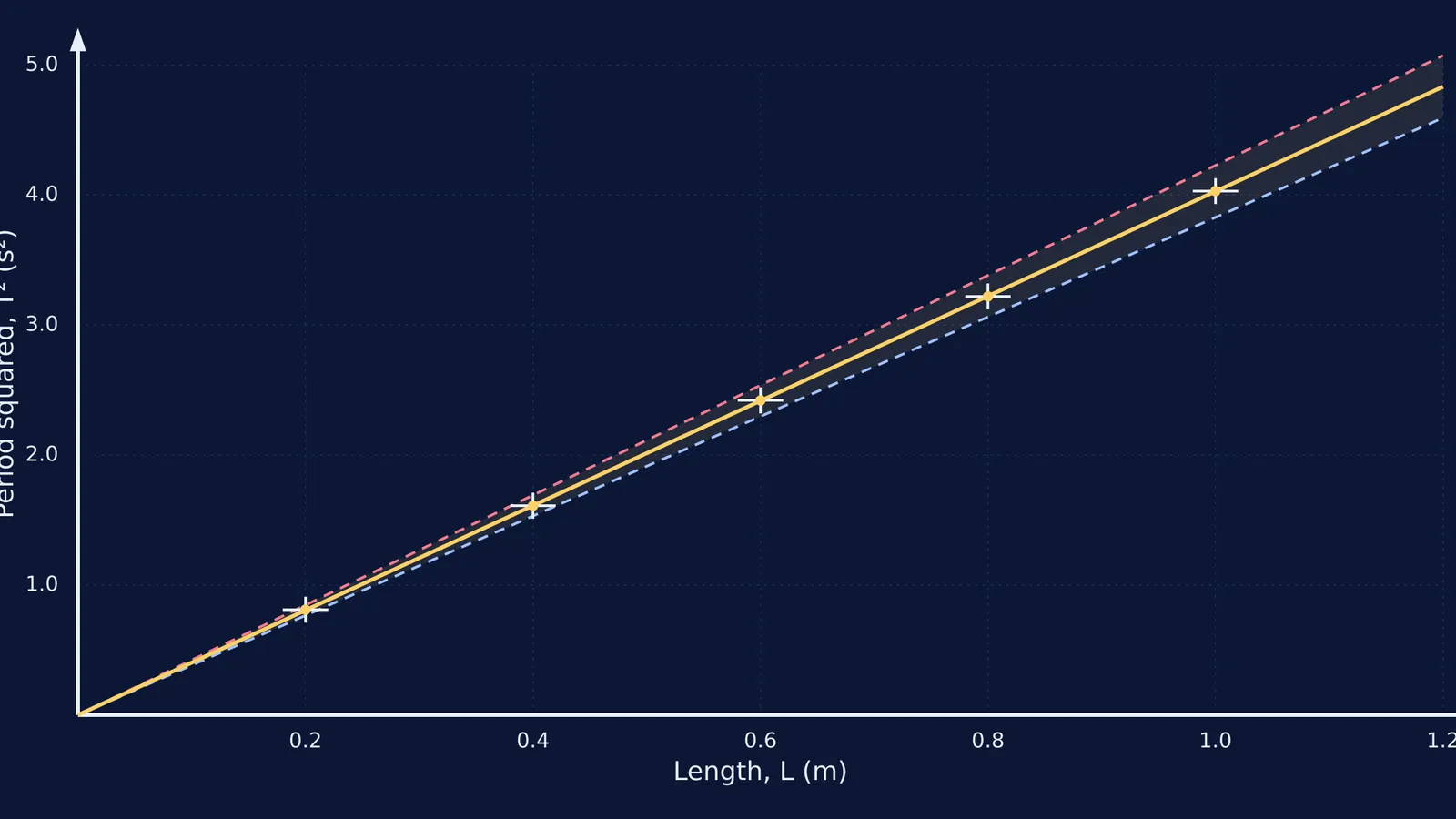
When checking the AI's derivation, watch for three classic traps. First, verify that the AI added relative errors rather than subtracting them; division in a formula still requires adding uncertainties. Second, confirm that the exponent of 2 was multiplied, not omitted. Third, check that reaction time was divided by the number of oscillations; timing 20 swings cuts period uncertainty by a factor of 20. For compounding rules, see our guide to combining absolute and percentage errors. For graphical error analysis, see measuring g with a simple pendulum.
What sources of error actually matter in your viva?
When facing external examiners in CBSE Class 12 physics practicals and viva, examiners test whether you understand what limited your precision.
Physics education research shows that learning to critique measurements transforms scientific understanding. In a landmark study published in *PNAS*, researchers N. G. Holmes, Carl Wieman, and D. A. Bonn tested students taught iterative cycles of quantitative comparison using uncertainties. Experimental students were 12 times more likely to spontaneously propose improvements to their methods and 4 times more likely to explain physical model limitations using their data. Over 50% sustained these inquiry habits into subsequent courses, compared to near 0% under traditional instruction.
In our pendulum example, timing uncertainty contributed 1.06% out of the 1.17% total error—nearly ten times more than the metre scale's 0.11%. Claiming that air resistance or scale reading was your main limitation proves you did not compute your errors. Furthermore, forgetting to add the bob's radius to thread length introduces an offset of roughly 1.0 cm on a 90 cm string—over 1.1% systematic error, which swamps the scale's 0.11% least count.
To build this depth before practical exams, the Fermi Problem Library provides worked problems with a step-by-step solver that explains the reasoning rather than printing an answer, helping you trace where approximations apply. When you use AI as a sparring partner to test your experimental numbers rather than a shortcut for lab write-ups, you walk into your practical exam knowing exactly what your apparatus proved.


