

On this page
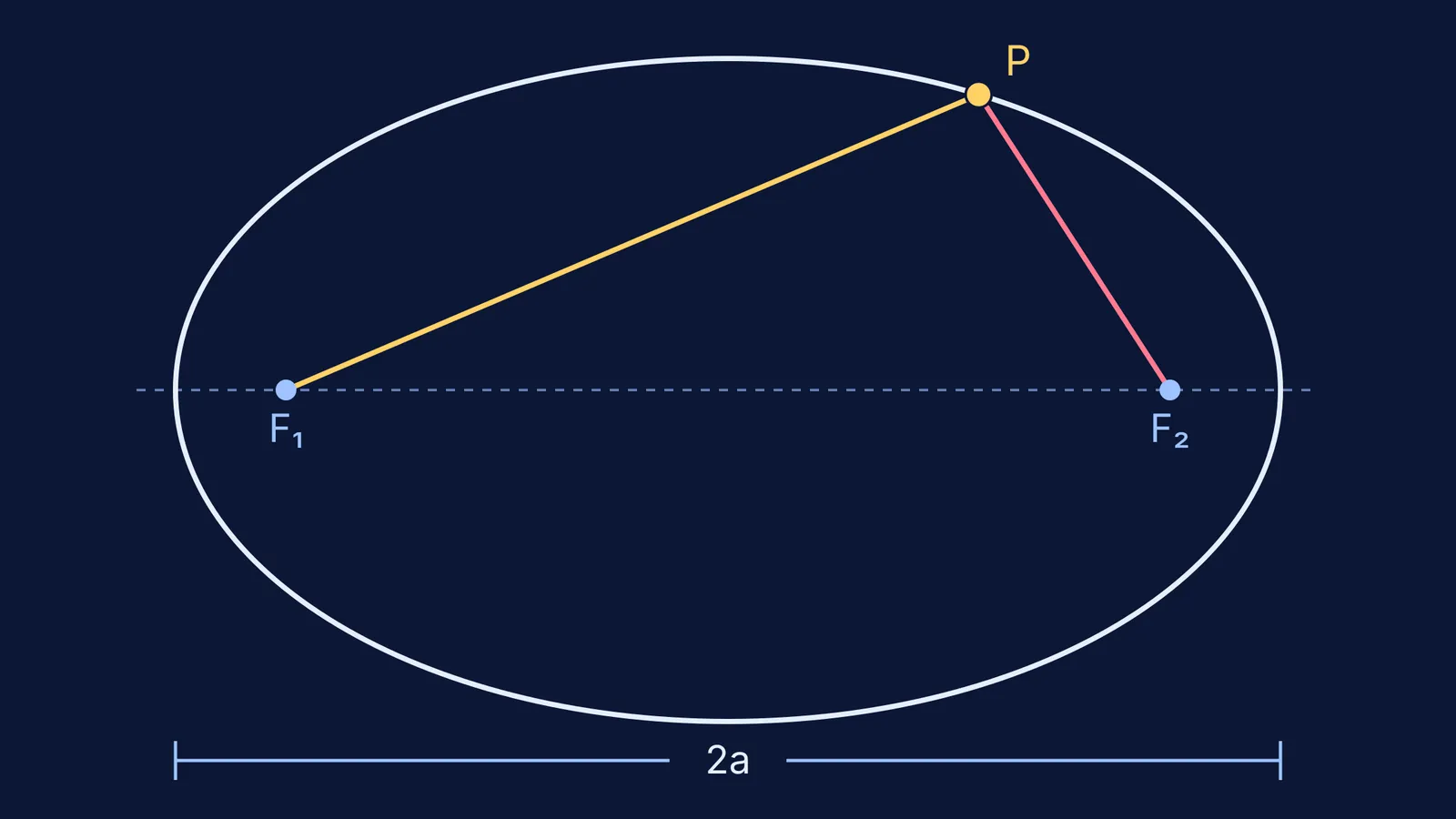
Add a point's distances to the two foci of an ellipse. Move the point and repeat: one distance grows, the other shrinks, and the total stays the same. Test it, then predict what happens when the foci are pulled apart.
What does "sum of distances from the foci" mean?
NCERT's Class 11 textbook defines an ellipse as the set of all points in a plane whose distances from two fixed points add up to a constant (NCERT Mathematics Class 11, Chapter 10: Conic Sections). The two fixed points are the foci. The chapter calls the length of the major axis 2a, the minor axis 2b and the distance between the foci 2c, and shows that the constant sum is 2a.
To see why, put the point at one end of the major axis. It is a − c from the near focus and a + c from the far one, so the total is 2a. At the end of the minor axis, each distance is √(b² + c²), and setting their sum equal to 2a gives the chapter's relation a² = b² + c².
For the algebra that proves this for every point, see focal distances on an ellipse: why PS + PS′ = 2a.
How do you check PF1 + PF2 = 2a yourself?
Start without a screen. Tie a string between two pins in cardboard, hold it tight with a pencil and trace round. The string's length is the sum of the two distances, so you draw an ellipse with 2a equal to that length.
Then check it with numbers. Take x²/25 + y²/9 = 1:
Here a = 5 and b = 3, so c = √(25 − 9) = 4. The foci are F1 = (−4, 0) and F2 = (4, 0).
Pick P = (3, 2.4). It is on the curve, because 9/25 + 5.76/9 = 0.36 + 0.64 = 1.
PF1 = √(7² + 2.4²) = √54.76 = 7.4.
PF2 = √(1² + 2.4²) = √6.76 = 2.6.
PF1 + PF2 = 10, which is 2a.
Try two more points: (0, 3) gives 5 + 5, and (5, 0) gives 9 + 1. The split changes; the total doesn't.
To make it interactive, plot P = (5 cos t, 3 sin t) in a graphing tool with a slider and show the sum of the two distances. As you drag t, PF1 swings between 1 and 9, PF2 does the opposite, and the sum stays at 10. For slider tips, see using graphing tools to learn functions.
What happens to the ellipse as the foci move apart?
Keep the string length 2a fixed and move the pins. Predict each case before you draw it:
Both pins in the same spot (c = 0). You get a circle of radius a.
Pins at c = 0.6a. Since b = √(a² − c²) = 0.8a, it is still fairly round.
Pins at c = 0.8a. Now b = 0.6a, as in the worked example.
Pins almost 2a apart (c close to a). b shrinks towards 0; the ellipse flattens towards the segment joining the foci.
NCERT notes that the constant sum is always greater than the distance between the foci, so 2a > 2c (NCERT Conic Sections). Case 4 shows why: with the pins 2a apart, the string has no slack left for a curve.
What does eccentricity measure?
NCERT defines the eccentricity of an ellipse as e = c/a, the distance from the centre to a focus divided by the distance from the centre to a vertex (NCERT Conic Sections). Because c is less than a, e lies between 0 (a circle) and 1. From a² = b² + c² you also get b/a = √(1 − e²).
That formula holds a surprise: the outline flattens slowly. At e = 0.5, b is still about 0.87a, while the foci are already halfway to the ends. NASA's Planetary Fact Sheet lists Earth's orbital eccentricity as 0.017 and Mercury's as 0.206 (NASA Planetary Fact Sheet). For Earth, b/a is about 0.9999, so a page-sized drawing of its orbit looks like a circle. Mercury's b/a is about 0.98, which still looks round, yet the Sun at its focus sits about a fifth of the semi-major axis from the centre.
For exam-style work on eccentricity, tangents and the auxiliary circle, see Ellipse for JEE.
Why predict before you drag?
In a 2004 study of physics classroom demonstrations, Catherine Crouch, Eric Mazur and colleagues found that students who passively watched understood the underlying concepts no better than students who never saw the demonstration. Students who predicted the outcome before seeing it showed significantly greater understanding (Crouch et al., 2004). So before you drag the slider, write down your guess for the shape at e = 0, 0.5 and 0.9.
The Fermi Simulation Lab has interactive simulations for ideas that are easier to see than to read. If the link between a, b and c still feels shaky, the Fermi Concept Library gives each concept its own lesson.
Next step: draw an ellipse with string, measure 2a with a ruler, and check three points.


