

On this page
When you immerse two electrodes in a blue copper sulfate bath and switch on the power, reddish-brown copper immediately plates the cathode. In school labs and exams like JEE and NEET-UG, electroplating questions often pose a simple prediction: if you double the current, how much more copper deposits? What if you double the time instead?
Many students assume higher current drives deposition more aggressively than time. In a landmark paper in *Science*, Wieman, Adams, and Perkins (2008) demonstrated that interactive simulations help learners build accurate mental models of invisible physical phenomena before tackling formal equations.
What is Faraday's first law of electrolysis?
Michael Faraday established in the 1830s that the mass of substance deposited at an electrode is directly proportional to the total electric charge passed through the electrolyte. Electric charge in coulombs equals current in amperes multiplied by time in seconds (Q = I × t), as explained in Chemistry LibreTexts/20%3A_Electrochemistry/20.09%3A_Electrolysis).
At the cathode, cupric ions gain two electrons to form neutral copper: Cu²⁺(aq) + 2e⁻ → Cu(s). Depositing one mole of copper atoms requires two moles of electrons.
According to 2022 CODATA values from the National Institute of Standards and Technology, the Faraday constant F is 96485.33 coulombs per mole of electrons. With copper's atomic weight at 63.546 grams per mole from the Commission on Isotopic Abundances and Atomic Weights, the mass formula is m = (I × t × M) / (2 × F). See how this reaction works in industrial tanks in our guide to the electrolytic refining of copper, or review multi-cell setups in Faraday's laws of electrolysis.
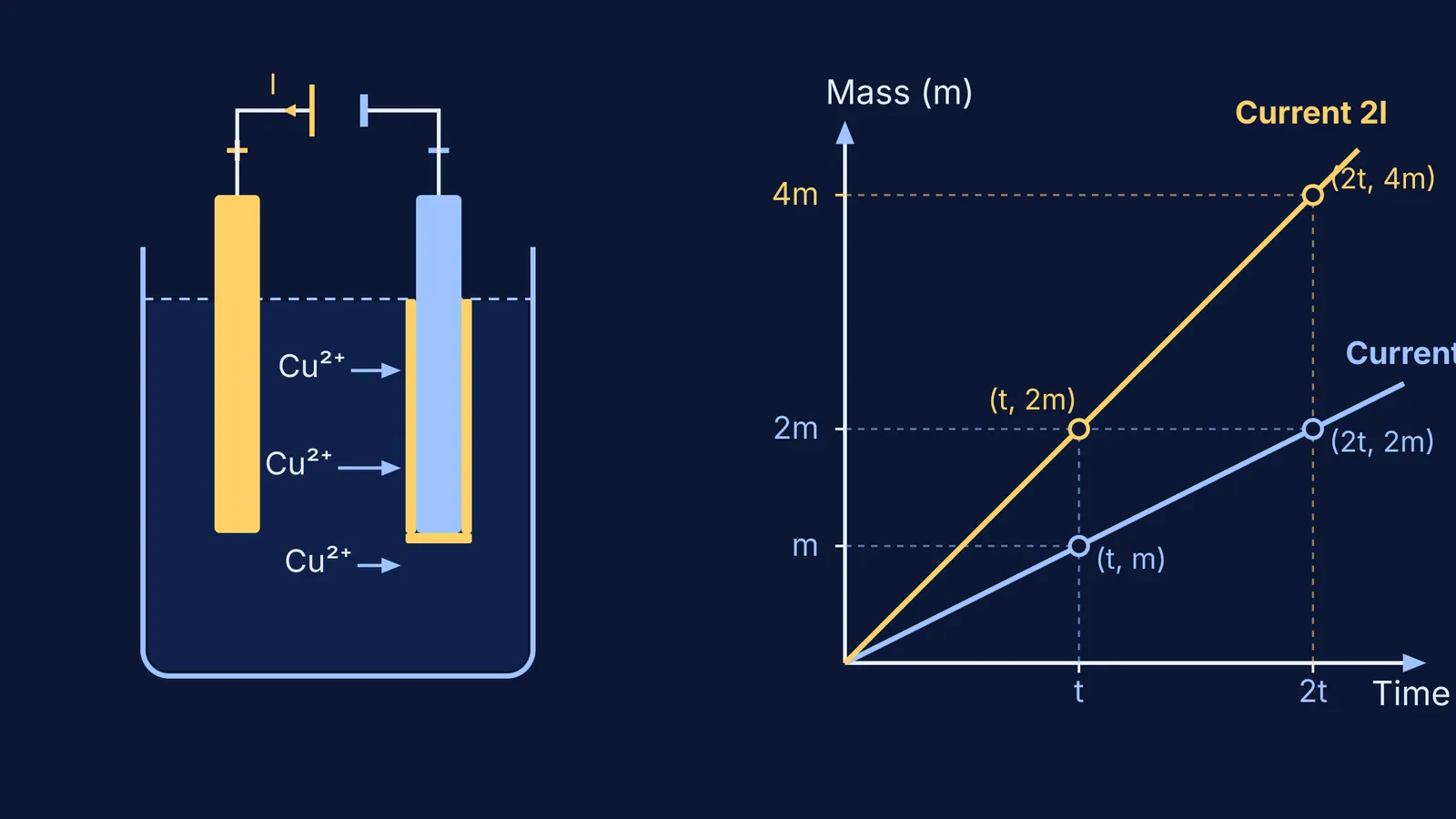
What happens to copper electroplating if you double current or time?
Because mass deposited depends linearly on charge (Q = I × t), current and time carry identical mathematical weight in Chemistry LibreTexts/20%3A_Electrochemistry/20.09%3A_Electrolysis).
Consider a baseline run where 2.0 amperes flows for 30 minutes (1800 seconds), delivering 3600 coulombs. Using copper's molar mass and two-electron reduction, approximately 1.185 grams of copper deposits on the cathode (about 1.186 grams if using the common textbook constant of 63.55 grams per mole).
Now test the scaling predictions against this baseline:
Doubling current: Passing 4.0 amperes for 30 minutes delivers 7200 coulombs, depositing approximately 2.371 grams of copper (twice the baseline).
Doubling time: Passing 2.0 amperes for 60 minutes (3600 seconds) also delivers 7200 coulombs, depositing approximately 2.371 grams of copper (twice the baseline).
Doubling both: Passing 4.0 amperes for 60 minutes delivers 14400 coulombs, depositing approximately 4.742 grams of copper (a fourfold increase).
In classroom labs and competitive numericals, the relationship remains strictly symmetric.
Why predict outcomes before running an electrochemistry simulation?
Manipulating sliders in a virtual lab is easy, but passive viewing often creates an illusion of competence.
Educational research shows that learning improves when students follow a Predict-Observe-Explain cycle. In the *Journal of Pedagogical Research*, Erdem Özcan and Uyanık (2022) studied 60 students over an eight-week intervention. Students who wrote down predictions and justified their reasoning before observing outcomes scored significantly higher on concept tests and retained their understanding in a retention test five weeks later.
Simulations let you test predictions instantly without chemical waste. Comparing simulations vs static diagrams shows how interactive controls help learners test edge cases and fix misconceptions.
For concepts that are easier to visualize than read, the Fermi Simulation Lab provides interactive simulations for the ideas that are easier to see than to read. You can adjust parameters, watch ions migrate, and confirm physical laws in real time.
How do you calculate copper mass deposited step by step?
To solve electroplating questions accurately, follow this four-step method:
Convert time to seconds: Multiply minutes by 60 or hours by 3600.
Find total charge: Calculate Q = I × t in coulombs.
Find moles of electrons: Divide charge Q by the Faraday constant (96485 coulombs per mole, indexed by NIST).
Compute copper mass: Divide electron moles by 2 (for Cu²⁺) and multiply by copper's standard atomic weight (63.55 grams per mole, documented by CIAAW).
When facing multi-step problems, the Fermi Problem Library provides worked problems with a step-by-step solver that explains the reasoning rather than printing an answer.


