

On this page
In short
Primary succession transforms a lifeless surface into a stable ecosystem. This progression typically takes hundreds of years to build enough soil for a climax forest (Britannica, 2024), but you can watch the timeline unfold instantly in a simulation.
Ecosystems are rarely static. Whether an area is wiped clean by a retreating glacier, a volcanic eruption, or a human-made disturbance, life slowly returns. However, the first species to arrive are very different from the ones that eventually take over.
If you are simply trying to map out how environments recover, memorising the stages of succession can feel abstract. By experimenting with a simulation, you can see exactly why species replace one another and what happens when the environment changes abruptly.
How does primary succession start on bare rock?
Primary succession occurs in completely lifeless areas where no soil exists, such as on newly exposed bare rock or lava flows (Britannica, 2024). Because plants need soil to grow, the area must first be broken down by organisms that can survive on bare minerals.
These initial colonisers are known as pioneer species. Lichens—a symbiotic partnership of fungi and algae whose unique traits are explored in our guide on viruses, viroids and lichens—and mosses are often the first to arrive. They are capable of surviving in harsh, nutrient-poor environments, and as they live, die, and decompose, they contribute the very first layers of organic matter and begin the long process of soil formation (Britannica, 2024).
What is the timeline from bare rock to forest?
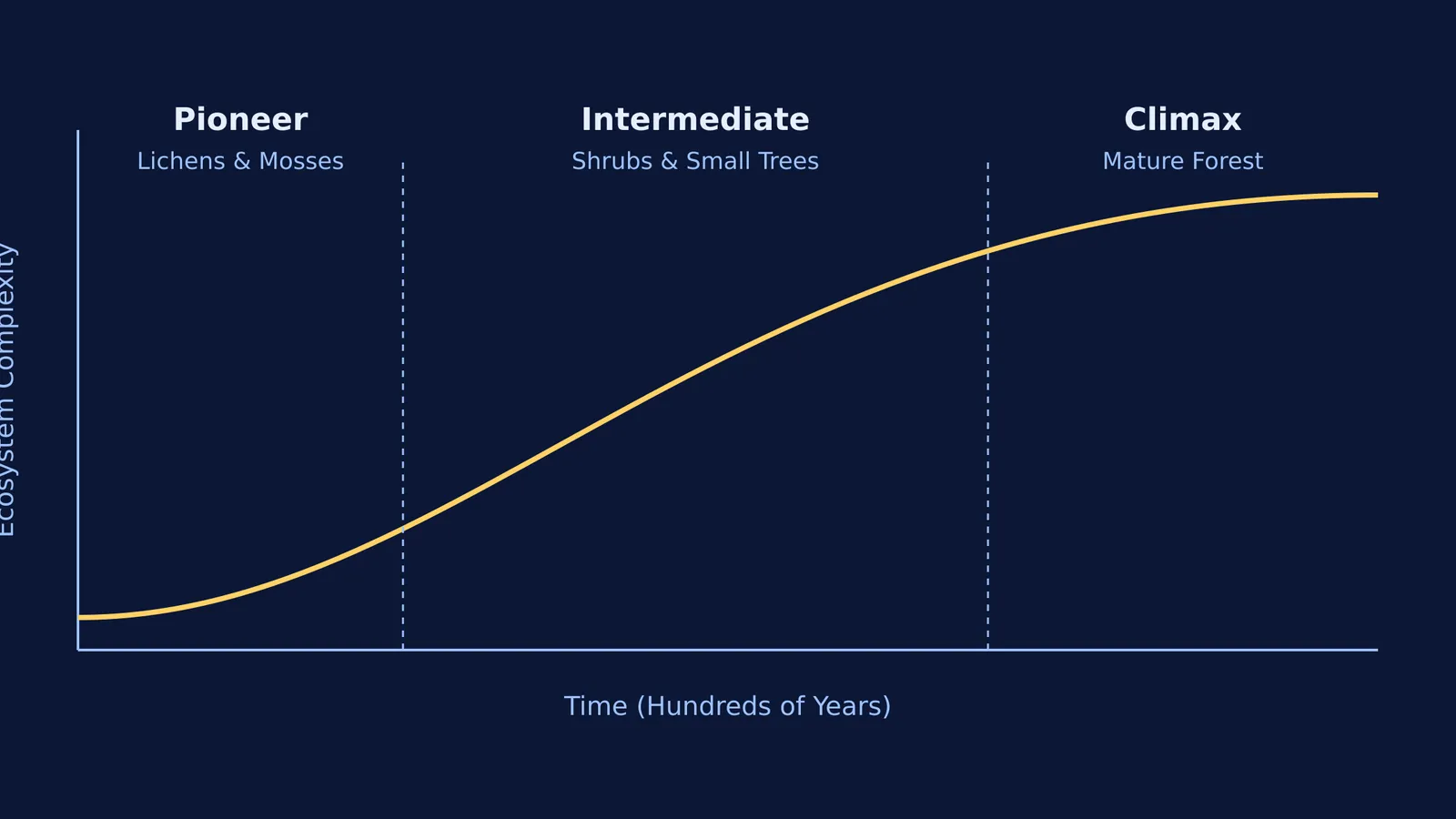
The transition from a sterile rock surface to a complex ecosystem is incredibly slow because soil building takes time. It often takes hundreds of years to reach a stable state known as a climax community (Britannica, 2024).
While specific timelines depend on the climate, a typical sequence in a temperate region follows these stages:
Pioneer Stage: Lichens and mosses dominate, breaking down rock and creating a thin film of soil.
Early Intermediate: As the soil deepens, simple plants like grasses and small annuals take root. They add more organic matter when they die, enriching the soil further.
Late Intermediate: Shrubs and fast-growing, sun-loving trees appear. Their root systems break up deeper rock, and their falling leaves significantly increase soil nutrients and depth.
Climax Community: Large, shade-tolerant trees grow taller than the pioneer trees, blocking their sunlight. This mature forest is self-perpetuating and remains stable unless a major disturbance occurs.
How do disturbances change ecological succession?
Once a climax community is established, it might seem permanent. However, natural disturbances—such as wildfires, windstorms, or floods—can drastically alter the landscape.
When a disturbance destroys the existing vegetation but leaves the soil intact, the ecosystem undergoes secondary succession. Because the soil already contains a seed bank and nutrients, the recovery process is much faster. It reaches a climax community more quickly than primary succession (Britannica, 2024). Fast-growing weedy species and annual grasses, displaying rapid arithmetic and geometric plant growth, colonise the soil almost immediately, followed shortly by shrubs and young trees.
If you are mapping out a succession timeline, follow this simple checklist to determine the current stage:
Check the soil: Is it bare rock with no organic matter? The ecosystem is in the pioneer stage.
Check the shade: Are small, fast-growing trees receiving full sunlight? It is an intermediate stage.
Check the canopy: Are large, shade-tolerant trees dominating the space? It has reached a climax community.
Running a succession simulation
Visualising centuries of ecological change from a textbook diagram can be difficult. The Fermi Simulation Lab provides interactive simulations for the ideas that are easier to see than to read. You can set the initial conditions to bare rock, introduce pioneer species, and predict the order of communities as time accelerates.
By adding a disturbance like a fire midway through your simulation, you can instantly observe the shift from primary to secondary succession. Fermi's AI tutor can also help you hold a line of reasoning across a session, noticing where you are stuck and deciding whether to explain the role of pioneer species or ask you what happens when shade-tolerant trees block the sunlight. If you want to check your conceptual knowledge of succession, the Fermi Concept Library contains every concept in physics, chemistry, biology, mathematics and computing, each with its own lesson and its place in the map.
Understanding ecological succession is about recognising patterns of competition and facilitation. By actively experimenting with these variables, you can confidently predict how an ecosystem will rebuild itself over time.


