On this page
Draw an angle bisector with a compass and you get one picture. Build it in dynamic geometry software and you get every picture at once: drag a point and the figure reshapes, but whatever you constructed stays true. GeoGebra describes itself as dynamic mathematics software for all levels of education, freely available for non-commercial users.
What does CBSE ask for in Class 9 and 10 constructions?
The CBSE Class 9 mathematics syllabus for 2026-27 expects you to construct bisectors of line segments and angles, triangles and other polygons that satisfy given constraints, and the circumcircle of a triangle. It also asks you to use congruence of shapes to make and test conjectures. The Class 10 syllabus for 2026-27 asks you to prove that a tangent is perpendicular to the radius at the point of contact, and that tangents drawn from an external point are equal. Dragging is how you test those conjectures. If the tangent theorems are new, start with our worked examples on tangents to a circle in Class 10.
Does dynamic geometry software help students learn?
A 2024 meta-analysis by Ji, Guo and Song pooled 107 studies with 10,507 participants and found a moderate positive effect of dynamic mathematics software on performance (d = 0.632). The studies cover many maths topics, not only geometry. Effects were larger when students used the software independently, and students did better on near-transfer than on far-transfer tests.
So keep your own hand on the mouse. The software shows you what is true; it does not tell you why. For when a moving picture beats a printed one, see what studies found about simulations versus static diagrams.
How do you drag a construction to see what stays true?
In a paper on conjecturing and proving in dynamic geometry, Anna Baccaglini-Frank, building on work by Arzarello, Olivero and colleagues, introduced students using the software Cabri to four ways of dragging:
Wandering: drag a point at random to see what the figure can do.
Maintaining: drag a point while trying to keep an interesting property.
With trace: leave a trail to see the path a point follows.
The dragging test: check whether a figure was really constructed or only looks right.
The paper uses Laborde's terms for a useful distinction: a soft invariant holds only while you drag carefully to keep it; a robust invariant survives any drag because the construction forces it. Robust invariants are the ones worth proving, and the paper describes conjectures written in "if ..., then ..." form as a step towards the proof.
Worked example: predict, drag, prove
Example 1: the perpendicular bisector.
Draw segment AB. With the compass tool, draw equal circles centred at A and B, radius more than half of AB. Join their intersection points; call the meeting point with AB M.
Put a point P on that line. Predict: how do PA and PB compare?
Drag P, then drag A. PA and PB stay equal; the angle at M stays 90°.
Dragging test: draw a line by eye that only looks perpendicular, then drag A. It tilts: nothing in the construction forced it.
Prove it: by construction, AM = BM and angle PMA = angle PMB = 90°, and PM is common, so triangles PMA and PMB are congruent by SAS and PA = PB.
Example 2: tangents from an external point.
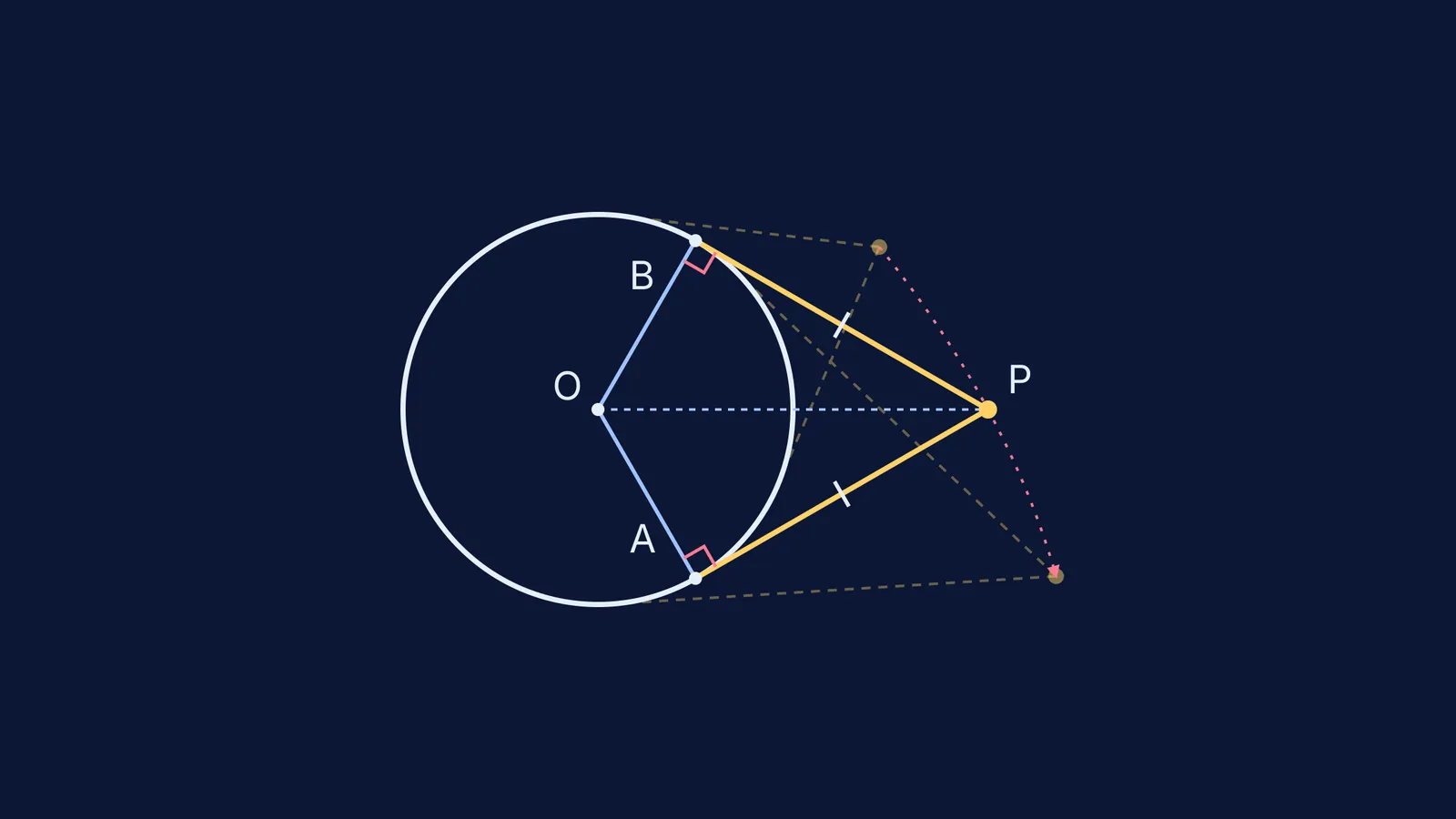
Draw a circle with centre O and a point P outside it. Draw the circle on OP as diameter; it cuts the first circle at A and B. Join PA and PB.
Predict: which is longer, PA or PB? What is angle OAP?
Drag P far, then near. The lengths change, but PA = PB and angle OAP = 90° every time.
Prove it: angle OAP = angle OBP = 90° (tangent is perpendicular to radius), OA = OB and OP is common, so triangles OAP and OBP are congruent by RHS and PA = PB.
How do you turn what you saw into a written proof?
Write the observation as "If ..., then ...".
Split the figure: what did you construct (given), and what did you only measure (to prove)?
Ask why dragging never breaks it, and trace that back to a construction step.
Find two triangles that share a side and name the criterion: SAS, ASA, SSS or RHS.
Close the laptop and write the proof by hand, a reason beside each line.
Our list of Class 10 maths theorems you must be able to prove shows which to practise this way. Parents can help with one habit: ask for a prediction before the drag, and a reason after.
If a figure is hard to hold in your head, the Fermi Simulation Lab has interactive simulations for ideas easier to see than to read. When you are stuck on why a step holds, Fermi's AI tutor can draw the figure and decide whether to explain, ask or show.
Tonight, build one bisector, make one prediction, and write one proof.