

On this page
You ask a chatbot when an exam application window closes, and it gives you a date in a confident sentence. The question that matters is where that date came from: a page it just read on the web, or a pattern it learned months ago.
Does a chatbot search the internet or answer from memory?
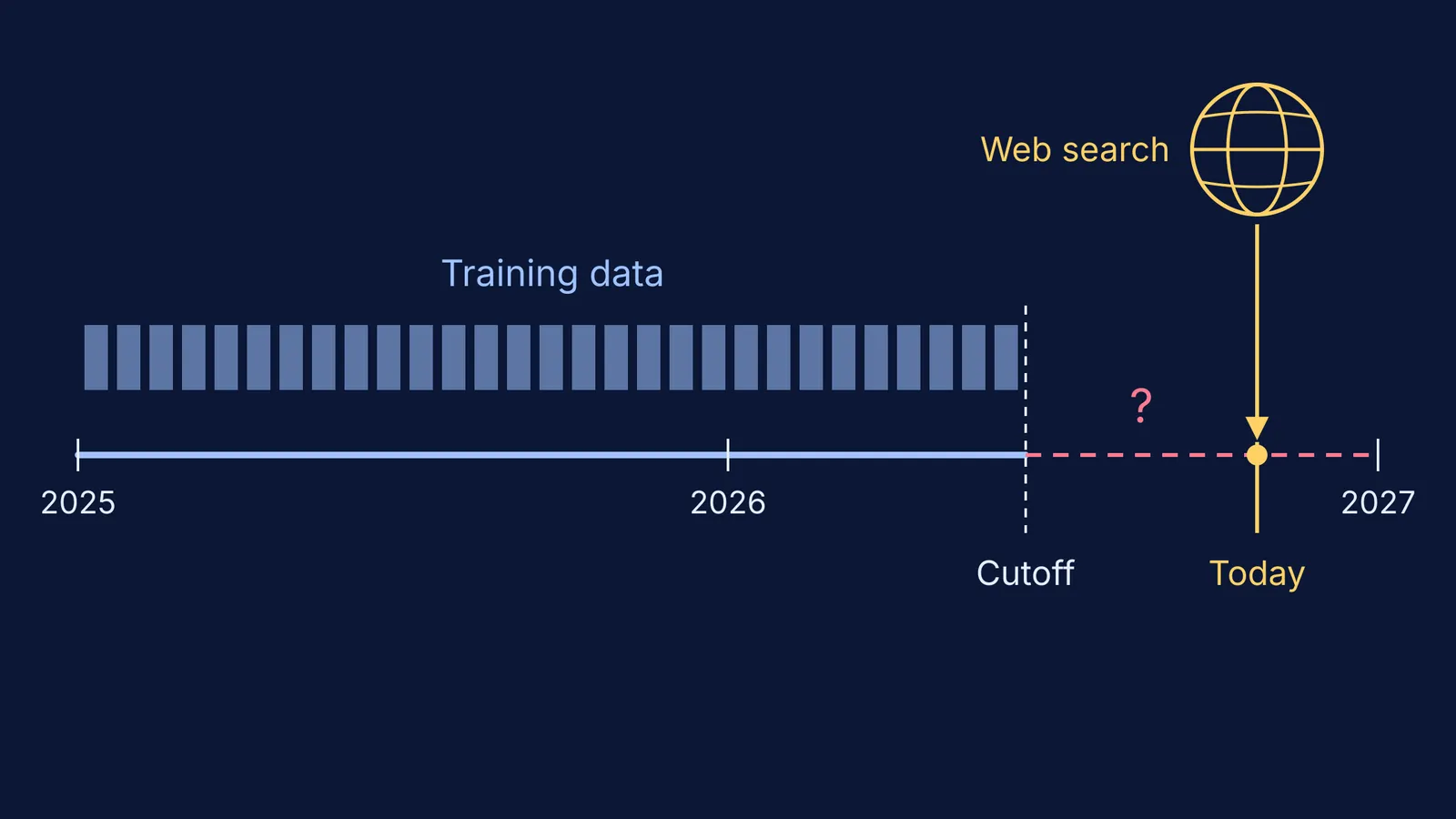
Its built-in answers come from memory. A chatbot runs on a large language model trained on a huge collection of text up to a fixed date, and its built-in knowledge stops there (we explain the training in how large language models work).
Anthropic defines a model's reliable knowledge cutoff as "the date through which the model's knowledge is most extensive and reliable" (Anthropic models overview). On that page, its current Claude models list a reliable knowledge cutoff of June 2026.
Many chatbots can also search the web. Anthropic's help page says Claude searches automatically "when you ask about topics that benefit from current information", and that you can ask for it by writing "Search the web" in your prompt (Claude help: web search). Whether a search runs depends on the app and your settings, so do not assume it did.
How can you tell if a chatbot searched the web?
Look for evidence on the screen, not for confidence in the wording.
A sources list or inline citations. Google says that when Gemini has sources, a Sources button appears at the bottom of the response or in-line, and that if there is no Sources button, Gemini "didn't provide any links for that particular response" (Gemini Apps Help).
A searching indicator while the answer is being written.
Links you can open that lead to a real page.
A date on the source that is newer than the model's cutoff.
If none of these appear, treat the answer as coming from memory.
A link is not proof either. In a test by Columbia's Tow Center for Digital Journalism, eight AI search tools were given excerpts from news articles and asked for each article's headline, publisher, publication date and URL; across 1,600 queries, they answered more than 60% incorrectly (Tow Center, Columbia Journalism Review, March 2025). The same study found that more than half of the responses from Gemini and Grok 3 cited fabricated or broken URLs. See how to check references when AI makes up sources.
Why does it matter for exam dates and notices?
Dates, fees, admit cards and results change every year, which is exactly what a frozen model cannot know.
A worked example: suppose a model's knowledge stops in June 2026 and an exam body puts out a notice in August 2026. Answering from memory, the model has never seen it. It may give you last year's date, with no warning that it is guessing.
Even assistants that cite sources get news wrong. In a study led by the BBC for the European Broadcasting Union, journalists from 22 public broadcasters in 18 countries reviewed more than 3,000 answers from ChatGPT, Copilot, Gemini and Perplexity (EBU, October 2025). They found that 45% of answers had at least one significant issue. In the same study, 31% of answers had serious sourcing problems and 20% had major accuracy issues, including hallucinated details and outdated information.
How do you ask a chatbot for sources?
Make it show its working. Copy these:
"Search the web for this, and give me the link to the official page for each fact."
"Did you search the web for that answer, or is it from your training data? What is your knowledge cutoff?"
"Quote the exact sentence from the source that gives this date, and tell me when that page was published."
"If you cannot find an official source, say so instead of guessing."
Then do a quick check on any link it gives you:
Open it. A link that does not load is a fail.
Check the domain: the exam body itself, or a site repeating it?
Find the date on the page or PDF notice.
Find the sentence the chatbot quoted. If it is not there, do not use the answer.
When is a chatbot's memory good enough?
Use one rule: does the answer change from year to year?
Stable ideas such as Newton's laws, the Krebs cycle or integration by parts do not depend on dates. Memory is usually fine here, though a chatbot can still slip on calculations, as we show in why AI chatbots get maths wrong.
Changing facts such as exam dates, eligibility, fees, cut-offs and results need the official page every time.
For the first kind, what you need is not a search but a clear explanation. Fermi's AI tutor is built for that: it holds a line of reasoning across a whole session, notices where you are stuck, and decides whether to explain, ask or show. For the second kind, bookmark the official site and check it yourself.
Next time a chatbot gives you a date, ask it the second question above before it goes in your planner.


