

On this page
You walk out of the exam hall feeling confident. You knew the underlying physics, remembered the historical dates, and memorised the complex formulas. But when the marks come back, your score is unexpectedly lower. A frequent reason for this gap is not a lack of subject knowledge, but a misunderstanding of the instruction verb at the start of the prompt. These are the command words—terms like "state", "explain", "derive", and "justify".
When a question explicitly asks you to "explain" an idea, writing a perfectly accurate factual description will not earn full marks. Examiners look for a specific logical structure to match the command word. Correcting this habit is one of the fastest and most effective ways to improve your grades without having to spend hours learning new content. This failure to match the answer shape to the question is a common trap seen in Class 10 CBSE maths board answer mistakes and advanced science papers alike.
Why do command words change your marks?
Content knowledge is your raw material, but the command word is the strict assembly instruction. If the examiner asks for a chair and you build a table, the quality of the wood does not matter. Educational authorities, such as the UK's Office of Qualifications and Examinations Regulation (Ofqual), standardise these instruction verbs across exam boards to ensure that tests remain fair, consistent, and transparent. They dictate exactly what shape an answer must take and how marks are awarded.
For instance, low-tariff questions worth one or two marks generally use verbs like "state" or "identify". The examiner expects a direct, unadorned fact. By contrast, high-tariff questions rely on verbs like "justify", "evaluate", or "discuss", which demand a reasoned verdict or a balancing of evidence. Providing a simple descriptive list of facts for a high-tariff question immediately caps your score, regardless of how accurate those facts are.
What do state, explain, derive and justify mean?
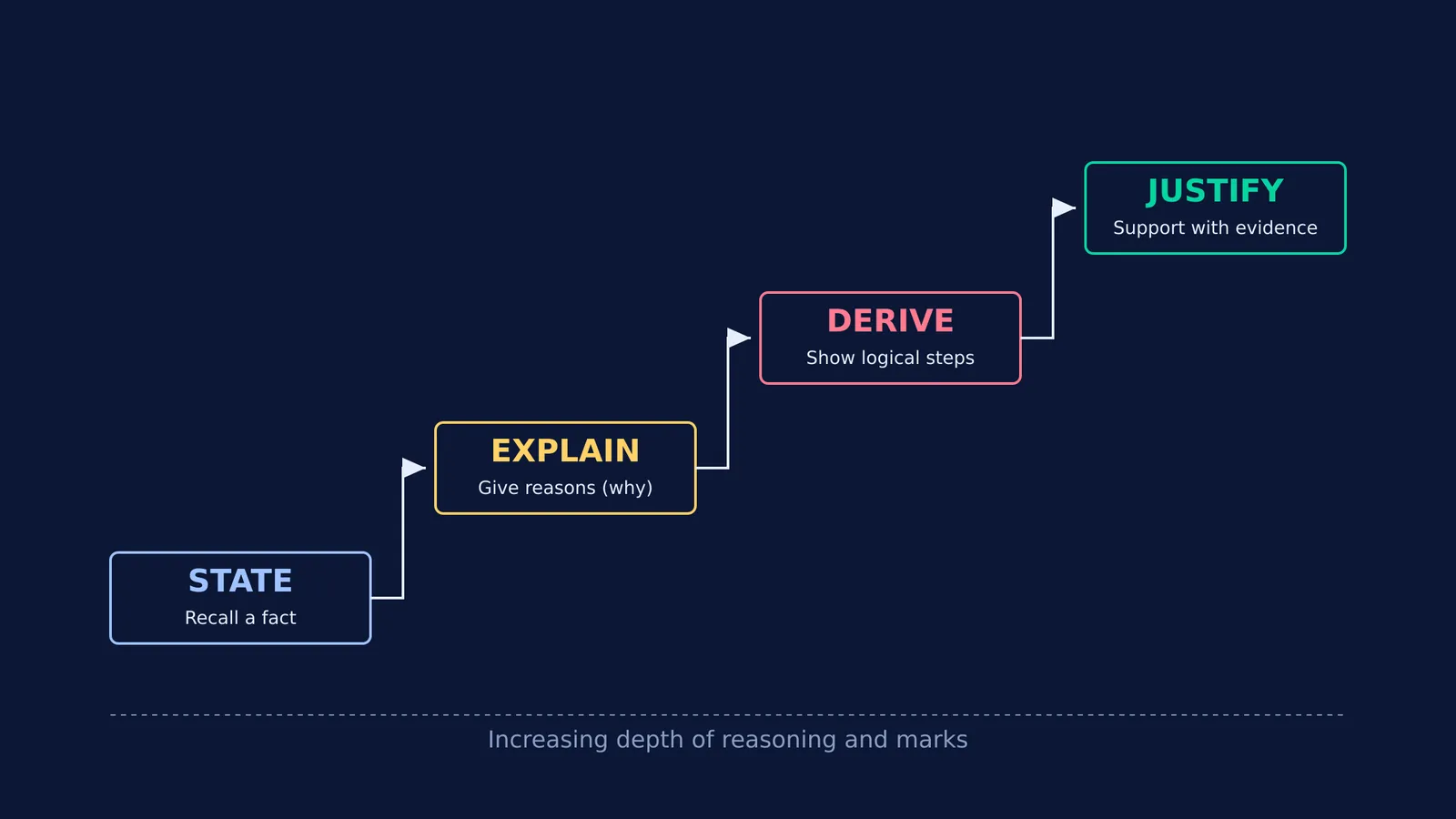
Every major board exam relies on a core set of command words to signal depth. While subjects have minor variations, here is what these common terms expect from your answer:
State: Express a fact in clear, brief terms. You do not need to provide any reasons, context, or background information. A single sentence or a precise mathematical phrase is usually enough to secure the mark.
Explain: Set out purposes or reasons. You must show the "why" or "how" of a process. This means explicitly connecting facts using joining words like "because", "therefore", or "so". Without these links, you are merely describing.
Derive: Show the mathematical or logical steps required to reach a specific formula or conclusion. The intermediate steps carry the bulk of the marks, which is why physics derivations in CBSE boards require careful, sequential structuring rather than just writing the final equation.
Justify: Support a case or statement with solid evidence. Give compelling reasons why your answer or choice is correct, often by referring to data in the question or eliminating weaker alternatives.
How do you practise board answers with AI?
Practising these specific answer structures is difficult to do on your own because it is hard to objectively grade your own depth of reasoning. This is where an AI tutor becomes highly useful as an immediate feedback partner. A 2024 study published in *Computers and Education: Artificial Intelligence* (Meyer et al.) found that AI-generated feedback significantly increases secondary students' text revision, motivation, and positive emotions during learning.
Rather than asking an AI to write an answer for you—which skips the cognitive effort entirely—you should ask it to evaluate your drafted text against a specific command word. Here is a practical, step-by-step sequence to try during your exam prep:
Ask for the expectation: Before you start writing, ask the AI, "What does the command word 'justify' strictly require for this 5-mark question?"
Draft your answer: Write your full response on your own, keeping the required structure in mind.
Get feedback on depth: Give the AI your drafted answer and ask, "Did I hit the depth required for an 'explain' question? Please point out where I missed a logical link or failed to provide evidence."
Revise: Rewrite your answer based on the specific structural gaps the AI identified.
Fermi's AI tutor is built for this kind of active, structured learning. Most learning tools answer questions, but Fermi teaches — it holds a line of reasoning across a whole session, notices where a student is stuck, and decides whether to explain, ask, or show. When a student brings a topic, a course, or a problem set, Fermi works out what they already know, builds a plan for the session, and teaches through it — writing on a board, drawing the figure, running the simulation, and checking understanding as it goes. By treating the AI as an examiner who checks your command words, you can train yourself to write answers in the exact shape the board demands.


