

On this page
Picture a box of gas particles bouncing around. Most collisions do nothing; a few make product. A reaction rate simulation lets you turn one knob at a time (temperature, concentration, catalyst) and watch how many collisions succeed. The trick is to predict the result before you press play.
What does collision theory say controls reaction rate?
The OpenStax Chemistry 2e chapter on collision theory sets out three conditions. The rate depends on how often reactant particles collide. They must collide in an orientation that brings the right atoms together. And the collision must carry enough energy.
Activation energy (Ea) is the minimum energy colliding particles need to form products (OpenStax Chemistry 2e).
The same chapter gives the Arrhenius equation, k = A·e^(−Ea/RT). Here A is the frequency factor, linked to how often particles collide and how they are oriented, R is 8.314 J/mol/K, and T is in kelvin.
So every knob in a simulation does one of two jobs. It changes how often particles collide, or it changes what fraction of collisions clear the energy bar.
How does concentration change reaction rate in a simulation?
Put twice as many A particles in the box and each B particle meets an A twice as often. For a single-step reaction A + B → products, the rate law is rate = k[A][B] (OpenStax, reaction mechanisms). Double [A] and the rate doubles. Double both and it goes up four times.
One catch for exams: the same OpenStax section says that for typical overall reactions the rate law must be determined from experimental data. Concentration changes how often particles collide, not k. If you are plotting concentration against time, our guide to reading integrated rate law graphs picks up from here.
Why does a 10 °C rise roughly double the rate?
OpenStax Chemistry 2e states that for many chemical processes, reaction rates approximately double when the temperature rises by 10 °C.
Faster particles collide more, but check by how much. The root mean square speed of a gas is u = √(3RT/M) (OpenStax, kinetic molecular theory). Going from 298 K to 308 K multiplies speed by √(308/298), about 1.017. That is under 2% faster, nowhere near double.
The real reason sits in the high-energy tail. The fraction of collisions with energy at or above Ea goes roughly as e^(−Ea/RT). A worked example with Ea = 50 kJ/mol:
At 298 K (25 °C): Ea/RT = 50,000 ÷ (8.314 × 298) ≈ 20.18, so e^(−20.18) ≈ 1.7 × 10⁻⁹. About 2 collisions in a billion have enough energy.
At 308 K (35 °C): Ea/RT ≈ 19.53, so e^(−19.53) ≈ 3.3 × 10⁻⁹.
Ratio: 3.3 ÷ 1.7 ≈ 1.93. The rate almost doubles, from a rise of just over 3% in absolute temperature.
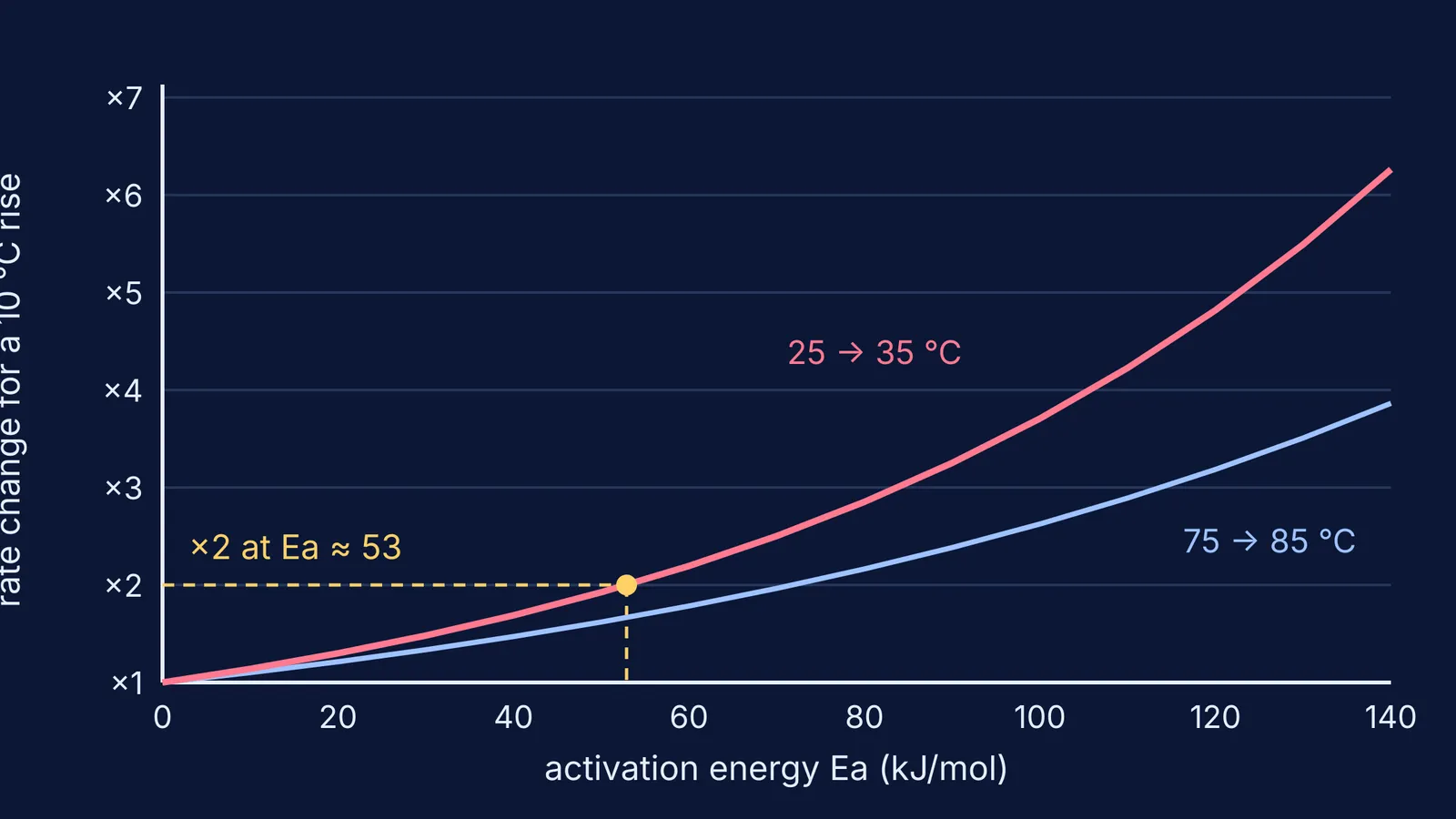
The doubling is a rule of thumb, not a law. Using the same Arrhenius equation, a 25 → 35 °C rise gives about ×1.3 for Ea = 20 kJ/mol, ×2 for Ea ≈ 53 kJ/mol and ×3.7 for Ea = 100 kJ/mol. From 75 to 85 °C, a 50 kJ/mol reaction gains only about ×1.6. For the exam-style version, see our post on the temperature coefficient of reaction rate.
How does a catalyst speed up a reaction?
A catalyst gives the reaction a different route with a lower activation energy, and it is not consumed (OpenStax, catalysis). Both paths begin and end at the same energies. In a simulation, particles move at the same speeds with or without the catalyst; only the bar is lower. Suppose a catalyst cuts Ea from 75 to 50 kJ/mol at 25 °C and A stays the same. The rate goes up by e^(25,000 ÷ (8.314 × 298)) ≈ e^10.1, or about 24,000 times. Catalysis has a long history too: read about Elizabeth Fulhame and the early study of catalysis.
Predict, then run: a five-minute simulation plan
Use any simulation with particle number, temperature and catalyst controls, and write each prediction down first using the Arrhenius equation and rate law above.
Baseline: count successful reactions over a fixed time.
Double one reactant. Predict about ×2, because collisions double.
Reset, then raise the temperature by 10 °C. Predict roughly ×2 for a moderate Ea, and notice that the particles barely look faster.
Reset, then add the catalyst. Predict a large jump with no change in particle speed.
If a prediction misses, note which lever you misjudged: collision frequency or the energy fraction.
To watch the energy tail move rather than picture it, the Fermi Simulation Lab has interactive simulations for ideas that are easier to see than to read. If the Arrhenius arithmetic trips you up, Fermi's AI tutor can run the simulation with you and check understanding as it goes.
For any rate question, ask first: does this change how often particles collide, or how many collisions clear the bar?


