

On this page
When a cricket captain loses the toss five times running, someone always says the next one is "due". It is wrong, and you can prove it with a coin, a pencil and half an hour.
After five heads in a row, is tails more likely?
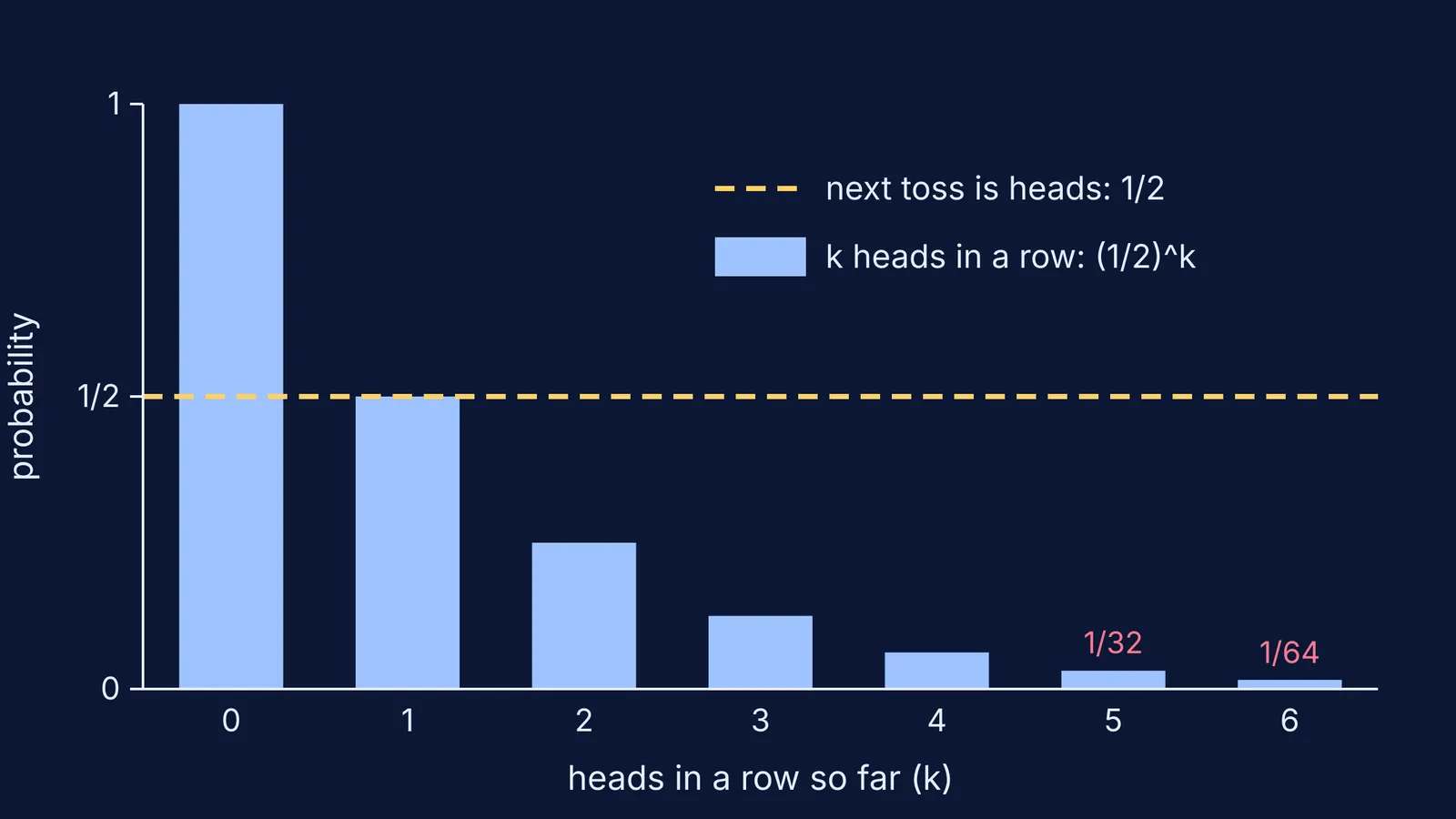
No. A fair coin has no memory, so each toss is independent of the ones before it, and the chance of heads is 1/2 every time.
Before you toss anything, HHHHHH and HHHHHT are equally likely: each has probability (1/2)^6 = 1/64. Once five heads have landed, those are the only two possible endings. They started equal, so they are still equal. Six heads in a row is rare; the sixth head, given the first five, is not.
In their 1971 paper Belief in the law of small numbers, psychologists Amos Tversky and Daniel Kahneman described the opposite belief: people expect a random sequence to correct itself, so after a run of one outcome they expect the other. This is the gambler's fallacy. As they put it, "The laws of chance, in contrast, do not work that way: deviations are not canceled as sampling proceeds, they are merely diluted."
How often do streaks of five or six appear in 100 tosses?
More often than you would guess. Mark Schilling's 1990 paper The longest run of heads gives exact chances for the longest run; the average number of streaks needs only pencil and paper.
Call a streak a run of the same face, heads or tails. A streak of five or more starts at a toss if that toss differs from the one before (chance 1/2) and the next four match it (chance 1/16), so 1/32 per toss. In 100 tosses there are 95 such starting places after the first toss, and the first toss itself only needs the next four to match (1/16).
Streaks of five or more: 95 × 1/32 + 1/16 ≈ 3.0 expected in 100 tosses.
Streaks of six or more: 94 × 1/64 + 1/32 ≈ 1.5 expected in 100 tosses.
Heads-only streaks are about half as common: roughly 1.5 runs of five or more heads and 0.75 runs of six or more.
People are poor at faking this. In a classroom exercise described on Dartmouth's Chance teaching pages, half a class tossed a real coin 100 times and half invented 100 tosses. The instructor told them apart by the longest run, getting all but one right; only one invented sequence contained a run of five or more.
Do real people bet against streaks?
Yes. Rachel Croson and James Sundali analysed 18 hours of security video from a roulette table in a Reno casino: 139 players placing 24,131 bets. Roulette spins are independent, like coin tosses. On even-money bets such as red or black, after streaks of one to four of the same outcome, bets were not significantly different from 50-50 for and against the streak. After streaks of five, players bet against the streak significantly more often. After streaks of six or more, 85% of those bets went against the streak, though only 41 bets followed such long streaks.
Try it: a 30-minute streak experiment
You need a coin, two sheets of paper and a partner.
Predict. Each of you guesses how many streaks of five or more 100 tosses will contain.
Fake it. One person writes 100 H and T by hand, trying to look random.
Toss it. The other tosses a real coin 100 times and records every result.
Count. Circle every run of five or more on both sheets and compare with the expected 3.
Check the next toss. On the real sheet, find every place with four heads in a row and tally what came next. Pooled across a class, the split should sit near half and half.
Swap and guess. Ask someone else to spot the fake. In the Dartmouth class, it was the sheet without long runs.
The same counting of outcomes returns in physics as entropy. The Fermi Simulation Lab has interactive simulations, including statistical mechanics, for ideas that are easier to see than to read.
When does the past change the next outcome?
Sometimes it does. Run this checklist before calling anything "due".
Does the process have memory? Drawing cards without putting them back does: each card removed changes what is left. A coin, a die or a roulette wheel does not.
Is the coin fair? If unsure, a long streak is evidence that it favours that side, making that side more likely, not less.
Are you mixing up "this whole sequence is rare" with "this next toss is rare"? Six heads in a row is 1/64; the sixth head after five is 1/2.
Is skill involved? A batter's form is not a coin.
If "independent" still feels slippery, read independent vs mutually exclusive events and five probability reasoning mistakes in JEE maths. The Fermi Concept Library also gives every mathematics concept its own lesson.
Next time someone says tails is due, toss the coin together and keep score.


