

On this page
Coaching institutes for exams like JEE and NEET often provide answer keys designed for speed. They skip intermediate algebraic steps or conceptual jumps, assuming you already know how to bridge the gap. If you make a mistake and check the key, you might not understand how step two became step three. This leaves you memorising the final answer rather than understanding the process. While memorisation might help you pass a minor unit test, it often fails you during a high-stakes competitive exam when problems are framed differently and require a deep understanding of the underlying principles.
Why do students struggle with mock test answer keys?
When you use NTA's official mock tests or your institute's practice papers, the accompanying solutions are usually brief. These brief keys are often written for teachers or advanced students who can effortlessly bridge the gaps in logic, leaving the average student confused and frustrated. Relying only on brief answers forces you to guess the missing logic. The alternative—studying detailed, step-by-step worked examples—is highly effective. Cognitive Load Theory suggests that when you see the full reasoning laid out, your brain spends less energy on trial-and-error and more on building a robust mental model.
A 2023 meta-analysis in the *Educational Psychology Review* found that worked examples are significantly more effective for mathematics performance than traditional problem-solving, with a medium overall effect size (g = 0.48) across 55 independent studies (Barbieri et al., 2023). Earlier foundational research also demonstrated that students given only problems to solve took nearly six times longer to complete a learning sequence and made more errors than those who studied worked examples (Sweller & Cooper, 1985).
How can AI expand a brief test solution?
When you encounter a skipped step in your coaching material, an AI tutor can act as a bridge. Instead of asking the AI to solve the problem from scratch, you can feed it the brief solution and ask it to explain the jump.
If you are stuck on a physics problem, Fermi's AI tutor can work out what you already know and build a plan for the session, writing on a board and checking your understanding as it goes. For mathematics, the Fermi Problem Library has worked problems with a step-by-step solver that explains the reasoning rather than printing an answer.
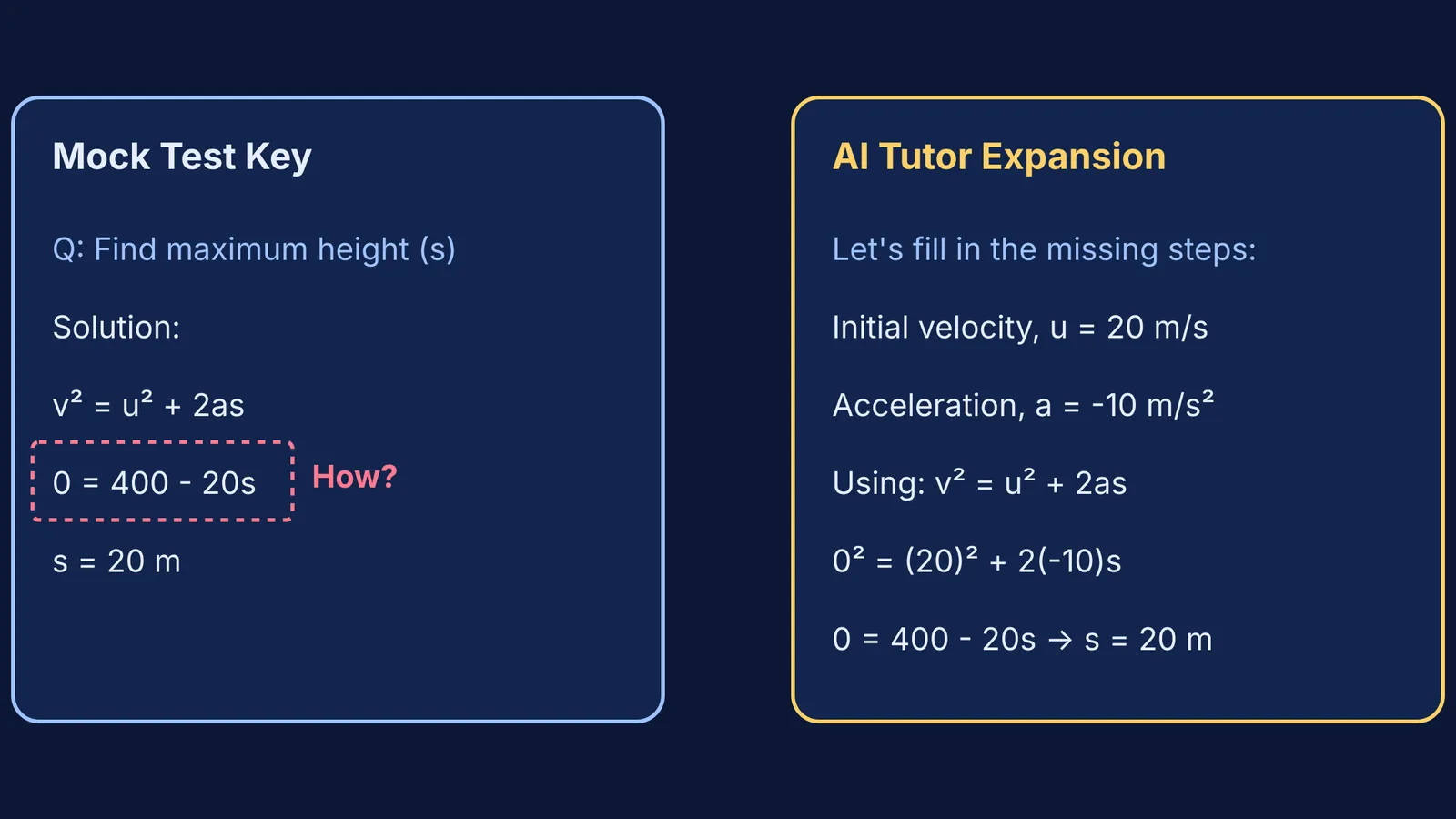
For example, if a test key jumps from v² = u² + 2as directly to s = 20, the tutor can break down the sign conventions and substitutions that led there. This is especially useful when learning how to review a JEE Advanced paper after you attempt it, as it ensures you actually learn from your incorrect attempts.
How do you ensure the AI uses your coaching faculty's method?
A common risk with general AI chatbots is that they might solve a Class 11 kinematics problem using university-level calculus, which is not what your faculty expects. To prevent this, you must anchor the AI to your specific syllabus and the brief solution provided.
Try using a prompt like this when pasting your question and the brief answer key:
"Here is a physics problem and the brief solution key provided by my coaching institute."
"Please explain the missing steps between step 2 and step 3."
"You must use only the algebraic method shown in the key; do not use calculus or introduce a different approach."
This script forces the AI to scaffold its explanation around the method you are actually meant to learn, turning a confusing answer key into a powerful, step-by-step study tool.


