

On this page
When you check your physics homework with a general AI chatbot, you might find that your answer is slightly off. You re-read your steps, look for arithmetic errors, and find nothing.
The mismatch is often not in the physics itself, but in the physical constants the AI chose to use behind the scenes. AI models memorise a vast spread of scientific literature, meaning they default to the most modern and exact measurements available. But for competitive exams, following those precise numbers can cost you marks.
Which values do AI models use?
Major scientific organisations update the fundamental constants every few years as measurement techniques improve. The 2022 CODATA recommended value for the Newtonian constant of gravitation (G) is 6.67430 × 10⁻¹¹ m³ kg⁻¹ s⁻².
General AI models usually draw on these modern lists. However, textbooks take time to catch up. For instance, the NCERT Class 12 Physics textbook has an appendix listing physical constants. You might be surprised to see that the printed value for the gravitational constant (G) is 6.673 × 10⁻¹¹ N m² kg⁻², depending on the edition.
Why the discrepancy? The value 6.673 × 10⁻¹¹ N m² kg⁻² was the recommended CODATA value back in 1998. It takes years for textbook revisions to propagate, so generations of Indian students have used it. Meanwhile, AI language models read modern databases, picking up the 2022 value. In a competitive exam setting, what the textbook and the examiner say is law, even if it is technically outdated in the wider scientific world.
Why does precision lead to wrong answers?
In multiple-choice questions with widely spaced options, a tiny difference in a constant will not hide the correct option. But in integer-type or numerical-value questions, precision matters.
Consider a typical exam problem: find the energy of a 300 nm photon in electron-volts (eV), correct to two decimal places.
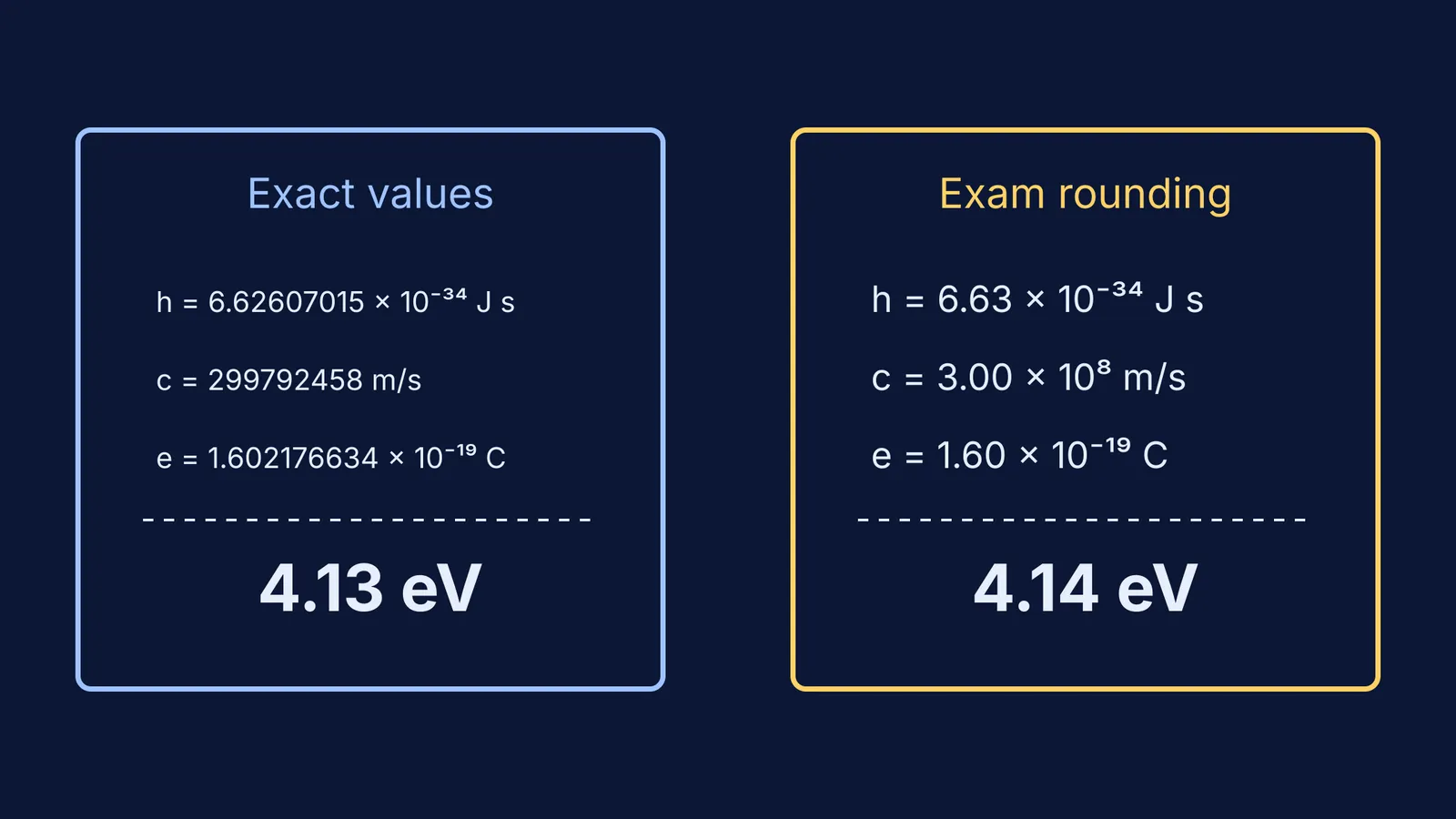
If you let a standard AI compute this, it uses exact CODATA values:
Planck's constant (h) = 6.62607015 × 10⁻³⁴ J s
Speed of light (c) = 299792458 m/s
Elementary charge (e) = 1.602176634 × 10⁻¹⁹ C
Applying E = hc / (λe), the AI calculates 4.13 eV.
But exam papers like JEE often instruct candidates to use specific rounded values to make calculations feasible without a calculator:
h = 6.63 × 10⁻³⁴ J s
c = 3.00 × 10⁸ m/s
e = 1.60 × 10⁻¹⁹ C
Using these standard exam approximations yields 4.14 eV. If you trust the general AI, you will enter the wrong number and lose the marks, despite understanding the concept perfectly.
How can you force an AI to follow exam rules?
If you are using an AI to check your work, you have to be explicit. You cannot just paste the problem text; you must also paste the data sheet from the front of the exam paper. Add a prompt saying, "Use exactly g = 10 m/s² and π² = 10."
Even with explicit instructions, standard chatbots sometimes slip back into using their memorised precise values halfway through a long derivation.
This is where purpose-built educational tools differ from open-ended chat interfaces. When a student brings a problem set, Fermi's AI tutor works out what they already know, builds a plan for the session, and teaches through it—reading the problem text carefully to apply the exact approximations demanded by the examiner.
Furthermore, if you are struggling with calculations, the Fermi Problem Library has worked problems with a step-by-step solver that explains the reasoning rather than printing an answer. This keeps the focus on the method, ensuring you know how to apply the right constants yourself.
What is the best strategy for students?
To avoid losing marks to rounding mismatches, build these habits into your daily practice:
Check the front page of the question paper: Exams like JEE and NEET always include a data table. Never overwrite given data.
Consult the NCERT Appendix: If the question does not provide the constant, flip to the back of your NCERT textbook. The values there are the standard for CBSE and NTA exams.
Use the right tools: Treat general AI bots with caution for numerical answers. If you need step-by-step help, use a structured tutor that respects exam constraints.
Delay your rounding: Keep expressions as fractions or multiples of π for as long as possible. Only plug in the constants at the final step.
Audit the AI: Prompt the chatbot with, "List the exact values of all physical constants you used in this calculation." You can then spot any divergence instantly.


