

On this page
Sometimes you give an AI tutor a genetics problem, and the final ratio feels wrong. Even as AI becomes more advanced, it frequently stumbles when asked to trace traits across generations and multiple genetic pathways.
Because an AI is a language model and not a biological simulator, it calculates probabilities based on word frequencies rather than tracking alleles. According to a 2024 University of California, Berkeley study, AI-generated math hints failed quality checks 32% of the time without mitigation. The researchers found that while specific prompting techniques could fix basic algebra, error rates for statistics remained at 13%. Genetics problems, which rely heavily on statistical probability and multi-step logic—especially when navigating Mendelian disorders—expose these exact weaknesses and mathematical flaws.
Why do AI tutors get genetics ratios wrong?
AI models look for patterns in language rather than applying biological laws from scratch. When asked about an X-linked recessive trait (such as colour blindness), an AI often falls into a symmetry trap.
For example, if you cross a carrier mother and a healthy father, the mother has a one-in-two chance of passing on the recessive gene. An AI might read this text and wrongly conclude that half of all the offspring will automatically be affected—or that exactly half of the sons and half of the daughters will inherit the condition without distinction.
What it misses is the "protective X" chromosome. A healthy father always passes a healthy X chromosome to his daughters. The daughters will never be affected, even if they inherit the recessive gene from their mother; they will only be carriers. The AI misses this strict biological constraint because it defaults to applying the same probability symmetrically to both sexes, completely disregarding the fundamental mechanism of X-linked inheritance.
How to check an AI wrong genetics ratio?
If an AI gives you an answer that feels incorrect, do not type, "Are you sure?" The AI will often apologise and confidently invent a new, equally wrong answer to please you.
Instead, use active learning. Active drawing of genetics mechanisms is an established undergraduate learning tool (Advances in Biology Laboratory Education, 2023). When you manually draw the cross yourself on paper, you force your brain to process the biological reality rather than just reading a text summary. Before asking an AI to solve a complex pedigree or a test cross vs back cross scenario, follow these fundamental steps to verify its logic:
Write down the parental genotypes carefully.
Identify the specific gametes each parent can produce.
Draw a Punnett square and fill in every cell.
Count the results manually.
A step-by-step example: The X-linked cross
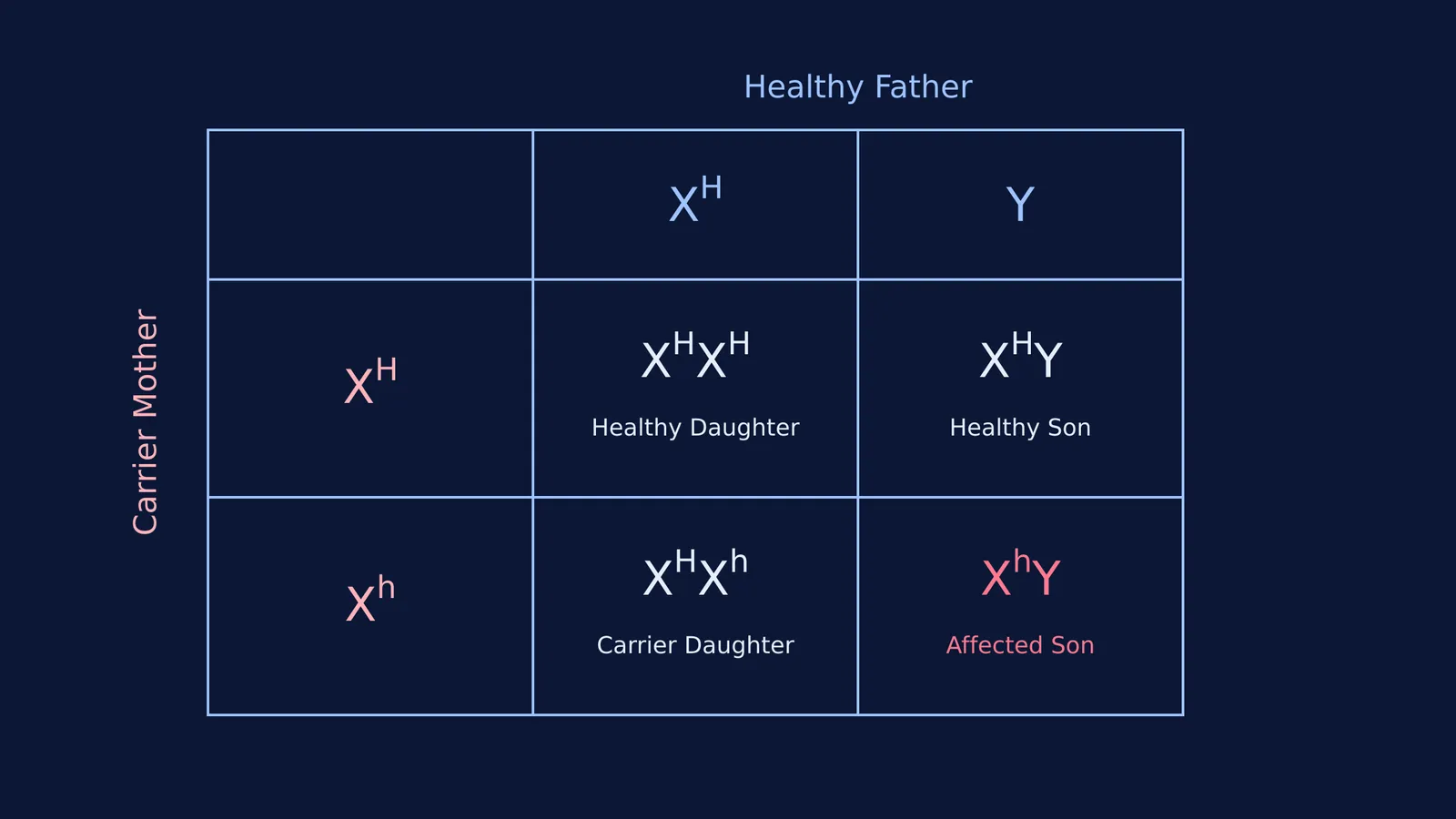
Let us map out the exact cross that confuses AI so frequently: a carrier mother (X^H X^h) and a healthy father (X^H Y).
Mother's gametes: X^H and X^h
Father's gametes: X^H and Y
When you construct the 2×2 grid on your paper:
The top-left cell combines X^H and X^H (a healthy daughter).
The bottom-left cell combines X^h and X^H (a carrier daughter).
The top-right cell combines X^H and Y (a healthy son).
The bottom-right cell combines X^h and Y (an affected son).
By looking at your own work, the real ratio is obvious. All the daughters are healthy (though some are carriers), and half of the sons are affected. If the AI stated that a different proportion of children are affected, you have just proved it wrong using basic principles.
A better way to learn genetics
To avoid these logic traps entirely, use tools designed to teach rather than simply output text. Fermi's AI tutor is built to hold a line of reasoning across a session. Rather than acting as a black box, it works out what you already know and teaches through it.
When you use the Fermi Problem Library for genetics, it provides a step-by-step solver that explains the reasoning. You can also review every concept in physics, chemistry, biology, mathematics and computing in the Fermi Concept Library, each with its own lesson and its place in the map, ensuring that you build a strong foundation before relying on software.
Remember: AI is an excellent study partner, but the final check must always happen on your own paper.


