

On this page
If you take a brand new deck of playing cards and shuffle it three or four times, you might assume it is thoroughly mixed. However, mathematics shows that the original order is still largely intact. Finding out exactly how fast that order disappears reveals a surprising rule about randomness and a phenomenon that completely changes how casinos and mathematicians handle cards.
Why does it take exactly seven shuffles?
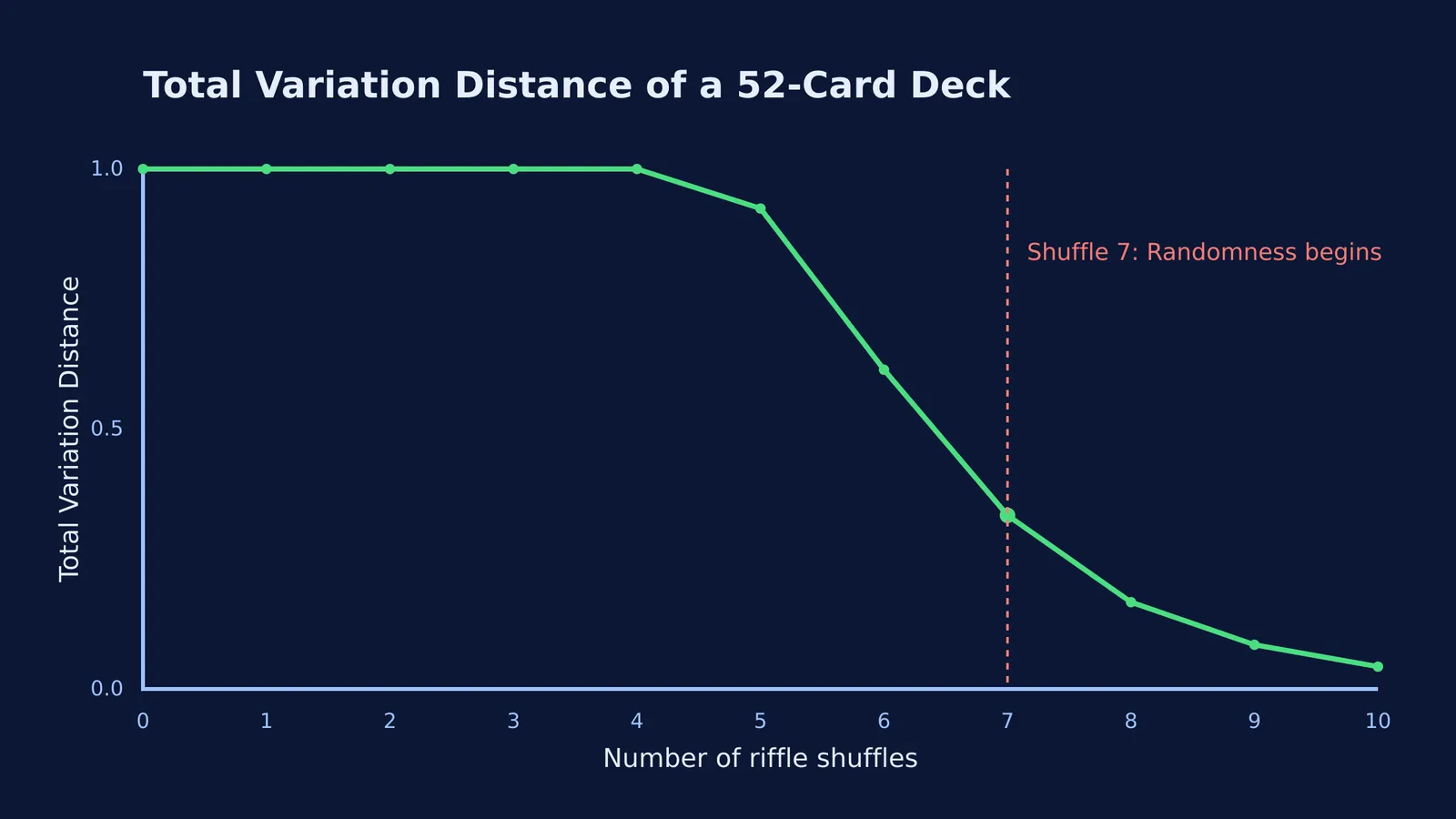
The definitive answer came in a 1992 paper by mathematicians Dave Bayer and Persi Diaconis, who tracked the probabilities of every possible card arrangement. They measured the Total Variation Distance, a metric where 1.0 means the deck is completely predictable and 0.0 means every possible order is equally likely.
They found that for a 52-card deck, the distance stays near 1.0 for the first four riffle shuffles. At shuffle five, the distance drops slightly to 0.924. At shuffle six, it falls to 0.614. Finally, at the seventh shuffle, it plummets to 0.334, the point where the deck crosses into being mathematically unpredictable for most practical games. By shuffle nine, the distance is just 0.085.
What is the cutoff phenomenon?
The most striking part of the Bayer-Diaconis proof is that a deck does not become gradually more mixed. Instead, it exhibits the cutoff phenomenon.
Imagine mixing cold milk into hot tea. The tea does not slowly turn beige; the milk forms a cloud that suddenly disperses through the whole cup. Similarly, a deck of cards holds onto its internal structures, called rising sequences, for several shuffles. A new deck has one rising sequence (the cards are perfectly in order). Each perfect riffle shuffle can at most double the number of rising sequences.
Because four shuffles create a maximum of 16 sequences, they cannot mimic randomness. The structural collapse only happens between the fifth and seventh shuffle.
How can you test the shuffle math yourself?
Reading about probability is one thing, but predicting and testing the result yourself is the best way to understand the cutoff phenomenon. Much like testing probability in a Secret Santa simulation, running the experiment reveals how quickly order breaks down. Here is a simple test to try at home:
Take a 52-card deck and arrange it in new-deck order (Ace through King of Spades, Hearts, Clubs, then Diamonds).
Perform one standard riffle shuffle, cutting the deck roughly in half and letting the cards interleave.
Turn the deck face up and deal through it slowly. Look for the Spades. You will find that they are still mostly in order, just interleaved with other suits.
Record how many separate "runs" of originally ordered cards you can spot.
Shuffle again and repeat. You will see the runs double.
Track the deck through the fifth and sixth shuffles. You will suddenly find it nearly impossible to predict the next card.
Why does predicting outcomes improve learning?
The card shuffle experiment works because it forces you to guess the state of the deck before you flip it over, turning passive reading into active learning. When you predict an outcome, you have to build a mental model of how the system works, which is similar to asking what-if questions to understand physics deeply.
Active learning requires you to commit to a prediction before you see the answer. If a concept is hard to picture, you can build intuition through physical experiments, or use the Fermi Simulation Lab for the ideas that are easier to see than to read. When you test a prediction and get it wrong, your brain is primed to understand exactly why the math behaves the way it does.


