

On this page
An Atwood machine is two masses hung from one string over a pulley. George Atwood invented it in 1784 as a laboratory experiment to check the laws of motion under constant acceleration. It is a standard Class 11 and JEE mechanics problem, and it suits a simulation because you can change one mass and watch acceleration and tension respond.
Below are six predictions to write down before you press play. A 2004 study by Crouch, Fagen, Callan and Mazur found that students who only watched a physics demonstration understood it no better than students who never saw it, while students who predicted the outcome first showed significantly greater understanding.
What are the Atwood machine formulas for acceleration and tension?
In the ideal case the pulley is massless and frictionless and the string is massless and does not stretch. MIT's physics notes list three assumptions behind equal tension on both sides: a massless pulley, a frictionless pulley and a massless rope. With m1 as the heavier mass:
Acceleration of each mass: a = (m1 − m2)g / (m1 + m2)
Tension in the string: T = 2m1m2g / (m1 + m2)
Both come from writing Newton's second law for each block and adding the two equations. For the heavier block, m1g − T = m1a. For the lighter one, T − m2g = m2a. If free-body diagrams still feel shaky, our five-step method for Newton's second law with free-body diagrams covers them, and pulley constraint relations explains why both blocks share the same size of acceleration.
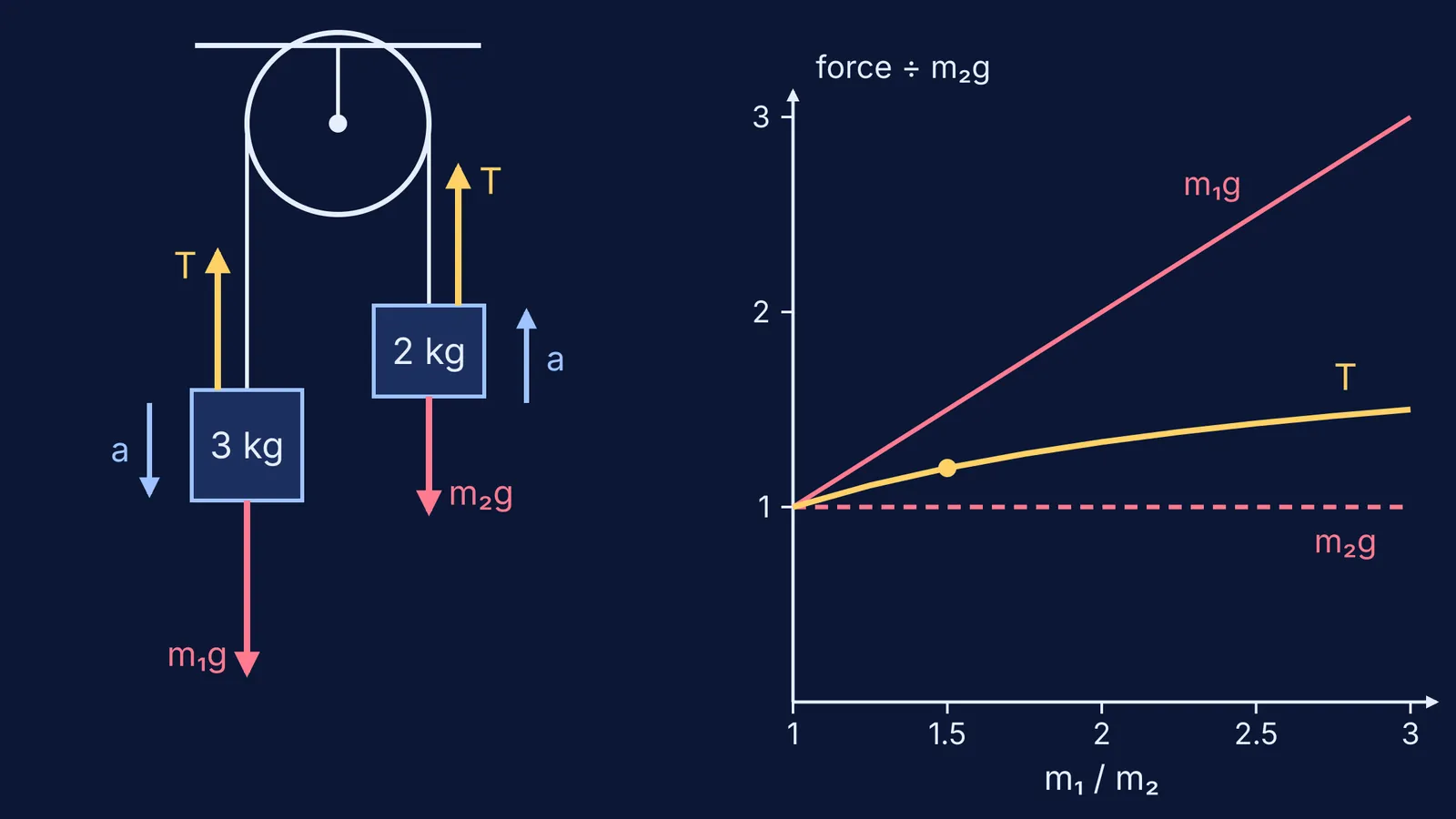
A worked example: 3 kg and 2 kg
Take m1 = 3 kg, m2 = 2 kg and g = 9.8 m/s².
Weights: m1g = 29.4 N and m2g = 19.6 N.
Acceleration: a = (1 × 9.8) / 5 = 1.96 m/s², heavier block down, lighter block up.
Tension: T = (2 × 3 × 2 × 9.8) / 5 = 23.52 N.
Check with the heavier block: 29.4 − 23.52 = 5.88 N, and 3 × 1.96 = 5.88 N. It matches.
Check with the lighter block: 23.52 − 19.6 = 3.92 N, and 2 × 1.96 = 3.92 N.
If a simulation disagrees, check its value of g and whether its pulley has mass.
Six predictions to test in the simulation
Keep m2 at 2 kg and change only m1. Predict each answer before you run it.
m1 = 4 kg. Prediction to check: a = 3.27 m/s², T = 26.13 N.
m1 = 2.5 kg. a falls to 1.09 m/s², T to 21.78 N.
m1 = 2.1 kg. a is only 0.24 m/s², and T is 20.08 N, very close to the lighter weight of 19.6 N.
m1 = m2 = 2 kg. a is zero and T is exactly 19.6 N. Give the blocks a push: they keep moving at a steady speed, because, as the Wikipedia article notes, equal masses are in neutral equilibrium.
m1 very large, say 100 kg. a gets close to g, the free-fall limit, and T heads towards twice the lighter weight: 38.43 N here, against a limit of 39.2 N. Both limits follow from the two formulas.
Swap the masses. Same size of a, opposite direction, same T. If your answer changed, recheck your signs.
Why is the tension between the two weights?
The lighter block speeds up upwards, so the string must pull it with more than its weight (T − m2g = m2a, positive). The heavier block speeds up downwards, so the string pulls it with less than its weight (m1g − T = m1a, also positive). Put together, m2g < T < m1g whenever the masses differ.
A neater view: with weights W1 = m1g and W2 = m2g, T = 2W1W2 / (W1 + W2), the harmonic mean of the two weights. A mean always lies between the numbers it averages, and this one leans towards the smaller, which is why 23.52 N is nearer 19.6 N than 29.4 N.
A common mistake is to say T = m1g. That would leave the heavier block with zero net force, so it could not accelerate.
How to run this as a 15-minute study session
Write the two Newton's-law equations from memory.
Predict a and T for the six cases, on paper.
Run each case and mark every miss.
For each miss, write one sentence on why: a sign, the value of g, or the tension mistake.
Sketch T against m1 and mark where it meets the lighter weight.
The same predict-then-test routine works for other topics, as in our post on learning projectile motion with a simulation. The Fermi Simulation Lab has interactive simulations for the ideas that are easier to see than to read. If you get stuck working out why a prediction failed, Fermi's AI tutor can work through it with you, drawing the figure and checking your understanding as it goes.


