

On this page
When you study physics or mathematics, reviewing notes can create a false sense of security. In their 2002 study in *Cognitive Science*, psychologists Leonid Rozenblit and Frank Keil documented the illusion of explanatory depth: learners believe they understand causal mechanisms thoroughly until forced to explain every step, at which point their self-assessed competence drops sharply.
In competitive exams like JEE and NEET, textbook exercises often reinforce autopilot habits: you see a flat floor, write N = mg, and move on. Asking an AI chatbot for ordinary "practice problems" simply reproduces predictable exercises. To expose genuine gaps before test day, invert the prompt: ask the AI for targeted trap questions designed around predictable cognitive slips. In their 1998 review of 250 studies in *Assessment in Education*, Paul Black and Dylan Wiliam found that diagnostic assessments confronting misconceptions yield learning gains between 0.4 and 0.7 standard deviations.
Why should you ask AI for trick questions on a concept?
Standard quizzes test whether you remember a formula; diagnostic trick questions test whether you understand the conditions under which it holds. Prompting an AI to catch your slips forces the model to test boundary conditions where routine shortcuts fail.
Physics education research shows why this active challenge is essential. In their 1992 Force Concept Inventory study in *The Physics Teacher*, David Hestenes, Malcolm Wells, and Gregg Swackhamer reported that while over 80% of students could recite Newton's third law at the start of term, fewer than 15% demonstrated genuine conceptual understanding after conventional instruction. Treating contact forces as fixed numbers rather than dynamic constraints remains a widespread obstacle.
How does a classic physics trap work on an incline?
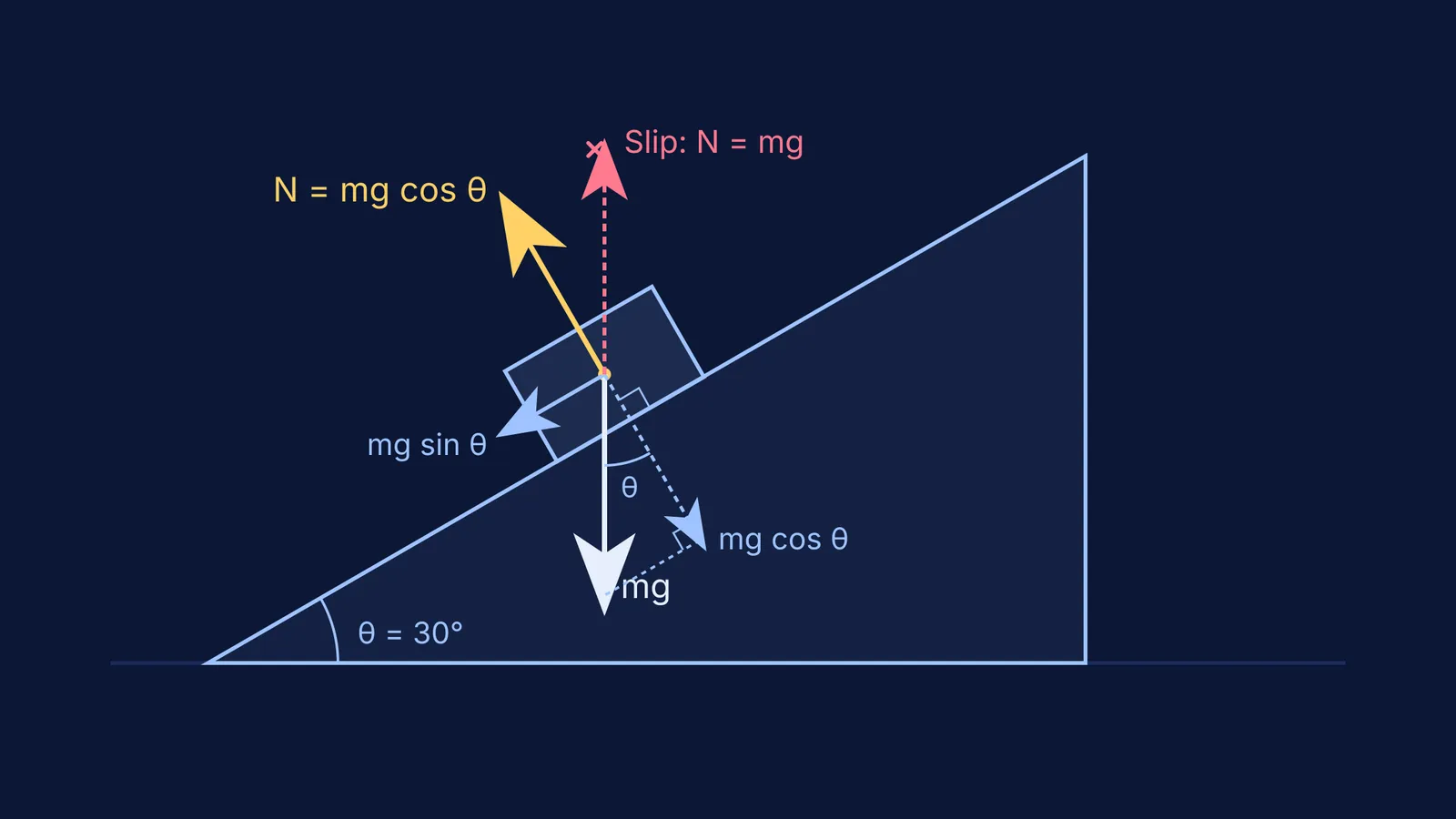
Consider a classic mechanics slip: calculating the normal force on a slope. On a flat floor, the upward normal force balances downward gravity: N = mg. This formula easily becomes an unthinking reflex.
Now consider a diagnostic trap question: a block of mass m = 5 kg sits on a rough ramp inclined at θ = 30° to the horizontal. What is the normal force exerted by the ramp? (Take g = 9.8 m/s²).
A common reflex is to answer 49 N (5 kg × 9.8 m/s²). That is the trap. The normal force acts perpendicular to the surface. On an incline, only the perpendicular component of gravity presses the block into the ramp:
N = mg cos θ = (5 kg)(9.8 m/s²)(cos 30°) = 49 × (√3 / 2) ≈ 42.4 N
Because cos 30° ≈ 0.866, the normal force drops to 42.4 N, which is 6.6 N below the object's flat-ground weight. Using N = 49 N corrupts every subsequent step, from friction to acceleration, a slip common in five JEE mechanics mistakes and problems finding the time for a block to slide down a rough incline. If you also push horizontally with force F = 20 N, the push adds a perpendicular component: N = mg cos θ + F sin θ = 42.4 N + 10 N = 52.4 N.
How can you prompt an AI to design diagnostic trap questions?
To prevent an AI from outputting routine calculations, give your prompt three clear rules:
Target specific misconceptions: Ask the model to test known student slips, like treating normal force as constant or ignoring water auto-ionisation in pH.
Require diagnostic distractors: Mandate four options where every wrong answer stems from a distinct reasoning flaw.
Withhold answers: Require the AI to grade your step-by-step reasoning before revealing the solution.
You can use this prompt:
"Act as a strict physics examiner. I am studying Newton's laws on inclined planes. Generate one multiple-choice question designed to catch a common conceptual trap, such as misidentifying the normal force. Provide four options where each incorrect answer represents a specific misconception. Do not give the answer or working yet. Ask for my choice and derivation first."
For broader strategies, review our guide on rules and example prompts for AI quizzes. When practicing, Fermi's AI tutor teaches rather than answers: it holds a line of reasoning across a session, notices where a student is stuck, and decides whether to explain, ask, or show.
What should you do after falling into a concept trap?
When an AI trap catches you, turn the slip into lasting retention with a four-step check:
Identify the assumption: Write out the unverified shortcut you took, such as assuming N equals mg.
State the physical law: Identify the governing rule—here, Newton's second law perpendicular to the surface (Σ F_perp = 0).
Check the limits: Test θ = 0° (N = mg) and θ = 90° (N = 0) to ensure the equation behaves at extreme boundaries.
Request a counter-variation: Ask the AI for a problem varying the setup, such as a block on an incline inside an accelerating elevator.
To see full reasoning paths, the Fermi Problem Library provides worked problems with a step-by-step solver that explains the reasoning rather than printing an answer. If rotating axes is difficult to visualize, the Fermi Simulation Lab offers interactive simulations for ideas that are easier to see than to read.


