

On this page
When you ask an AI chatbot to explain a physics derivation or calculus principle, the reply almost always arrives as a dense wall of text or a bare formula. You read the fluent sentences, glance at the symbols, and nod along. Everything sounds authoritative, making it easy to assume you understand. Yet when you face a fresh numerical in an exam, that clarity evaporates.
This breakdown happens because a single representation creates an illusion of competence. Words describe mechanisms loosely, while equations can be manipulated without understanding the physical system. To verify an AI's explanation and build durable mastery, prompt the tool for four distinct representations: words, an equation, a graph, and a worked numerical example. Then, check whether all four agree.
Why should you ask AI for multiple representations?
In learning science, relying on one format is a known obstacle to deep understanding. In *Learning and Instruction*, Shaaron Ainsworth outlined the DeFT framework for learning with multiple representations, identifying three cognitive functions:
Complementary roles: Words explain causality, equations specify exact relations, graphs display continuous variation, and numerical examples anchor physical scale.
Constraining interpretation: An explicit representation prevents misinterpreting an ambiguous one; a graph with a horizontal asymptote prevents assuming a quantity grows without bound.
Constructing deeper insight: Translating between formats forces learners to build a coherent mental schema rather than memorising isolated symbols.
Physics education research shows that representational fluency separates experts from beginners. In the *American Journal of Physics*, Alan Van Heuvelen showed that expert physicists routinely sketch qualitative representations—such as free-body diagrams and graphs—before touching a formula, whereas novices hunt blindly for equations. Furthermore, Patrick B. Kohl and Noah D. Finkelstein found that student performance varied dramatically across verbal, mathematical, and graphical formats on identical problems, with students' format preferences correlating poorly with actual competence.
How do language models get confused between formulas and graphs?
Large language models generate text by predicting likely token sequences. They readily recall equations and algebraic derivations because formula syntax appears abundantly in their training datasets. However, coordinating symbolic expressions with graphical behaviour and physical intuition exposes a critical blind spot.
In a 2024 study in *Physical Review Physics Education Research*, Giulia Polverini and Bor Gregorcic evaluated ChatGPT-4 on the 26-item Test of Understanding Graphs in Kinematics (TUG-K). The AI model achieved an average score of only 10.85 out of 26, an accuracy of 41.7%. More strikingly, its accuracy on visual interpretation was just 30.9%. Even when the model quoted correct physical laws in text, it regularly misread slopes, confused axes, and misidentified how curves bend.
This gap makes unexamined AI answers hazardous. If you only request a formula, you miss the contradictions in its reasoning. For more on catching these errors, see our guide on when AI gets physics wrong.
When a concept is difficult to visualise from text alone, dynamic visual environments make mechanics tangible. The Fermi Simulation Lab provides interactive simulations for the ideas that are easier to see than to read.
How do you structure the four-part prompt for AI?
To make an AI chatbot provide a rigorous explanation, demand all four representations at once, adapting Van Heuvelen's representational approach:
"Explain [Concept] across four representations:
Words: The physical mechanism in plain language.
Equation: The formula, defined variables with SI units, and boundary conditions.
Graph: The plot of dependent versus independent variable, including intercepts, initial slope, curvature, and asymptotes.
Worked example: Realistic numbers calculated at t = 0, t = τ, and t = 5τ, checking consistency."
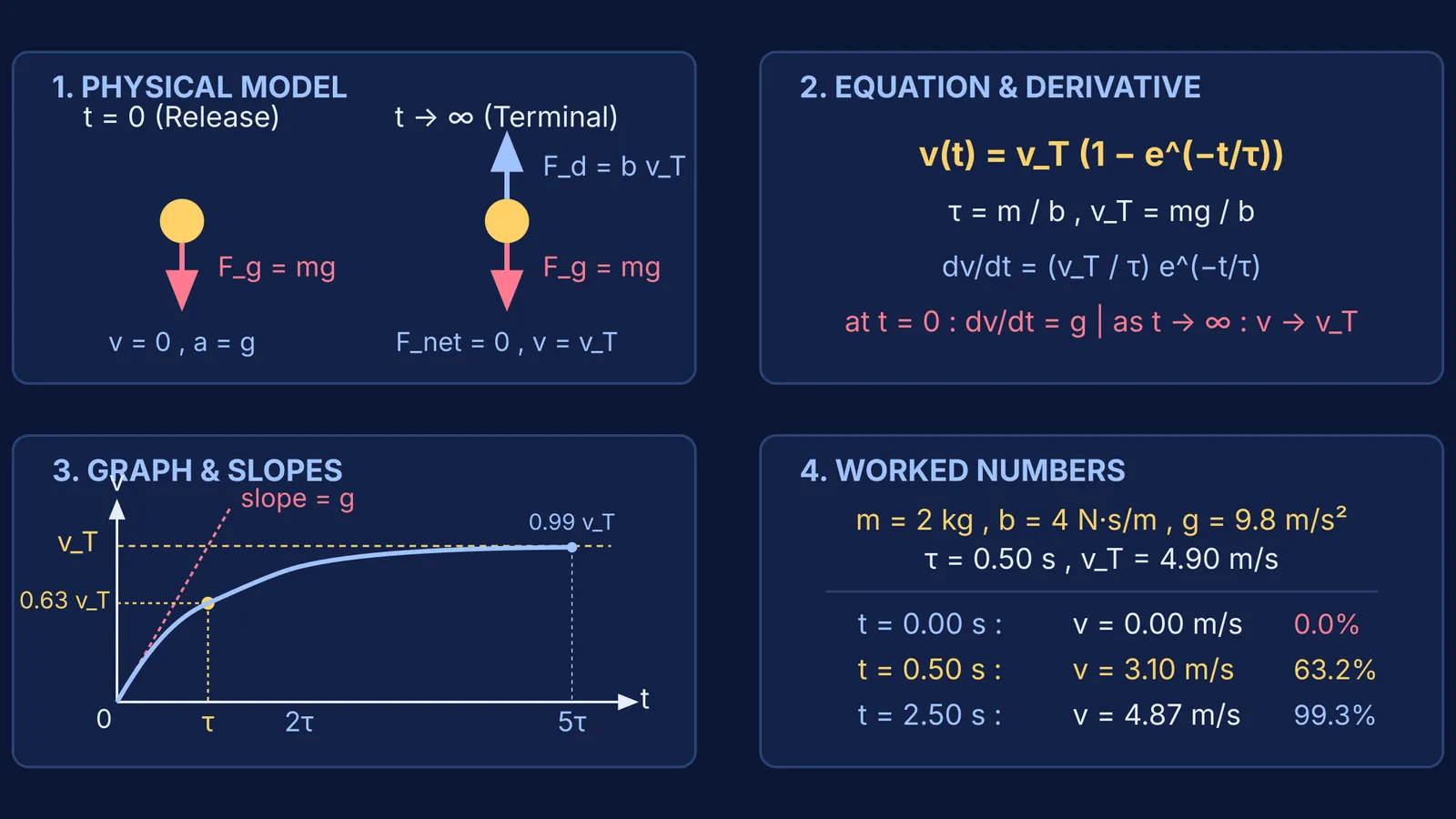
Here is how this four-part structure unpacks an object falling under linear air drag:
Words: Gravity pulls downward with force mg. As speed builds, drag bv increases. Net force decreases until drag balances gravity, reaching constant terminal velocity.
Equation: v(t) = v_T × (1 − e^(−t/τ)), with τ = m/b and v_T = mg/b. At t = 0, v = 0, a = g; as t → ∞, v → v_T, a → 0.
Graph: The v-t curve starts at (0, 0) with slope g, is concave downward, and asymptotes to v = v_T.
Worked example: With m = 2 kg, b = 4 N·s/m, g = 9.8 m/s², τ = 0.50 s and v_T = 4.90 m/s. At t = 0.50 s, v = 3.10 m/s (63.2% of v_T); at t = 2.50 s, v = 4.87 m/s (99.3%).
How do you check that all four representations agree?
Once the AI replies, treat the four parts as an audit checklist:
Check the origin: Does the graph's y-intercept match the equation at t = 0 and the example's starting value?
Check the initial slope: Does the equation's first derivative match the graph's initial slope? For slope pitfalls, see our guide on interpreting slopes and areas on physics graphs.
Check the asymptote: Does the horizontal asymptote match the equation as the independent variable approaches infinity?
Check the curvature: If words describe saturation, the second derivative must be negative and the curve concave downward.
Most conversational bots give an answer and stop. When you need interactive learning, Fermi's AI tutor teaches rather than answers: it holds a line of reasoning across a session, notices where a student is stuck, decides whether to explain, ask, or show, writes on a board, draws the figure, and checks understanding as it goes. For problem sets, the Fermi Problem Library offers worked problems with a step-by-step solver that explains the reasoning rather than printing an answer. For more on comparing tools, see our analysis of tutors that teach versus chatbots that give answers.
By turning every AI query into a four-representation challenge, you transform a passive chat into an active, verifiable learning workbench.


