

On this page
You set up the activity exactly as the book said, waited, and got something else. An unexpected result is data, and working out why it happened teaches more chemistry than a result that simply matches the answer key.
Why did my NCERT activity give a different result?
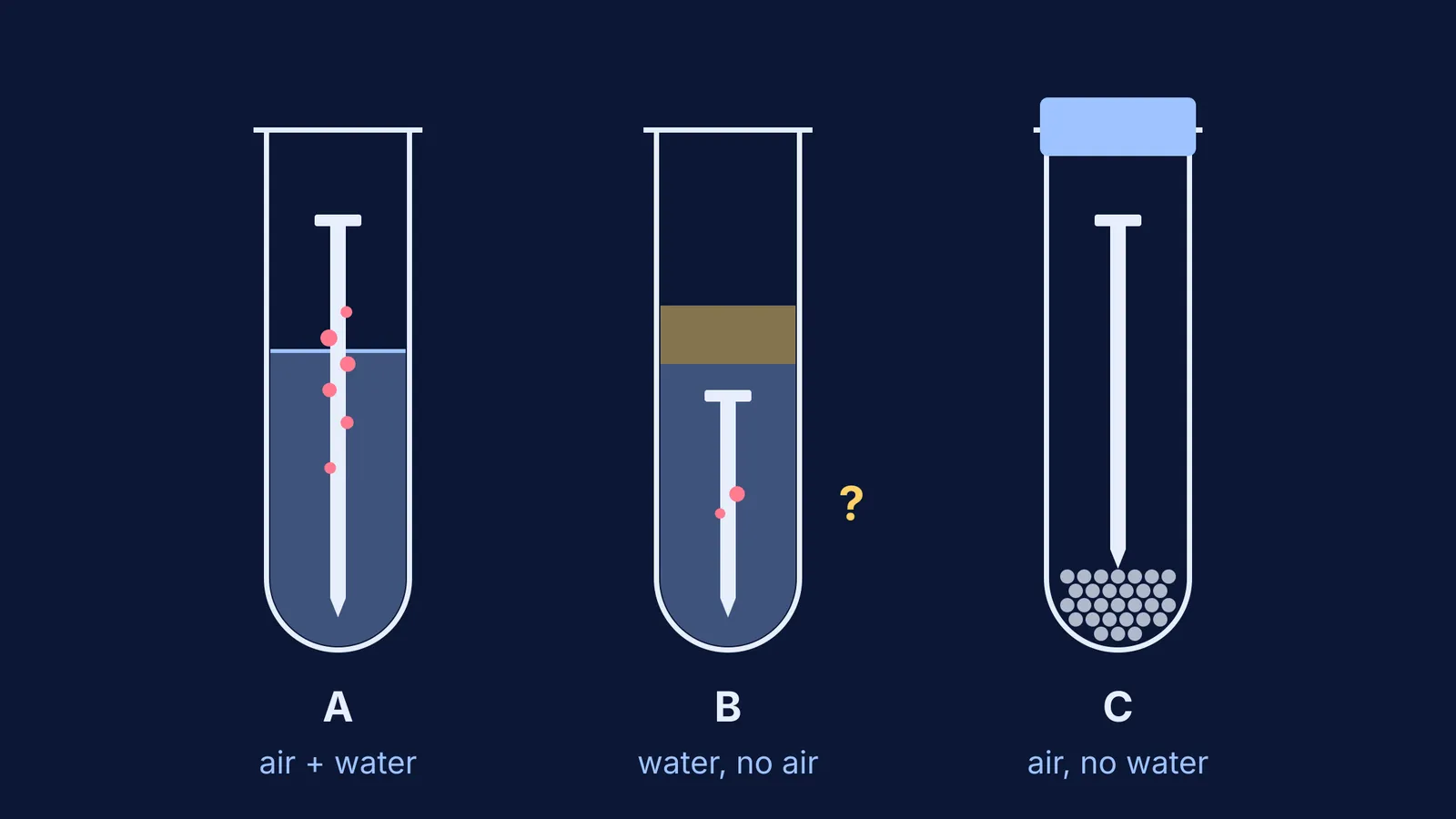
We'll use one example the whole way through: the rusting test from the chapter on metals and non-metals (our Class 10 metals and non-metals guide covers the theory). The Royal Society of Chemistry publishes a version of this experiment for schools. It uses four tubes; we'll follow the three that match the textbook. One nail goes in deionised water. One goes in boiled deionised water with a little oil poured over the surface “to prevent air from reaching the water”. One goes in a stoppered tube with anhydrous calcium chloride granules, which absorb water. The RSC says to leave the tubes for at least three days. Of these three, only the nail with both air and water should rust. (The RSC's fourth tube adds salt, which speeds up rusting.)
Now suppose the nail under oil shows a few brown spots too. Your job is to find out why.
How do I ask AI why my science activity result was different?
Don't ask “what is the right answer?” Ask for a list of possible causes, and for a way to test each one. Give the AI the details only you know, using this script:
“I did a rusting activity: three iron nails in test tubes, left for a few days.”
“Tube B had water I boiled, cooled, then covered with cooking oil. The nail rusted slightly. The textbook says it should not rust.”
“List the possible causes, most likely first. For each, tell me a test I can do safely at home and what result would support it.”
“Don't tell me which cause is correct. I want to find out myself.”
A reply might give causes like these. Treat every one as a guess you still have to check. AI can sound sure and still be wrong, so it is worth knowing how to check an AI's reasoning.
Air got back into the water while it cooled, before the oil went on.
The oil layer was thin or broken, so air reached the water.
The nail head stuck up through the oil into the air.
The nail already had tiny rust spots before you started.
How do I test each cause myself?
Change one thing at a time and keep everything else the same. Scientists call this the control of variables strategy. In a 1999 study in Child Development, Zhe Chen and David Klahr found that 7- to 10-year-olds given explicit teaching of this strategy, along with probe questions, could learn it and transfer it to new problems. Probe questions alone, without that teaching, did not help (ERIC summary).
For our rusty nail, that means one new tube for each cause, set up beside a fresh copy of tube B:
Air back in the water: have an adult pour the oil on straight after boiling, while the water is still hot, and let it cool under the oil.
Thin oil layer: pour a thicker layer of oil and check that it covers the whole surface.
Nail sticking out: use a shorter nail, or more water, so the whole nail sits under the oil.
Rust already there: rub the nail with sandpaper until it is bright, then compare it with an unrubbed nail from the same packet.
Leave all tubes for the same number of days and photograph them together. If only one change stops the rusting, you have good evidence for that cause.
What should my science activity write-up include?
Keep it to one page; reasoning matters more than results.
Question: Does iron rust in water if air is kept out?
What I did: Setup, materials, dates, and what was different from the book.
What I expected: The textbook prediction.
What I saw: Plain description and a dated photo.
Possible causes: The list, with “suggested by AI” next to the ones that came from a chatbot.
Tests and results: One line per test.
What I concluded: The cause your evidence supports, and how sure you are.
What I'd do next time: One change.
Starting from a question and running a fair test is also the core of a good school science project.
If a cause on the list depends on an idea you haven't met yet, such as how air dissolves in water, the Fermi Concept Library has a lesson for every concept in chemistry. Fermi's AI tutor is built to teach rather than just answer: it decides whether to explain, ask or show, which suits a student who wants to find the cause themselves.
Pick the activity that surprised you this week, write down what you saw, and set up your first test tube tonight.


