On this page
Cut a paper circle like a pizza and line the slices up in a row. Before you read on, predict: as the slices get thinner, what shape does the row become? Write your guess down. A 2021 review by Garvin Brod in Psychonomic Bulletin & Review argues that predicting is a learning strategy in its own right, citing initial evidence that a prediction makes a wrong guess more surprising and that the surprise draws attention to the correct answer.
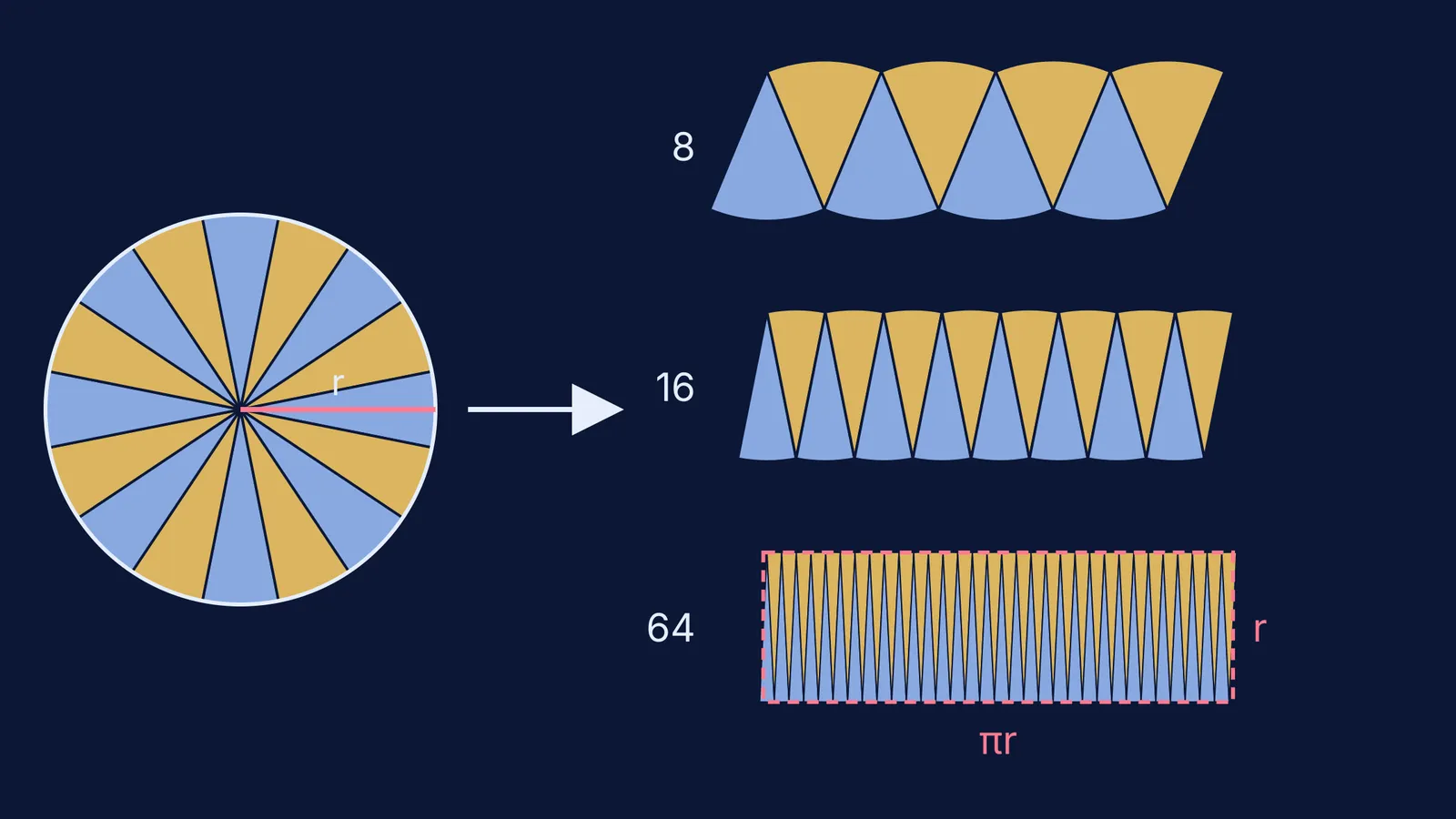
What happens when you cut a circle into 8, 16 and 64 sectors?
Lay the sectors alternately point-up and point-down, so neighbouring straight edges touch. Half the curved edges end up along the bottom, half along the top.
8 sectors: a lumpy row of scallops with leaning ends.
16 sectors: smaller waves, steeper ends; nearly a parallelogram.
64 sectors: from arm's length the bumps almost vanish. It looks like a rectangle.
The shape the row approaches is a rectangle. The Wikipedia article on the area of a circle credits a version of this rearrangement, using the triangles of an inscribed polygon instead of curved slices, to the Japanese mathematician Satō Moshun, Nicholas of Cusa and Leonardo da Vinci.
Why is the area of a circle πr²?
You need two facts, and neither of them is the area formula.
What π means. π is the ratio of a circle's circumference to its diameter (Wikipedia: Pi). So a circle of radius r has circumference π × 2r = 2πr.
Each slice's straight edges are radii. Every sector is r long from its point to its arc.
Now read the rectangle:
Height: from the bottom row of arcs to the top row is one slice's length, r.
Length: the arcs along the bottom are half of all the slices, so together they make half the circumference: ½ × 2πr = πr.
Area: length × height = πr × r = πr².
No slice was stretched or thrown away, so the rectangle has the same area as the circle.
How close do 8, 16 and 64 slices really get?
With n slices, each sector's angle is 360°/n. Using the triangle version of the argument and a calculator, here are three measures of how far the row is from a true rectangle:
Lean of the ends: half a sector angle. That is 22.5° for 8 slices, 11.25° for 16 and about 2.8° for 64.
Bumpiness: an arc sticks out beyond its straight chord by r(1 − cos(180°/n)). On a circle of radius 10 cm that is about 7.6 mm for 8 slices, 1.9 mm for 16 and 0.12 mm for 64, thinner than a pencil line.
Missing area: swap each slice for the triangle inside it. The triangles cover sin(360°/n) ÷ (2π/n) of the circle: about 0.900 for 8 slices, 0.974 for 16 and 0.998 for 64.
The gap keeps shrinking towards zero as n grows, which is why the answer is exactly πr² and not just roughly. The same shrinking-to-zero idea, the start of calculus, is behind finding areas by adding thin horizontal strips.
Is the rearrangement a real proof?
It is a convincing picture; 'looks like a rectangle' needs the limit argument above. Archimedes did the careful version. The first proposition of his *Measurement of a Circle* states that the area of any circle equals a right-angled triangle whose two shorter sides are the radius and the circumference (Measurement of a Circle). That triangle's area is ½ × r × 2πr = πr², the same answer. In the same work he drew 96-sided polygons inside and outside a circle to show that π lies between 3 10/71 and 3 1/7 (MacTutor biography of Archimedes).
India has its own chapter. Aryabhata's *Aryabhatiya*, dated to around 499 CE, gives correct formulas for the areas of a triangle and a circle, and approximates π as 62832/20000 = 3.1416 (Aryabhatiya). Centuries later, Madhava of Sangamagrama found infinite series for π.
A 20-minute plan for the kitchen table
Draw a circle of radius 8 cm on card with a compass.
Fold it in half three times and cut along the folds to get 8 sectors. Write your prediction.
Lay them point-up, point-down and measure with a ruler. Expect a length near πr, about 25 cm, and a height near 8 cm.
Repeat with 16 sectors (fold four times). What stays the same, and what changes?
Explain the result aloud in three sentences, saying 'πr²' only at the end.
Parents can ask questions instead of giving the answer: 'Which edge is the radius?', 'Where did the circumference go?' and 'What would 1,000 slices look like?'
Sixty-four slices is fiddly with scissors. Ideas that are easier to see than to read are what the Fermi Simulation Lab is for. To judge when moving pictures help, read what studies found about simulations and static diagrams. If π itself feels shaky, the Fermi Concept Library gives every mathematics concept its own lesson.