On this page
What is the angle between two lines formula?
When two straight lines intersect on a coordinate plane, they form two pairs of vertically opposite angles. By convention, we describe their relationship using the acute angle, θ.
If you know the slopes of the two lines, m₁ and m₂, you can predict the angle between them using this formula: tan θ = |(m₁ − m₂) / (1 + m₁m₂)|
The absolute value bars ensure that tan θ is positive, which gives the acute angle. If you need the obtuse angle, you simply subtract the acute angle from 180°. Testing this relationship visually helps you remember it; a landmark study found that failure rates under traditional lecturing increase by 55% over the rates observed under active learning (Source: PNAS, 2014).
How do you find the angle when slopes are 1 and −1?
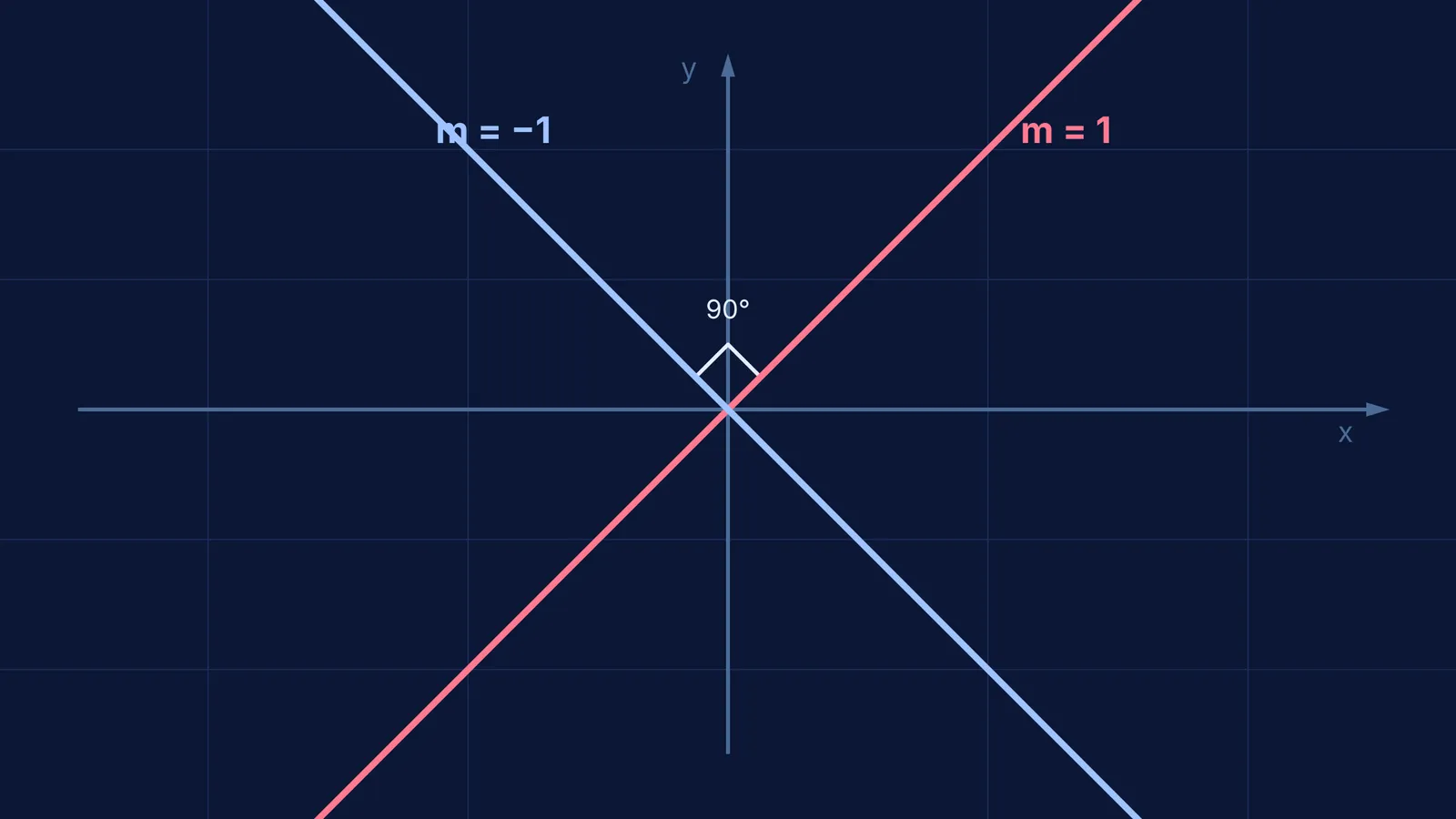
If one line has a slope of m₁ = 1 and the other has a slope of m₂ = −1, you can substitute these values directly into the denominator of the formula: 1 + m₁m₂ = 1 + (1)(−1) = 1 − 1 = 0
Because the denominator is zero, the fraction is undefined. In trigonometry, when the tangent of an angle is undefined, the angle is exactly 90° (or π/2 radians). This means the two lines are perpendicular, creating a perfect right angle at their point of intersection, regardless of where on the coordinate plane they meet.
You can also think about this geometrically. A line with a slope of 1 rises at a 45° angle to the positive x-axis. A line with a slope of −1 falls at a 135° angle. The difference between 135° and 45° is exactly 90°.
When are two lines perpendicular?
The case of slopes 1 and −1 points to a general rule that applies across all coordinate geometry. For any two non-vertical lines to be perpendicular, the angle between them must be 90°. This only happens when tan θ is undefined, which in turn requires the denominator of our formula to be exactly zero: 1 + m₁m₂ = 0 m₁m₂ = −1
If the product of the two slopes is −1, the lines are perpendicular. This is often written as m₁ = −1/m₂, meaning perpendicular lines have negative reciprocal slopes. (If one line is vertical, its slope is undefined, and a line perpendicular to it must be perfectly horizontal with a slope of 0, parallel to the x-axis.)
If you want to practice finding these properties, it helps to read related topics such as the condition for three lines to be concurrent or finding the circle through three given points.
How to test slope pairs interactively?
Instead of just memorising the m₁m₂ = −1 rule, it is better to change the slopes yourself and watch what happens to the intersection. The Fermi Simulation Lab provides interactive simulations for the ideas that are easier to see than to read. You can drag a line to make its slope steeper and instantly see how the acute angle changes.
When you attempt harder coordinate geometry questions, you might know the theory but still get stuck on the algebra. If that happens, the Fermi Problem Library has worked problems with a step-by-step solver that explains the reasoning rather than printing an answer, helping you spot exactly where your working went wrong.