

On this page
Why do students struggle with Class 12 maths proofs?
For CBSE board exams and JEE Main, Class 12 mathematics proofs often feel like exercises in rote memorisation. Students stare at multi-line derivations in calculus or matrices, memorise algebraic steps, and quickly forget the underlying logic.
Cognitive science explains why. In an eye-tracking study in the *Journal for Research in Mathematics Education*, researchers Matthew Inglis and Lara Alcock (Inglis & Alcock, 2012) found that undergraduates read proofs by scanning formulas sequentially. In contrast, mathematicians shifted their gaze between consecutive lines to infer the implicit "warrant"—the unstated theorem, definition, or axiom justifying each transition.
When students ignore warrants, comprehension collapses. In a follow-up study in the *Journal for Research in Mathematics Education*, Mark Hodds, Lara Alcock, and Matthew Inglis (Hodds et al., 2014) showed that training students to identify logical warrants and self-explain each step raised proof comprehension scores by 17% in lecture trials, with an effect size of d = 0.95 in individual trials, persisting across 4 weeks. Skipping this analysis creates persistent confusion when studying limits and continuity for JEE or classifying removable and jump discontinuities.
What questions should you ask an AI tutor about each line?
Most students treat AI chatbots passively, asking them to generate complete proofs and copying the output. This reproduces the textbook trap: you receive a finished derivation with intermediate justifications hidden.
To build genuine understanding, treat the AI as a dialogue partner. As Juan Pablo Mejía-Ramos and colleagues demonstrated in *Educational Studies in Mathematics* (Mejía-Ramos et al., 2012), proof comprehension requires breaking an argument into distinct dimensions: understanding local statements, uncovering warrants, and evaluating edge cases.
When working through formal mathematics, Fermi's AI tutor teaches rather than answers: it holds a line of reasoning across a session, notices where a student is stuck, and decides whether to explain, ask, or show.
Direct an AI tutor to scaffold any proof using four checks:
Warrant check: What definition, theorem, or axiom justifies this step?
Motivation check: Why introduce this substitution instead of working with original terms?
Condition check: Under what hypotheses is this operation valid, and where does it fail?
Goal check: How does this intermediate equality bring us closer to the conclusion?
How does line-by-line questioning work for continuity proofs?
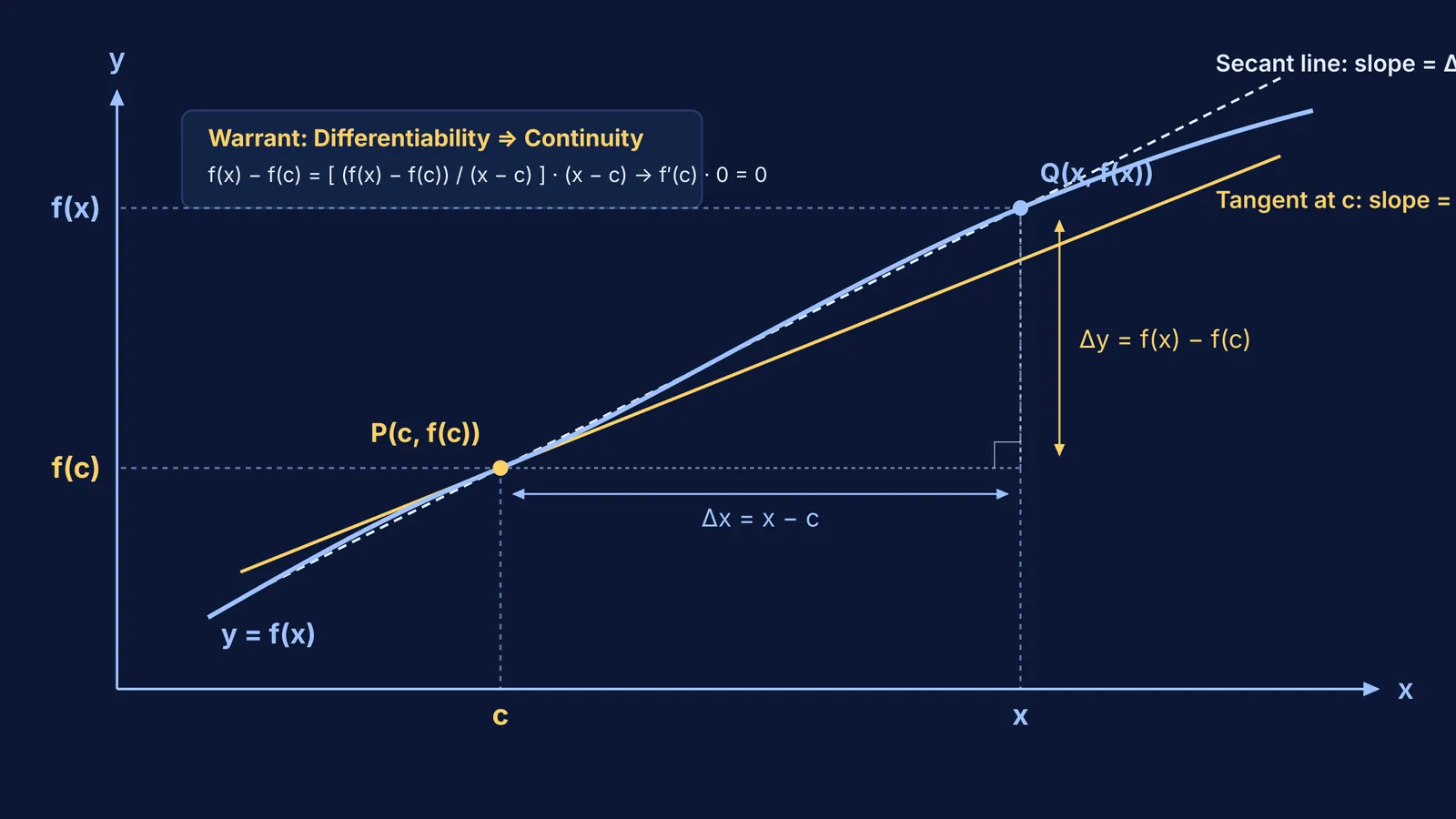
Consider the foundational calculus theorem: "If a function f is differentiable at point c, then f is continuous at c." Textbooks typically present this proof in five terse steps:
By definition, f′(c) = lim (x→c) [f(x) − f(c)] / (x − c) exists finitely.
For x ≠ c, write f(x) − f(c) = {[f(x) − f(c)] / (x − c)} × (x − c).
Take limits: lim [f(x) − f(c)] = lim {[f(x) − f(c)] / (x − c)} × lim (x − c).
Evaluate: lim [f(x) − f(c)] = f′(c) × 0 = 0.
Therefore, lim (x→c) f(x) = f(c), proving f is continuous at c.
To unpack this proof, ask your AI tutor about Line 2: "Why multiply and divide by (x − c)?" The AI explains that continuity requires showing f(x) − f(c) approaches 0. Because f(x) has no explicit formula, introducing the difference quotient links the unknown limit to the finite derivative f′(c).
Next, probe Line 3: "What warrant allows splitting the limit?" The AI highlights a strict condition: the limit product rule requires both factor limits to exist finitely. Because f′(c) exists and lim (x→c) (x − c) = 0, splitting is mathematically sound. Finally, asking "Does continuity imply differentiability?" prompts the AI to demonstrate why the converse fails at sharp corners using f(x) = |x| at x = 0.
How do you unpack matrix proofs with an AI tutor?
A parallel technique works in linear algebra. In NCERT Class 12 Chapter 3, students encounter the uniqueness theorem: "If A is an invertible square matrix, its inverse is unique."
The textbook proof proceeds as follows:
Assume B and C are both inverses of A, so AB = BA = I and AC = CA = I.
Write B = B × I = B × (AC).
Regroup by associativity: B = (BA) × C.
Substitute BA = I: B = I × C = C, proving B = C.
Students often memorise this derivation without seeing the mechanism. Ask your AI tutor: "Why is Line 3 the decisive step, and what algebraic law makes it legal?" The AI explains that while matrix multiplication is non-commutative, it is associative. Regrouping allows us to substitute BA = I, collapsing B into C.
The Fermi Problem Library has worked problems with a step-by-step solver that explains the reasoning rather than printing an answer. This inquiry also clarifies related properties, such as why the reversal law holds for the adjoint and inverse of a matrix.
Interrogating warrants transforms proofs from stressful obstacles into transparent, logical structures that stay with you through board exams and competitive tests.


