

On this page
When you first start solving mechanics problems, the language can feel like a riddle. Blocks are always "smooth", strings are always "light", and objects are constantly "just about to slip". These are not descriptive adjectives meant to paint a picture; they are strict mathematical constraints.
For the 1.47 million unique candidates who registered for the JEE Main in 2024 (NTA), fluency in this physics dialect was essential. Missing a single word often means missing the equation needed to solve the problem.
What do the tricky words in JEE questions actually mean?
Physics problems use standard terms to tell you which forces to ignore and which to maximize.
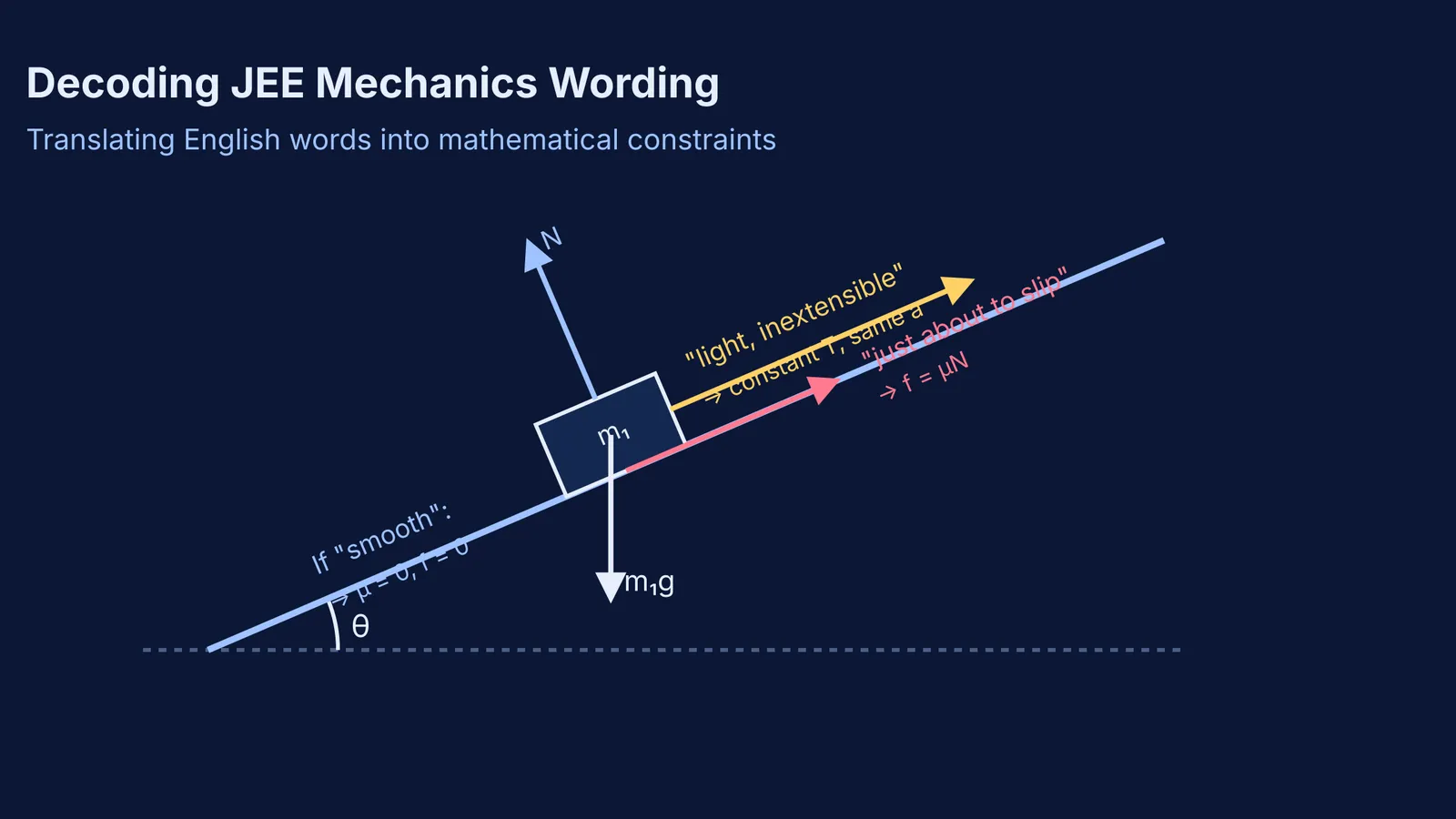
Smooth: This means you can entirely ignore friction (Mathcentre). The only contact force the surface exerts is the normal reaction perpendicular to it.
Just about to slip / just about to move: This phrase signals that the object is in a state of limiting equilibrium. The static friction has reached its absolute maximum value, allowing you to use the equation f = μN (Wikipedia). Any tiny increase in force will cause the object to accelerate.
If a question asks for the angle of repose or angle of friction, it is asking you to find the exact angle where the block is "just about to slip" down the incline.
Why does a string being "light" and "inextensible" matter?
Strings and pulleys appear in almost every Newton's laws problem, often described with two specific words that simplify your calculations:
Light: A light string or pulley is assumed to have zero mass. Because the string has no mass of its own to accelerate, the tension remains constant throughout its entire length. If you are pulling a spool by its string, you do not need to account for the weight of the string itself.
Inextensible (or inelastic): The string cannot stretch. This is a geometric constraint which guarantees that any objects connected by the string move together. If one block accelerates at a given rate, the other block must also accelerate at the exact same rate.
When a monkey is climbing a rope, the assumption that the rope is light and inextensible allows you to link the monkey's acceleration directly to the tension without calculating the rope's stretching energy.
How does AI explain JEE question wording?
If you are staring at a problem and do not know which equations to write down, it often helps to ask an AI to decode the language first. Instead of asking for the final answer, you can paste the question and ask: *What assumptions should I make from the wording?*
This is where a specialized tool like Fermi's AI tutor steps in. Most learning tools answer questions. Fermi teaches — it holds a line of reasoning across a whole session, notices where a student is stuck, and decides whether to explain, ask, or show.
A student can bring a problem set or a scanned assignment. Fermi works out what they already know, builds a plan for the session, and teaches through it — writing on a board, drawing the figure, and checking understanding as it goes. If a student misses the word "smooth", the tutor will pause and ask them what that word implies for the friction force, helping them build the vocabulary they need for the exam.


