On this page
When you review a practice test, the usual routine is to look at the questions you got wrong and read the solutions. If you are using an AI, you might paste the question and ask, "Why are options B, C, and D incorrect?" This helps you spot traps, but it leaves a dangerous gap in your understanding. Knowing how to eliminate a wrong answer is not the same as mastering the physics or mathematics that makes the right answer true.
To build a deeper understanding, you have to ask why the correct option holds. Educational research shows that this shift from passive review to active reasoning is one of the most effective ways to study.
Why does explaining the correct option improve learning?
Cognitive scientists call this process "self-explanation" or "answer justification". When you guess an answer or use a shortcut, you bypass the core concept. By forcing yourself to explain the correct option—or having a tutor guide you through it—you have to retrieve related ideas and build a logical bridge.
A 2018 meta-analysis of 64 studies found that students prompted to self-explain their answers showed a significant improvement in learning, with an effect size of Hedges' g = 0.55 (Bisra et al., 2018). This means students who explained the "why" behind the right answers consistently outperformed those who just checked their scores or read standard solutions.
A 2012 study showed that multiple-choice tests build stronger memory when students provide reasoning for their choices (Little et al., 2012). The effort of retrieving the justification locks the concept into long-term memory. When you merely read an answer key, you experience fluency—the text makes sense, and you assume you could have reproduced that logic on your own. This phenomenon is known as the illusion of competence. By forcing yourself to articulate the reasons aloud or in text, you shatter that illusion. The struggle to put the concept into words reveals exactly where your understanding is weak, allowing you to focus your study time on those precise gaps rather than re-reading material you already know.
Can you ask AI why the correct option is right?
If you are using an AI tutor, you can replicate this reasoning condition without needing a human teacher to check your logic. Instead of asking for the final solution, ask the AI to walk you through the foundational steps of the correct choice.
Fermi's AI tutor can work out what you already know and build a plan for the session, so you sit down to a clear next step. Rather than printing an answer, it holds a line of reasoning across a session, noticing where you are stuck and deciding whether to explain, ask, or show. It teaches you the concept from the ground up, much like learning derivatives from first principles.
How can you test your understanding with a new case?
When you evaluate an AI tutor, look for its ability to test your understanding with variations. Once you know why option A is correct, the true test of mastery is applying that rule to a changed scenario.
Changing a variable transforms a static memorization task into a dynamic problem-solving exercise. For instance, if you are studying a physics problem about a block sliding down an inclined plane, do not just memorize the final formula for acceleration. Instead, ask the AI what would happen if the friction coefficient doubled or if the incline angle increased. This forces you to trace the effect of a single change through the entire system.
Try this three-step framework when reviewing your next mock test:
Identify the gap: Pick a question where you guessed the right answer or used the process of elimination.
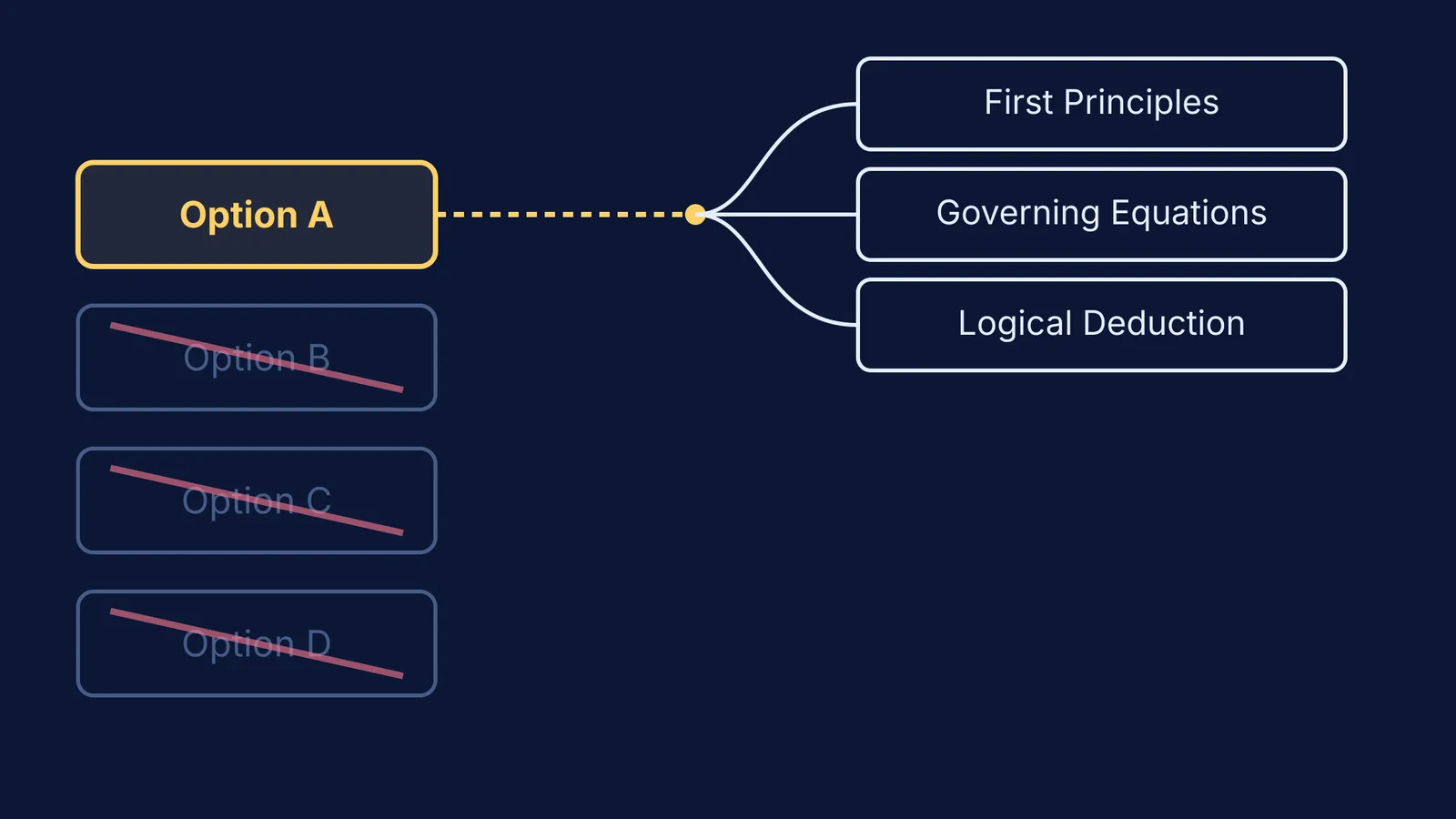
Prompt for first principles: Ask the AI, "Explain why option A is mathematically correct from first principles, without just proving B, C, and D are wrong."
Change a variable: Once the AI explains the rule, test yourself. Ask, "If I change the mass to 2m, or double the velocity, does this option still hold? Ask me a follow-up question to check my logic."
This active engagement prevents the illusion of competence. Can AI tutors teach better than chatbots that give answers? Yes, precisely because they act as a sounding board for your reasoning, catching the small flaws in your mental model before the actual exam does.