

On this page
Probability in Class 10 introduces classical probability, which relies on a simple, logical rule: count the outcomes you want, and divide by the total number of possible outcomes. But this math only works if all the outcomes have the exact same chance of happening. When working through complex problems, especially when using an AI to practice, an excellent habit you can build is to list out every single outcome first before attempting any division.
What is the sample space in Class 10 probability?
In probability theory, the sample space of an experiment is the set of all possible outcomes of that experiment (Wikipedia). If you skip writing this out, it is incredibly easy to miscount or group outcomes together in a way that breaks the mathematics completely.
In the Class 10 syllabus, you are moving away from experimental probability—where you actually toss a coin 100 times and count the heads—and moving toward theoretical probability. For the theoretical math to work, the outcomes in your sample space must be "equally likely." Outcomes of an experiment are equally likely if there is no reason to expect one outcome in preference to the others (Wikipedia).
If you do not list your sample space, you might accidentally count a group of outcomes as a single event, which ruins the equal likelihood requirement.
Are "two heads" and "one of each" equally likely?
A classic mistake happens when a student or an AI tries to evaluate tossing two coins without writing down the space. If you try to do the counting in your head, you might naturally conclude there are three possibilities: two heads, two tails, or one of each.
This exact trap is often found in Class 10 exercises, which ask students to evaluate whether the probability of each of these three grouped outcomes is 1/3. The argument is completely incorrect because these three groups are not equally likely.
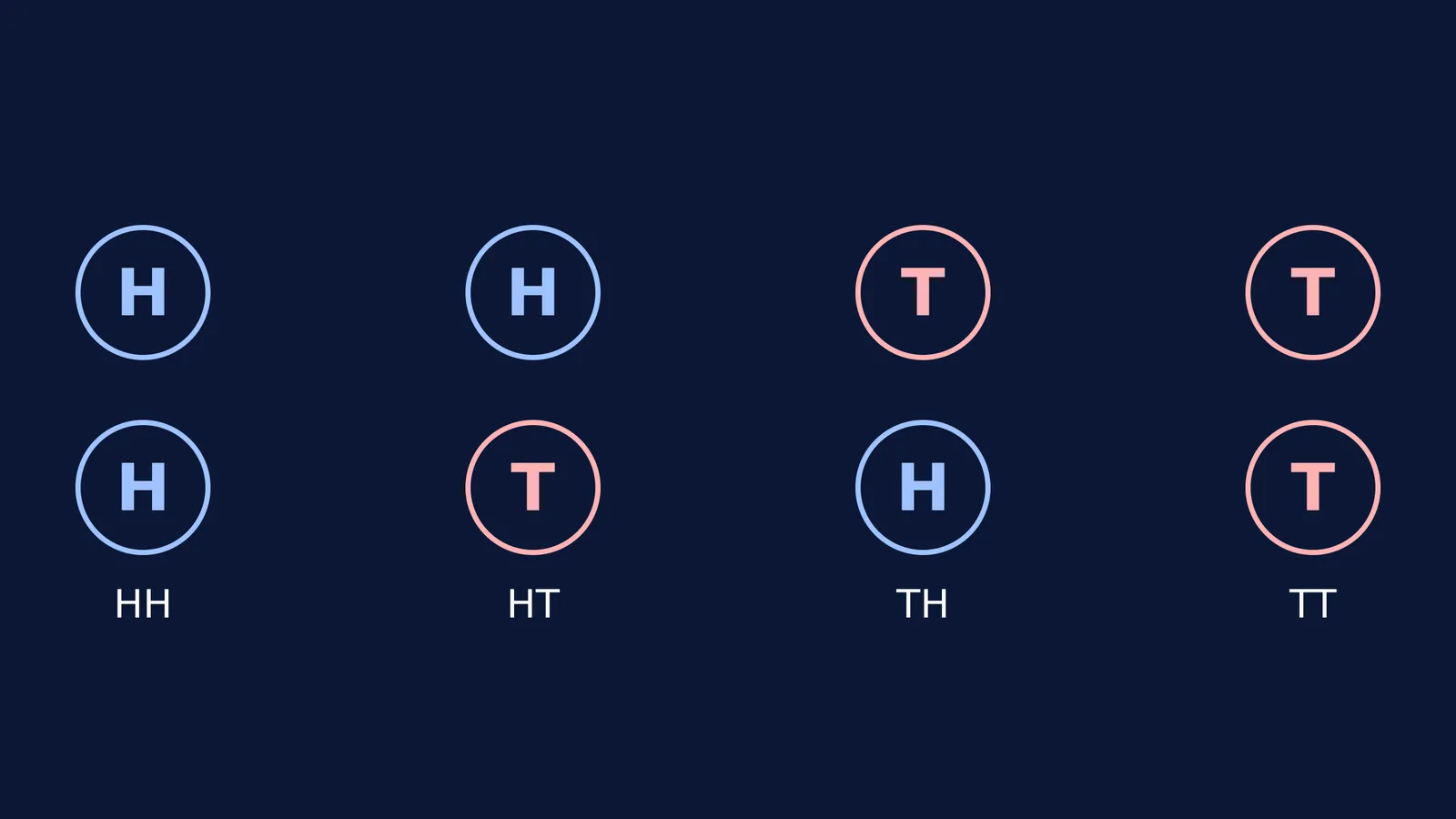
If you take the time to list the full sample space for tossing two coins, you get four distinct outcomes: HH, HT, TH, and TT (Wikipedia).
The probability of getting two heads (HH) is exactly 1/4 (Wikipedia).
The probability of getting two tails (TT) is exactly 1/4.
The probability of getting "one of each" includes both HT (a head on the first coin and a tail on the second) and TH (a tail on the first coin and a head on the second). Because it covers 2 of the 4 possible outcomes in the set, its probability is 1/2.
Grouping HT and TH into a single "one of each" category hides the fact that it is twice as likely to occur as getting two heads.
This rule applies to all classical probability problems. For example, if a question asks for the probability of rolling a sum of 7 with two dice, trying to hold all 36 possible outcomes in your head is a guaranteed way to make a mistake. By writing down the 6-by-6 grid of outcomes from (1,1) to (6,6), you can visually circle the six pairs that add up to 7, which correctly gives a probability of 6/36, or 1/6 (Wikipedia).
How to use an AI tutor for Class 10 probability?
When using an AI to practice mathematics, do not just ask it for the final answer. General chatbots might sometimes fall into the same trap of grouping outcomes improperly if they rush to a conclusion. They might output a final fraction, leaving you confused about how they got there, or worse, leaving you with an incorrect answer that looks confident.
If you are working with Fermi's AI tutor, you can rely on it to teach the correct method. Fermi works out what you already know, builds a plan for the session, and teaches through it—checking your understanding as it goes. Rather than just giving you the answer, it will guide you to identify the outcomes yourself.
To build the right study habits and get the most out of your practice sessions, use this specific prompt framework when asking any AI for help with a tricky probability problem:
Ask for the space first: "Before calculating the probability, please list the full sample space for this experiment."
Check for equal likelihood: "Are all the outcomes you listed equally likely? Why or why not?"
Verify the count: "Now, count how many outcomes in that space match my target event."
By forcing the AI—and yourself—to lay out the foundation before doing any division, you will easily catch tricky wording around phrases like "at least one", "at most two", and "one of each".
For more practice with building sample spaces, you can explore Probability in Class 10: cards, dice and coins worked step by step or look at how counting changes in With and without replacement: probability problems compared. If you find yourself frequently making similar conceptual mistakes, reviewing common traps in Probability in JEE maths: five reasoning mistakes and fixes can help solidify your reasoning.


